In the annals of British aviation history, few aircraft have played as versatile and enduring a role as the Westland Whirlwind. Among its many variants, the HAR.10 stands out as a testament to the helicopter’s adaptability and importance to naval operations. This search and rescue variant of the venerable Whirlwind served as the eyes, ears, and lifeline of the Royal Navy’s fleet for over two decades.
Stepping into the cockpit of a Whirlwind HAR.10, pilots were greeted by a relatively spacious and well-laid-out instrument panel. The controls were robust and responsive, a product of continual refinement since the type’s introduction in the 1950s. The single Rolls-Royce Gnome H.1400 turboshaft engine, an improvement over earlier piston engines, provided smooth and reliable power.
Taking off in a Whirlwind was an experience that showcased the unique capabilities of rotary-wing flight. As collective pitch was increased and the massive rotor blades bit into the air, the aircraft would lift vertically with a distinctive whop-whop-whop sound. The transition to forward flight was smooth, with the Whirlwind’s streamlined fuselage helping it achieve respectable cruising speeds for its era. Once airborne, the Whirlwind HAR.10 revealed its true character. It was stable and predictable, qualities that made it ideal for its search and rescue role. The aircraft could comfortably cruise at around 100 knots (185 km/h), with a maximum speed approaching 120 knots (222 km/h) – figures that allowed it to cover large search areas efficiently while maintaining the ability to slow down or hover when needed.
One of the most challenging aspects of flying the Whirlwind HAR.10 was operating in adverse weather conditions, often a necessity in search and rescue missions. The aircraft’s stability and powerful engine allowed it to cope with strong winds and turbulence, but pilots had to remain vigilant, especially when operating near ships or during rescue winch operations. The HAR.10’s search and rescue equipment was state-of-the-art for its time. It featured a rescue hoist capable of lifting 600 pounds, a searchlight for night operations, and a variety of flotation devices and medical equipment. Pilots and crew had to master not only flying the aircraft but also operating this specialized gear, often in high-stress situations.
The Whirlwind’s story begins in the early 1950s, as Britain sought to develop its own helicopter industry. Westland Aircraft, already experienced in building licensed versions of Sikorsky helicopters, took on the challenge of creating a uniquely British rotorcraft. The result was the Westland Westminster, a large transport helicopter that, while impressive, proved too ambitious for the time. However, the project led to the development of the smaller Westland Whirlwind, based on the Sikorsky S-55 but with significant British modifications. The first Whirlwind flew in 1952, powered by an Alvis Leonides radial engine. It quickly proved its worth in various roles, including troop transport, casualty evacuation, and anti-submarine warfare. The Royal Navy, in particular, saw great potential in the Whirlwind for shipboard operations. Externally, the HAR.10 was distinguished by its longer nose, housing the new engine, and the large bubble canopy that provided excellent visibility for the crew. The aircraft’s fuselage was modified to incorporate a large sliding door on the starboard side, facilitating easier access for rescue operations.
As the 1960s approached, helicopter technology was advancing rapidly. The introduction of turboshaft engines offered significant improvements in power-to-weight ratio and reliability. Westland seized this opportunity to upgrade the Whirlwind, fitting it with a Rolls-Royce Gnome turboshaft engine. This new variant, designated the HAR.10 (Helicopter, Air-Sea Rescue, Mark 10), entered service in 1962. The HAR.10 represented a significant leap forward in capability. The turboshaft engine provided more power and better high-altitude performance, crucial for search and rescue operations in varied conditions. The aircraft’s range was extended, and its payload capacity increased, allowing it to carry more rescue equipment and survivors.
The Whirlwind HAR.10 quickly proved its worth in service. Operating from both shore bases and ships, it became an integral part of naval air operations. Its primary role was search and rescue, but it also performed utility transport, medical evacuation, and even anti-submarine warfare duties when required. One of the key advantages of the HAR.10 was its ability to operate from small ship decks. Its relatively compact size and good stability in hover made it ideal for shipboard operations, even in rough seas. This capability allowed the Royal Navy to extend its search and rescue coverage far out into the Atlantic and North Sea. The HAR.10’s career with the Royal Navy was long and distinguished. It remained in service until the mid-1980s, a testament to both the aircraft’s suitability for its role and the fundamental soundness of the Whirlwind design. During its service life, Whirlwind HAR.10s were involved in countless rescue missions, saving hundreds of lives at sea.
Beyond the Royal Navy, the Whirlwind found success in various other roles and with other operators. The Royal Air Force used similar variants for search and rescue duties over land, while civilian operators employed Whirlwinds for everything from offshore oil rig support to police work.
For the pilots who flew it, the Whirlwind HAR.10 represented a unique challenge. While it lacked the speed and range of fixed-wing aircraft, it offered unparalleled flexibility and the ability to operate in conditions that would ground other aircraft. The added complexity of search and rescue equipment meant that pilots had to be part aviator, part technician, and part lifesaver. One former Royal Navy pilot recalled, “Flying the HAR.10 was about as demanding as it gets. You’re often operating at the limits of the aircraft’s performance, in terrible weather, trying to pluck people from the sea or a pitching ship deck. But when you successfully completed a rescue, there was no better feeling in the world.“
Search and rescue missions in the Whirlwind were often grueling affairs. Flights could last several hours, with the crew scanning vast stretches of ocean for tiny targets. Once a survivor was located, the real challenge began. Hovering the aircraft steadily while the winchman was lowered required immense concentration and skill, especially in high winds or rough seas.
The HAR.10 played a crucial role in maintaining safety at sea during a period of increased maritime activity. It provided comprehensive search and rescue coverage across its areas of operation, saving countless lives and providing a vital safety net for both military and civilian mariners. The Whirlwind HAR.10’s long service life also meant that it served as a bridge between generations of rotary-wing technology. Pilots who had flown earlier piston-engined helicopters found in the HAR.10 a more powerful and capable machine. Conversely, for younger pilots destined for more advanced helicopters like the Sea King, the Whirlwind offered valuable experience in the fundamentals of rotary-wing flight and rescue operations.
As the 1980s progressed, the writing was on the wall for the Whirlwind HAR.10. Newer, more capable helicopters like the Westland Sea King were taking over the search and rescue role, offering greater range, speed, and capacity. The Whirlwind’s 1950s-era design was becoming increasingly difficult and expensive to maintain. The Royal Navy finally retired its last HAR.10s in the mid-1980s, bringing to a close over two decades of Whirlwind operations. The legacy of the Whirlwind HAR.10 extends far beyond its operational service. It demonstrated the vital role helicopters could play in naval operations, particularly in search and rescue. The lessons learned from its long career influenced the development of subsequent rescue helicopters and helped shape search and rescue doctrines around the world.
The Westland Whirlwind HAR.10 may not have the speed of jet fighters or the capacity of large transport aircraft. But in its own way, it represents the best of British aviation ingenuity – taking a proven design and adapting it to meet critical needs. For the pilots who flew it and the countless individuals it rescued, the HAR.10 was more than just a helicopter; it was a lifeline in times of dire need. As we look back on the career of the Whirlwind HAR.10, we see more than just a search and rescue helicopter. We see an aircraft that embodies the transition from the early, experimental days of rotary-wing flight to the sophisticated, mission-specific helicopters of today. Its story is one of adaptation, reliability, and life-saving capability – qualities that ensure its place in the annals of aviation history. The Whirlwind HAR.10 stands as a testament to the importance of specialized aircraft in military and humanitarian operations. Its legacy lives on in the modern search and rescue helicopters that continue to pluck people from danger in the world’s most challenging environments. While it may no longer patrol the skies, the spirit of the Whirlwind – that unwavering commitment to saving lives against all odds – continues to inspire aviators and rescuers around the globe.
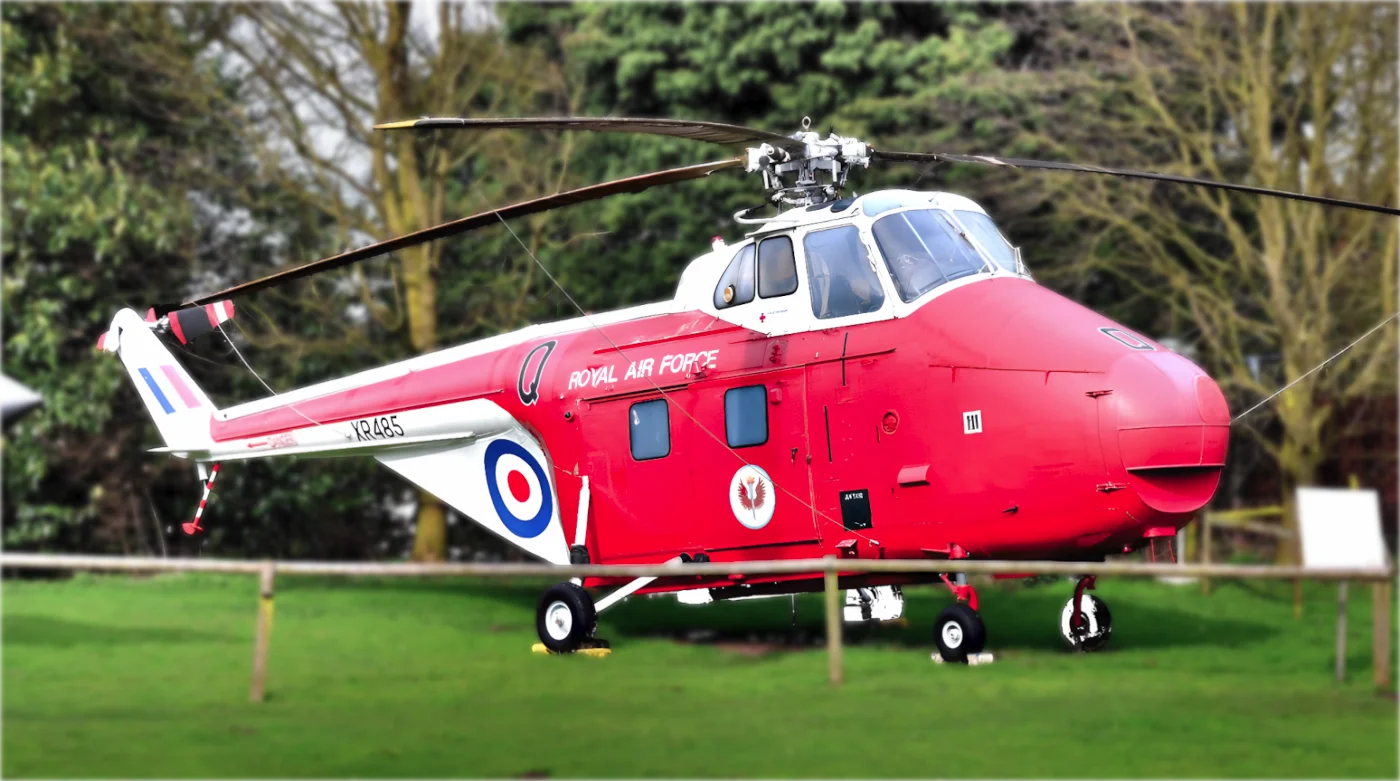
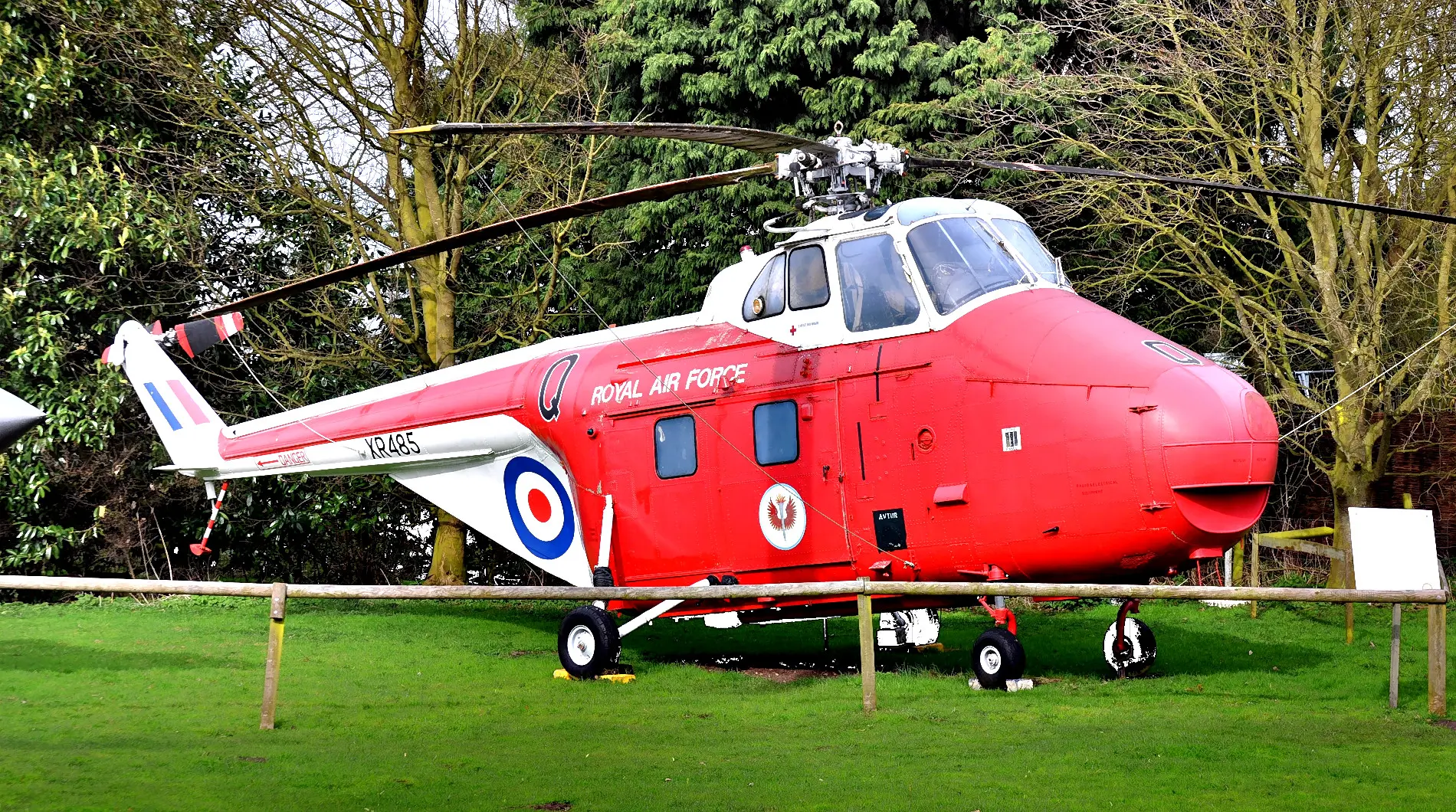
Our Whirlwind XR485
This aircraft made its maiden flight in May 1963 and was displayed at the 1963 París Air Show. it was then delivered to RAF Central Flying School at Ternhill and, subsequently, transferred to No.2 FTS at Shawbury. It was retired in 1980 and purchased by the Museum in 1981.
Westland Whirlwind HAR.10 XR485 served with the Royal Air Force in the search and rescue (SAR) role from the early 1960s through to the 1980s — a period of transition in British rotary-wing aviation.
Built by Westland Aircraft, XR485 was part of the final and most capable iteration of the Whirlwind series. The HAR.10 variant featured a Rolls-Royce Gnome H.1000 turboshaft engine, offering significantly improved power, reliability, and performance over earlier piston-engined models. It was derived from the American Sikorsky S-55, but modified for British conditions and requirements.
XR485 was likely operated by RAF SAR units such as No. 22 Squadron, No. 202 Squadron, or No. 228 Squadron, all of which flew Whirlwinds from coastal stations across the UK, including RAF Coltishall, RAF Brawdy, and RAF Leuchars. These bright yellow-liveried helicopters became an iconic sight over British coastlines, often called upon to rescue stricken sailors, stranded climbers, and downed aircrew.
In its operational life, XR485 would have been fitted with rescue winch gear, a crew of 3–4, and the capacity to carry several casualties or passengers. The HAR.10s were often deployed in harsh weather and challenging terrain, making the most of their Gnome engine’s added muscle.
By the late 1970s and early 1980s, the HAR.10 fleet was being phased out in favour of more modern designs like the Westland Wessex and eventually the Sea King HAR.3. XR485 was withdrawn from service and, rather than scrapped, was preserved — it is now on display at the Norfolk and Suffolk Aviation Museum at Flixton, where it serves as a striking example of Cold War-era British SAR aviation.