The North American T-28C Trojan: A Versatile Trainer / Warrior
The North American T-28C Trojan, a variant of the successful T-28 series, stands as a testament to adaptable aircraft design. Originally conceived as a trainer, the T-28C found its niche in naval aviation and later proved its worth in combat roles. Pilots who flew the T-28C Trojan often described it as a pleasure to handle. The aircraft’s robust construction and powerful engine gave it a solid feel in the air, inspiring confidence in both novice and experienced pilots. The cockpit, designed with training in mind, offered excellent visibility through its large canopy, crucial for both instructional purposes and operational flying.
The T-28C was powered by a Wright R-1820-86 Cyclone radial engine, producing 1,425 horsepower. This substantial power plant gave the aircraft impressive performance for its size and role. Pilots appreciated the aircraft’s responsiveness and its ability to perform aerobatic maneuvers, making it an excellent platform for developing advanced flying skills.
One of the distinctive features of the T-28C was its tail hook, a necessary addition for carrier operations. Pilots transitioning to carrier-based aircraft found the T-28C invaluable in learning the unique skills required for naval aviation, including carrier launches and recoveries.
The T-28C Trojan was designed to bridge the gap between primary trainers and more advanced jet aircraft. Its capabilities made it well-suited for this role:
- Performance: With a maximum speed of around 343 mph and a service ceiling of 25,000 feet, the T-28C offered performance that prepared pilots for the demands of frontline aircraft.
- Range: The aircraft had a range of approximately 1,000 miles, allowing for extended training missions and cross-country flights.
- Carrier suitability: The addition of a tail hook, strengthened landing gear, and other modifications made the T-28C capable of carrier operations, a crucial feature for naval aviation training.
- Armament capability: While primarily a trainer, the T-28C could be equipped with weapons, including machine guns, rockets, and light bombs, allowing it to serve in light attack roles when needed.
- Rugged construction: The T-28C’s robust airframe could withstand the stresses of repeated carrier landings and aerobatic maneuvers, ensuring a long service life.
The aircraft’s handling during takeoff and landing was generally forgiving, an important characteristic for a trainer. However, the T-28C demanded respect, particularly in carrier operations where precision was paramount. Its sturdy landing gear was well-suited to the rigors of carrier landings, providing a stable platform during the critical moments of touchdown.
The aircraft’s design emphasized simplicity and ease of maintenance, important factors for a trainer that would see intensive use. Its radial engine, while less streamlined than inline or jet engines, was known for its reliability and ease of service.
US Navy Service
The T-28C entered U.S. Navy service in the 1950s, quickly becoming a staple of naval aviation training. It was used extensively at Naval Air Stations across the United States, playing a crucial role in preparing pilots for the challenges of carrier-based operations.
The T-28C’s role in Navy training was comprehensive:
- Advanced training: The aircraft bridged the gap between basic trainers and high-performance jets, allowing students to develop advanced flying skills.
- Carrier qualification: The T-28C was instrumental in introducing pilots to the unique demands of carrier operations, including catapult launches and arrested landings.
- Instrument flying: Its stable platform and well-equipped cockpit made it ideal for teaching instrument flight procedures.
- Formation flying: The T-28C’s handling characteristics made it well-suited for teaching formation flight tactics.
- Weapons training: The aircraft’s ability to carry armament allowed for basic weapons delivery training, preparing pilots for combat roles.
While designed as a trainer, the T-28 series, including the C model, saw active combat service. During the Vietnam War, T-28s were used extensively in counter-insurgency (COIN) operations. While the U.S. Navy primarily used the T-28C for training, some were transferred to South Vietnamese forces and saw combat action. The aircraft’s rugged construction and ability to operate from austere airfields made it well-suited for COIN operations. T-28s were used for close air support, armed reconnaissance, and light strike missions. Their relatively slow speed and good low-altitude handling made them effective in these roles, able to provide accurate fire support to ground forces.
Zaire Air Force Service
The Zaire Air Force, serving what is now the Democratic Republic of the Congo, operated a fleet of T-28 Trojans, including FG289, during the 1970s and 1980s. These aircraft played a significant role in the country’s military operations and internal conflicts. Zaire acquired its T-28s primarily from France, which had previously used them in counter-insurgency operations in Algeria. The Zaire Air Force utilized these robust aircraft for both training and light attack missions. Their reliability and ability to operate from austere airfields made them well-suited to the challenging conditions in central Africa.
During the Shaba I and Shaba II conflicts in 1977 and 1978, T-28s were employed in combat roles, providing close air support to government forces fighting against separatist rebels. The aircraft’s ability to carry a variety of weapons, including bombs and rockets, made it an effective platform for these operations.
Legacy
The North American T-28C Trojan served the U.S. Navy faithfully until the 1980s when it was gradually replaced by more modern trainers. Its long service life is a testament to its effectiveness as both a training platform and a light attack aircraft.
The T-28C played a crucial role in shaping generations of naval aviators. Many pilots who went on to fly the Navy’s most advanced fighters and attack aircraft, including the F-4 Phantom, A-7 Corsair II, and later the F/A-18 Hornet, received their introduction to carrier aviation in the cockpit of a T-28C.
Today, numerous T-28s, including some C models, remain airworthy in private hands. These aircraft are popular on the airshow circuit, where their robust construction and impressive performance continue to impress spectators. The distinctive sound of the T-28’s radial engine serves as a powerful reminder of an important era in aviation history.
The North American T-28C Trojan, with its versatility, reliability, and combat capability, left an enduring mark on naval aviation. It stands as a symbol of an era when propeller-driven aircraft still played vital roles in military operations, bridging the gap between the piston age and the jet age. The T-28C’s legacy lives on in the skilled pilots it trained and the impact it had on military aviation tactics and training methods.
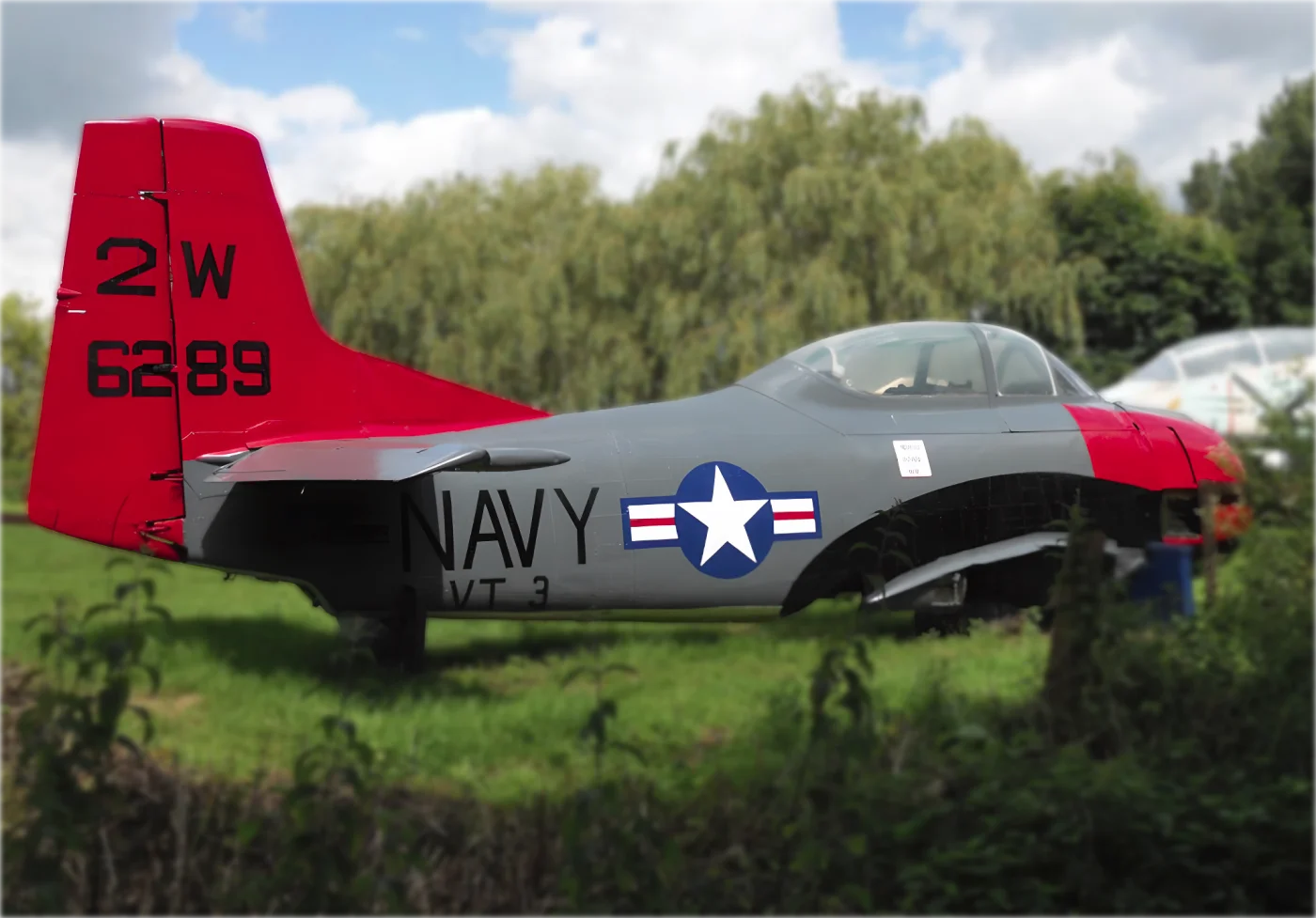
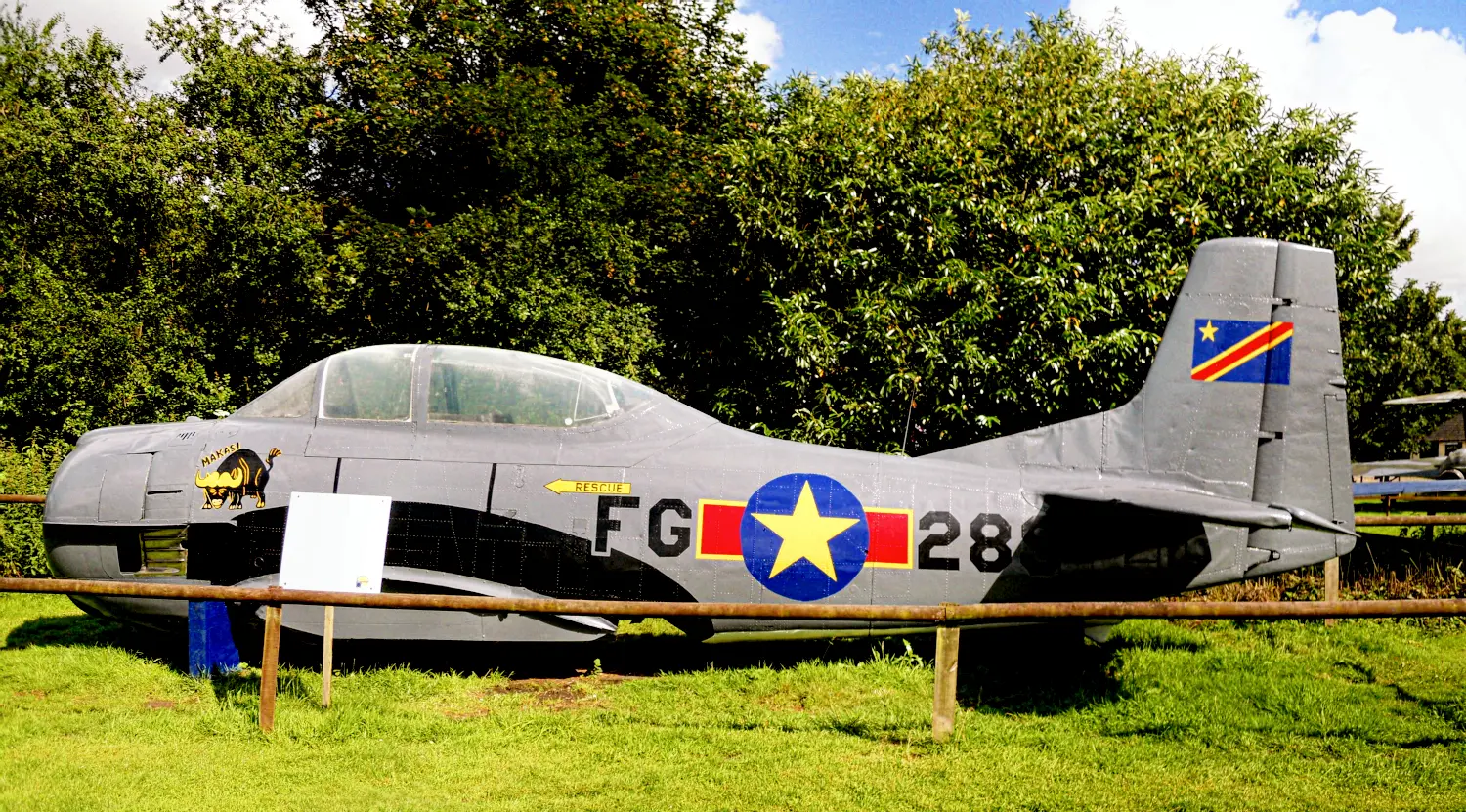
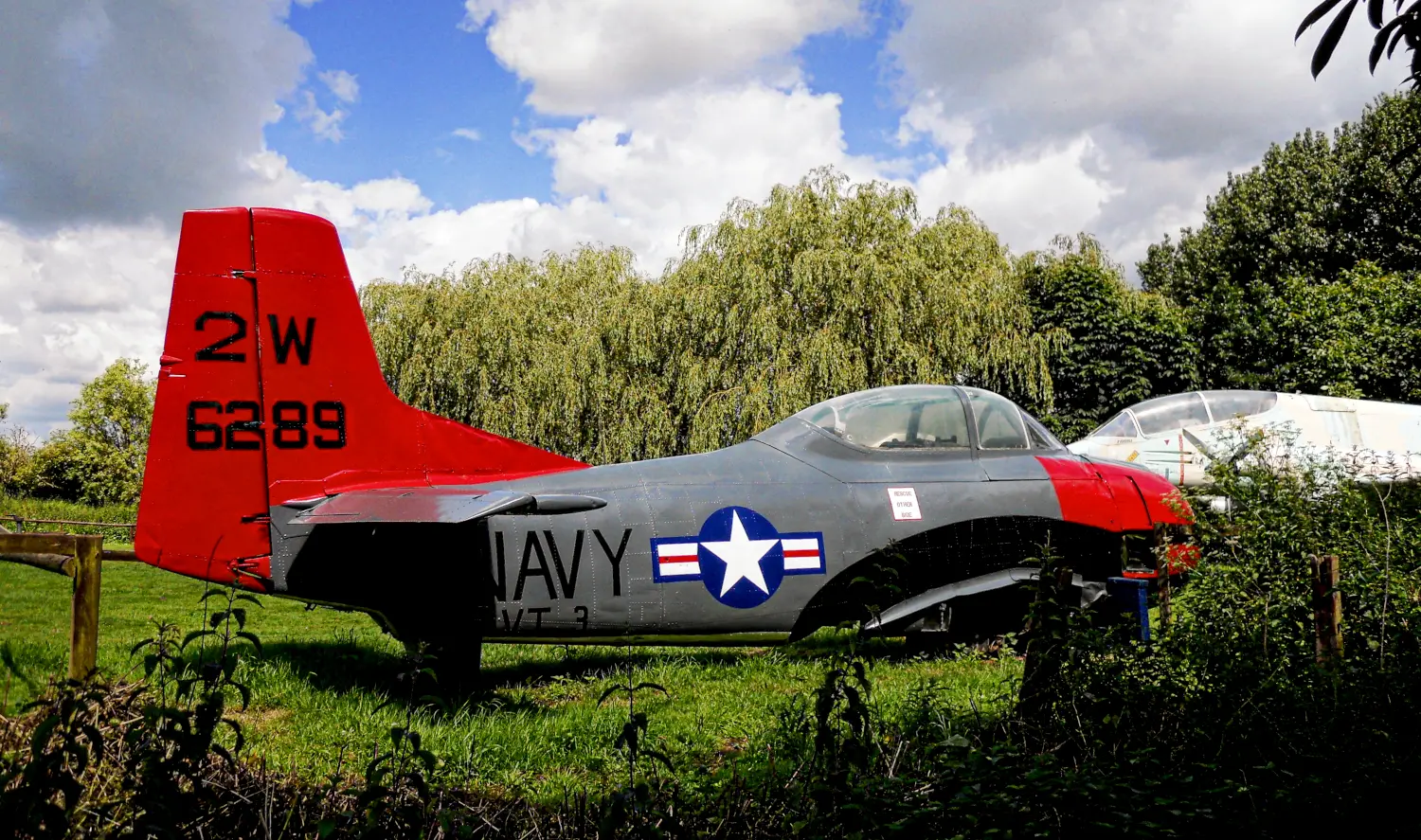
Our T28C Trojan 14629 / FG289
T-28C BuNo 14629 began its career with the United States Navy, delivered in October 1957 to the Air Training Command at NAS Pensacola. It initially served in the basic carrier qualification role, providing advanced pilot instruction. The aircraft was subsequently transferred to the Bureau of Naval Weapons at Columbus, Ohio, and assigned to Training Squadron VT-5, operating out of Saufley Field, Florida. Here, it participated in carrier landing practice aboard the USS Lexington (CV-16) — a crucial step in preparing naval aviators for front-line service.
The aircraft later moved to VT-3, another naval training squadron based at Whiting Field, and was reportedly struck off US Navy charge in 1964 after around seven years of active service.
Soon after retirement, the aircraft entered a murky and politically complex second life. It was transferred via covert channels, believed to be under CIA auspices, to the Congo Air Force during the Congo Crisis. Now based in Léopoldville, it was re-serialled as FA-200 and employed in a light attack and counter-insurgency role. The aircraft took part in operations during the escalating conflict, including the Shaba rebellions, and was reportedly flown by foreign contract pilots and Congolese crews.
When the Republic of the Congo became Zaire, FA-200 was redesignated as an AT-28C under the Zaire Air Force, adopting the serial FG289. It was reportedly stationed at Kamina Air Base, a central hub of Zairian military air operations, and took part in a number of combat support missions, though specific details remain sparse due to the classified or undocumented nature of many operations.
Declared surplus in 1977, FG289 was eventually acquired by a private buyer. While being ferried back toward the United States via the UK, it suffered a forced landing at Limoges, France, and was subsequently dismantled. In an unusual twist, the fuselage ended up in East Ham, London, and remained in storage or partial display for some years.
In May 1981, the aircraft was acquired by the Norfolk and Suffolk Aviation Museum at Flixton. During its restoration, no fewer than eight sets of insignia were uncovered beneath the layers of paint, revealing the aircraft’s remarkable journey:
- 2 × US Navy markings
- 4 × Congo Air Force roundels
- 1 × Zaire Air Force insignia
- 1 × US civilian ferry registration
Today, FG289 / BuNo 14629 stands as one of the most enigmatic and storied T-28s in preservation, representing both Cold War training heritage and the shadowy world of proxy conflict aviation.