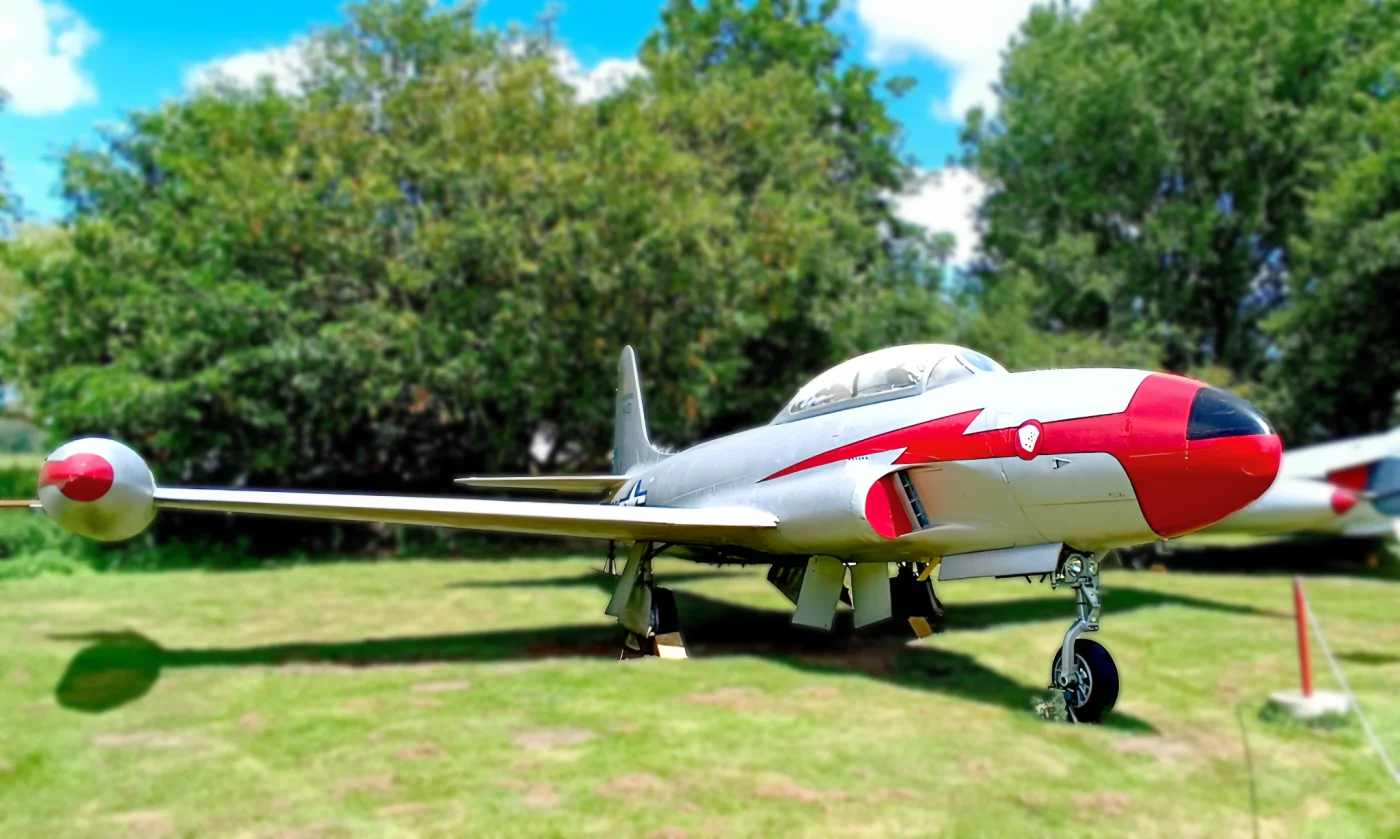
The Lockheed T-33A, affectionately known as the “T-Bird,” stands as a testament to the ingenuity of post-World War II aircraft design. This two-seat jet trainer played a pivotal role in shaping generations of pilots across the globe, including those of the Royal Air Force (RAF). Let’s explore the history, capabilities, and flying experience of this iconic aircraft.
The T-33A’s story begins with its predecessor, the single-seat P-80 Shooting Star. As the United States Air Force (USAF) transitioned to jet aircraft in the late 1940s, the need for a dedicated jet trainer became apparent. Lockheed’s solution was to modify the P-80, extending the fuselage to accommodate a second cockpit for an instructor pilot. This new aircraft, initially designated the TF-80C, first flew on March 22, 1948. The T-33A quickly proved its worth, offering a stable and forgiving platform for pilots transitioning from propeller-driven aircraft to jets. Its success led to widespread adoption not only by the USAF but also by numerous air forces around the world, including the Royal Air Force.
The RAF’s involvement with the T-33A began in the early 1950s as part of the Mutual Defense Assistance Program. The aircraft was introduced to supplement the RAF’s existing jet trainers and provide advanced training for pilots destined for frontline jet fighters. The RAF designated their T-33As as Lockheed T.33A (the period after the “T” being a British designation convention). These aircraft primarily served with No. 228 Operational Conversion Unit at RAF Leeming and No. 2 Tactical Weapons Unit at RAF Chivenor. The T-33A played a crucial role in preparing RAF pilots for more advanced aircraft like the Hawker Hunter and English Electric Lightning.
Pilots who have had the privilege of taking the controls of a T-Bird often speak of it with a mix of respect and affection.
Stepping into the cockpit of a T-33A, pilots are greeted by a relatively spacious environment for a jet of its era. The side-by-side seating arrangement allows for excellent communication between instructor and student, a crucial factor in its success as a trainer. The instrument panel, while seemingly cluttered by modern standards, is logically arranged. The essential flight instruments are grouped in the standard “T” arrangement, with engine gauges and other systems monitors flanking them. The control stick, reminiscent of its fighter lineage, falls naturally to hand.
Beginning the start-up sequence, pilots are reminded of the T-33A’s place in aviation history. The whine of the starter gradually builds as it spools up the Allison J33 turbojet engine. As fuel is introduced, a distinctive smoke plume often trails from the exhaust – a characteristic quirk of early jet engines. Taxiing the T-33A requires some finesse. The aircraft’s long nose can obstruct forward visibility, necessitating S-turns on the taxiway. The manual nosewheel steering, controlled by rudder pedals, offers precise control but demands constant attention.
As the throttle is advanced for take-off, the J33 engine’s 5,400 pounds of thrust pushes the T-33A down the runway with authority. The acceleration is not breathtaking by modern fighter standards but provides a noticeable contrast to piston-engined trainers of the era. Rotation occurs at around 100 knots, and the T-33A rises into the sky with a grace that belies its utilitarian purpose. The climb rate of approximately 4,000 feet per minute allows for quick ascents to training altitudes. Once airborne, the T-33A reveals its true character. Pilots often describe the handling as honest and predictable – ideal qualities for a trainer. The controls are well-harmonized, allowing for smooth and precise maneuvering.
Aerobatics in the T-33A are a joy for many pilots. While not as agile as dedicated fighters, the T-Bird can perform a full range of maneuvers including loops, rolls, and Cuban eights. The side-by-side seating allows instructors to demonstrate techniques clearly and intervene if necessary.
Approaching for landing, the T-33A’s benign handling qualities shine. The aircraft’s clean lines necessitate careful speed management, but the effective speed brakes aid in controlling the descent profile. Touchdown is typically smooth, with the tricycle landing gear providing stable ground handling. One quirk that kept students alert was the T-33A’s propensity for “floating” if excess speed was carried into the flare. This characteristic taught valuable lessons about energy management and the importance of flying a stabilized approach.
The T-33A’s capabilities placed it in a sweet spot for advanced jet training. With a maximum speed of about 600 mph (Mach 0.8) at sea level and a service ceiling of 48,000 feet, it could adequately prepare pilots for the performance of early jet fighters. The aircraft’s performance envelope allowed students to experience transonic flight characteristics and high-altitude operations, essential skills for jet fighter pilots.
The T-33A’s armament capabilities, though rarely used in its primary training role, included provisions for two .50 caliber machine guns and underwing hardpoints for practice bombs or rockets. This allowed for basic weapons training without transitioning to a dedicated fighter aircraft.
The T-33A’s influence on military aviation cannot be overstated. Its long service life – spanning from the late 1940s well into the 21st century for some air forces – meant that generations of pilots received their introduction to jet flying in its cockpit. For the Royal Air Force, the T-33A served as a bridge between the early jet era and the more advanced trainers that followed. It helped standardize jet training methods and prepared pilots for the increasingly complex fighter aircraft entering service in the 1950s and 1960s.
The T-33A’s impact extended beyond its training role. Its reliability and versatility led to its adaptation for various other missions, including reconnaissance, target towing, and even light attack in some air forces. The aircraft’s design influenced subsequent trainer developments, with its basic configuration of side-by-side seating and straight wings becoming a standard for many subsonic jet trainers.
The Lockheed T-33A “T-Bird” holds a special place in aviation history. Its role in training RAF pilots, though not as extensive as in some other air forces, was nonetheless significant. The aircraft’s forgiving nature, coupled with performance that adequately prepared pilots for frontline fighters, made it an ideal advanced trainer.
For those who flew it, the T-33A often represents a fond memory – a stepping stone in their aviation careers that taught valuable lessons in jet handling, energy management, and the nuances of high-speed flight. Its legacy lives on in the countless pilots who began their jet careers in its cockpit and in the training philosophies it helped to shape. As we reflect on the T-33A’s history, particularly its service with the Royal Air Force, we see more than just an aircraft. We see a teacher, a trusted companion, and a crucial link in the chain of aviation progress. The Lockheed T-33A may have been surpassed by more advanced trainers, but its contribution to military aviation remains indelible.
Our T33-A 55-443
Initial USAF Service:
- Served with the 20th Fighter-Bomber Group (FBG) and 803rd Fighter-Bomber Group, USAF
- This would have been in the mid-1950s after delivery
Mutual Defense Aid Programme (MDAP):
- One of 1,058 T-33As supplied to Europe under the Mutual Defence Aid Programme
- The MDAP was a key Cold War program where the U.S. provided military equipment to NATO allies
French Air Force Service (1956-1978):
- Served with the French Air Force (Armée de l’Air) for 22 years
- Based at Nancy and Sonteux air bases
- This was during the height of the Cold War when France was rebuilding its air force
Post-Service:
- Returned to RAF Sculthorpe, Norfolk at the end of its French service in 1978
- RAF Sculthorpe was a former USAF base that had been used during the Cold War
- Placed on loan to your museum in 1978 by the USAF
This aircraft represents a perfect example of Cold War military cooperation – built in America, serving first with the USAF, then helping train French pilots during NATO’s early years, and finally ending up preserved in a museum. The 22-year service life with the French Air Force is quite remarkable and shows how durable and effective the T-33 design was.