Flight Training Area
Link Trainers and Flying Training
The principle of providing flying training in an aircraft without actually taking off was created early in the last century. Examples at this time were the Saunders Teacher, a modified aeroplane mounted on a universal joint linked tot he ground, and the Italian Gabardini Company. The idea of using a captive aeroplane for elementary training, or for amusement, was patented in Britain by Eardley Billing in 1910. Other examples, progressively more complicated in construction and realism, followed over the years.
In the U.S., Edwin Link gained his early engineering experience with his father's firm, The Link Piano and Organ Company, of Binghampton, New York. His first patent was granted for an improvement in the mechanism of player pianos! The flight trainer was developed in the period of 1927-29 in the basement of the Link factory and he made use of the familiar vacuum/pneumatic mechanisms from the family business. The first trainer, advertised as 'An effective Aeronautical Training Aid - a novel, profitable amusement device' - was described in a patent filed in 1930. Pitch, roll and yaw movements were initiated in the same manner as in its predecessors, but vacuum/pneumatic bellows were used for actuation. Vacuum was also used as an analogue computing medium for the instruments.
The device was not regarded as a wise investment by others at that point, nor seen to meet a training need. A need certainly did exist in instrument training, however, so Edwin Link fitted cockpit instruments as standard equipment to his design and blind flying training was started by the Links at their flying school in the early 1930s. The importance of this was recognised, notably by the U.S. Army Air Corps. This gave Link Trainers a great reputation so increasing sales.
The Model C followed in 1936, able to rotate through 360 degrees, which allowed for a magnetic compass to be installed, while the various instruments were operated either mechanically or by vacuum. The Link Trainer became a simple form of analogue computer, fitted with a full set of instruments to guide the pupil on an imaginary flight. The simulated course is automatically recorded and traced by the three-wheeled course plotter (the self-propelled and steerable "crab") across paper, or a map on the instructor's desk. A duplicated instrument panel is also present, electronically harmonised with those in the Trainer's cockpit. This miniature aeroplane is pivoted on a universal joint. Between the fuselage and the turntable are four supporting bellows and realistically recreates most of the sensations and "feel" of flying.
Both calm and rough-air flying conditions can be created by the instructor. The Trainer will also initiate stall when recorded airspeed and attitude fall outside pre-determined limits. It then goes into a very realistic spin, with the instruments performing normally for such conditions. A cross-country "flight" of up to 200 miles is possible, during which the instructor is able to confront the pupil with most of the difficulties that can occur during a genuine flight, Link Trainers were also sold to France and Germany - a Luftwaffe bomber pilot of 1940 had spent 50 hours in a Link Trainer!
The Link Trainer type D4 of 1950 is also designed and equipped to provide thorough instruction in the use of radio signals, radio beams and radio compass. Both the Lorenz Landing System or SBA and SCS51 precursor of ILS for blind landings in fog are simulated. Modern-day computerised flight simulators are much more sophisticated and very realistic - and also expensive. In its time, however, the Link Trainer was at the forefront of flight technology, saving many lives... and actual aeroplanes.
We have four examples of Link Trainers, although two of them are not operational. Whilst thousands existed in the UK before, during and after World War ll, they are now quite rare - even more so in working order. A small Museum team, led by member Ray Kidd, has devoted considerable effort over a number of years to their re-assembly and restoration. Regular work is required to improve and maintain them, and spare components are always being sought.
In 1937, the first Link Trainers were delivered to the RAF and an airline company, American Airlines. These were the Model C-2 in the US and D for the UK and were generic trainers. The US Army Navy Trainer Model 18 (A-NT 18) of 1940/1 was designed to represent the AT-6/SNJ/Harvard aircraft.
The newest Link Trainer we have is over 50 years old and therefore serviceability can be a problem. Please check before visiting if you wish for close access or to see a trainer operating. Because of difficult access, health and safety and insurance reasons we cannot let the general public operate the trainers without qualified supervision. Sometimes a fit and agile enthusiast or veteran may get the opportunity of a test flight.
Our Flight Training Exhibits
Zenair CH601 UL Zodiac
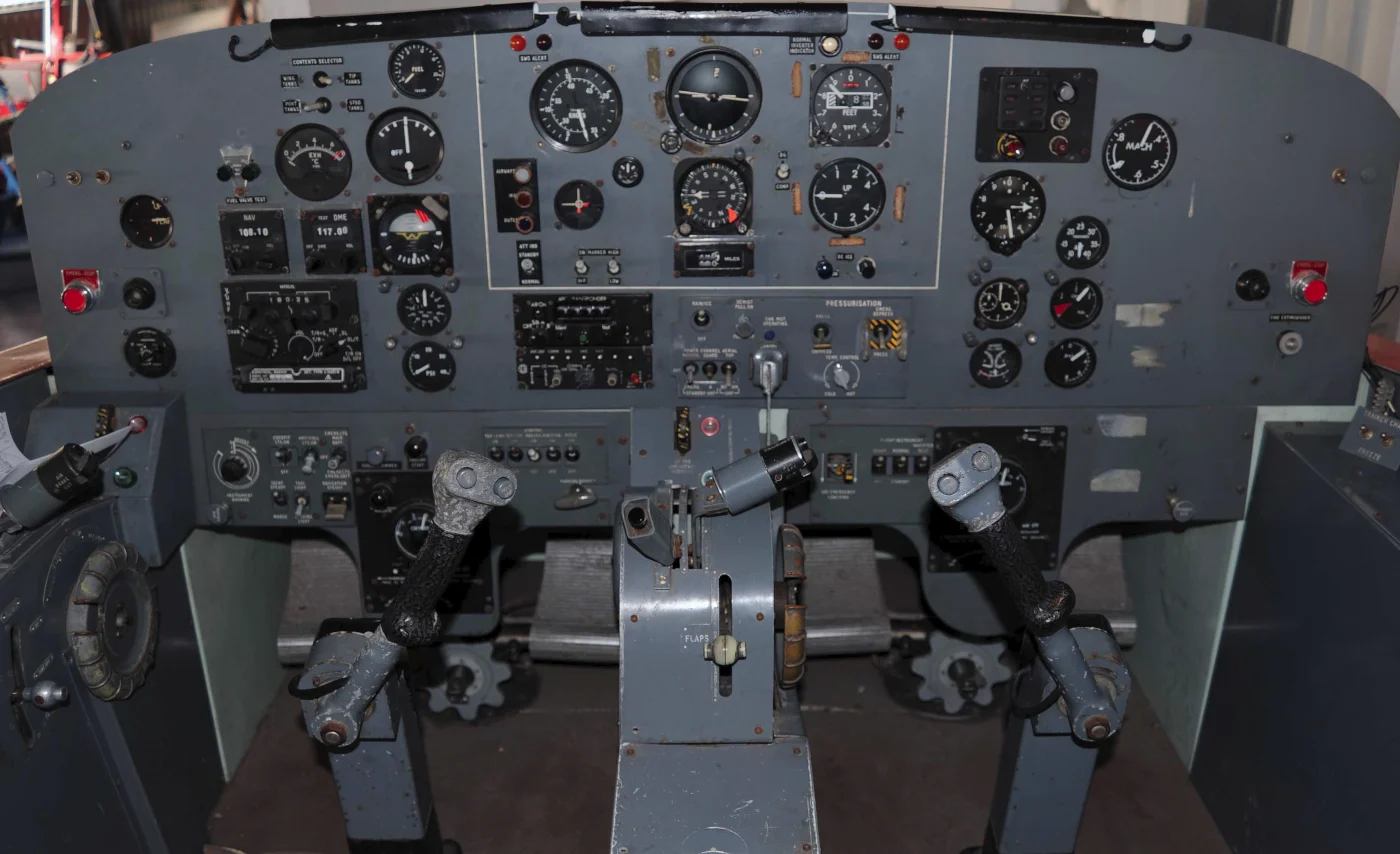
The Zenair CH601 UL Zodiac was an Ultralight Aircraft from Canada. Supplied in a kit for or fully built, it had room for pilot and one passenger. Our airframe, registration number G-CDFL, was involved in a serious accident on July 13, 2019, at Caunton Airfield, Nottinghamshire, and was subsequently written off. No one was hurt in this accident. The cockpit section was rescued by the museum and used as the basis of a flight simulator.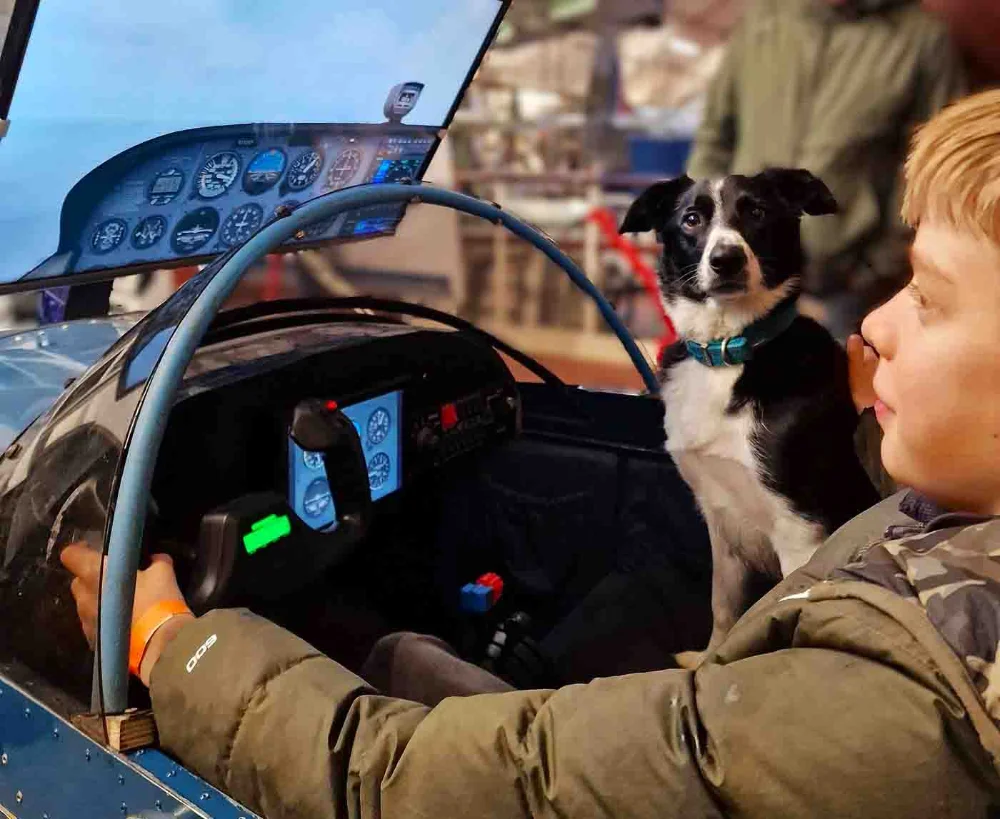
ANT 18
This trainer appears to date from 1940 and is operating with problems and limitations, some of which may be original. As with other Link Trainers, it had been much modified before we acquired it. The Wind Drift Unit is unlikely to be original and the instrument panel is reversed to clear space for the “radio” unit. It often struggles to regain level flight from full bank but is more agile than the heavier D4, having the same actuators.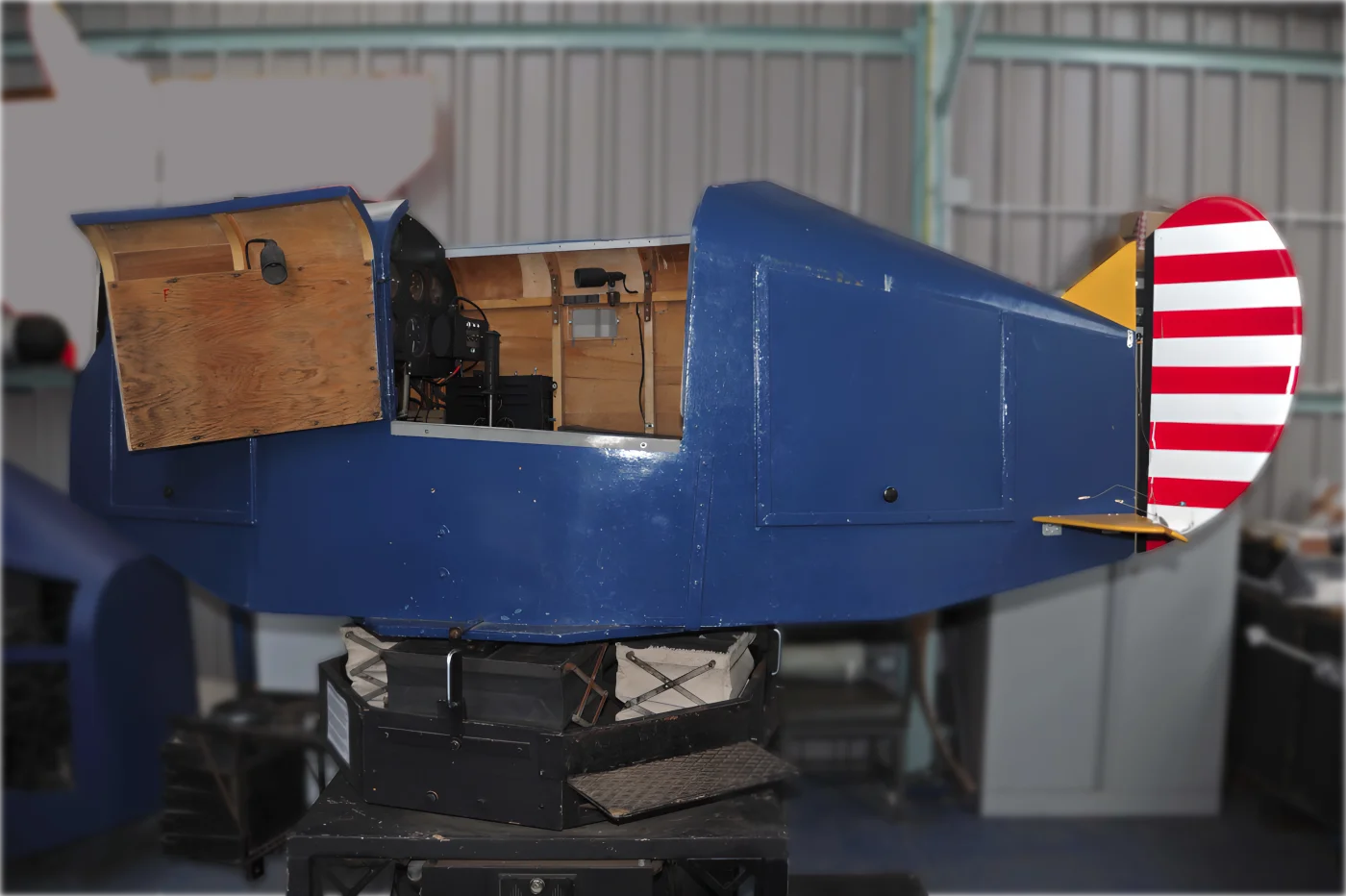
D4 (Piston Provost)
Manufactured in 1949/50 to Air Ministry order by Aviation Trainers Limited, incorporating Link sub-assemblies. Now complete with all systems and overhead radio, it normally “flies” well but the radio navigation systems are not fully checked out. As acquired, the desk radio unit was stripped to give intercom only and the overhead radio was missing. The automatic radio compass system was bypassed to give a heading indicator. The vacuum achieved is at the lowest acceptable level although we cannot find any significant leaks. A spare “turbine” is in store awaiting rebuild. This is the “favourite” for operation as it produces a flight map/certificate.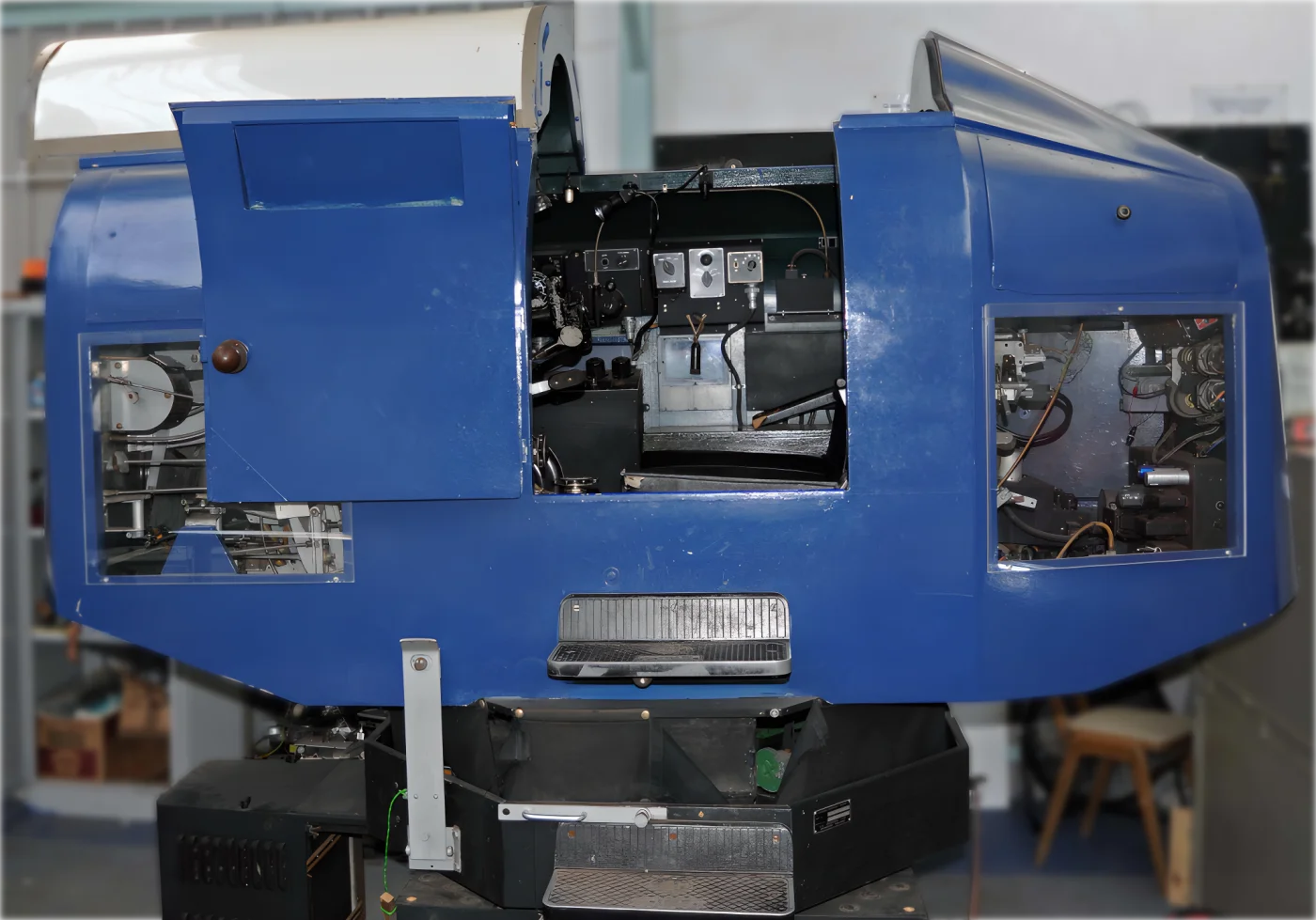
Simulated Trainer
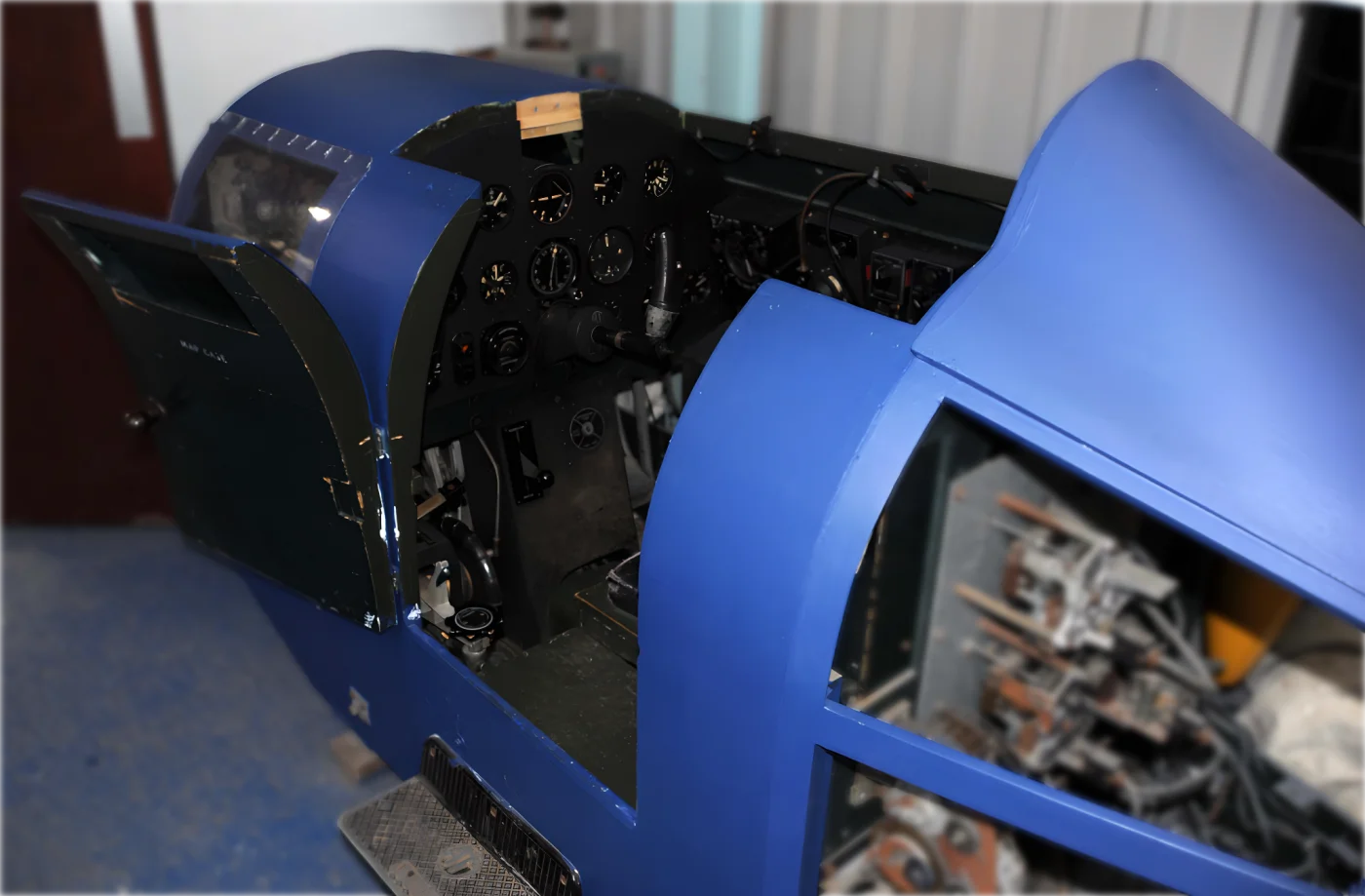
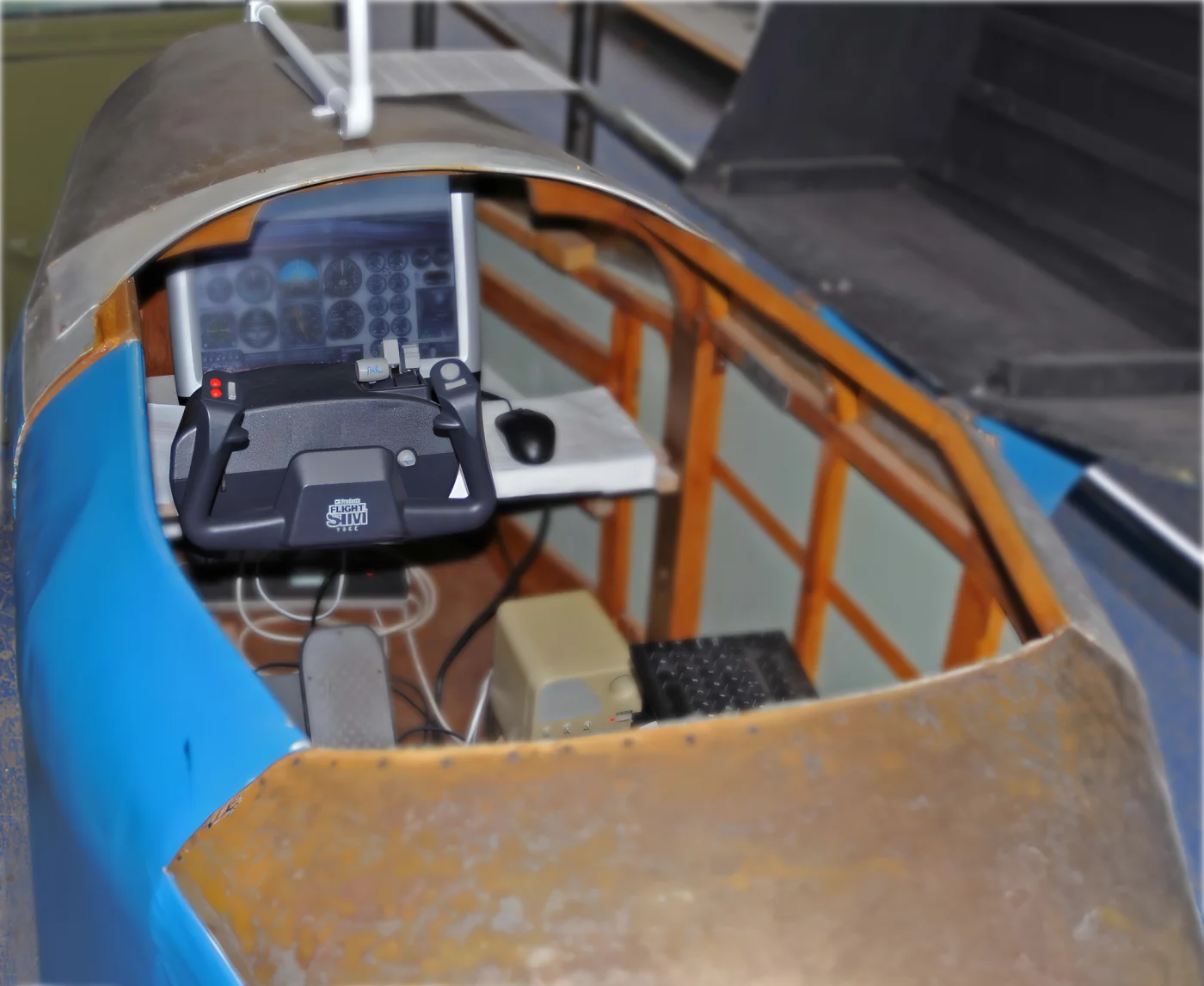
To provide support for our demonstration units and a simulator for those with physical handicaps we have a dummy cockpit with PC based Flight Simulator at wheelchair height. The Instrument panel is from a Link Trainer with the body produced on site.
A video splitter drives a second screen so that visitors outside the operating area can see what the “Pilot” is seeing. Great entertainment if the landing ends in a very realistic crash.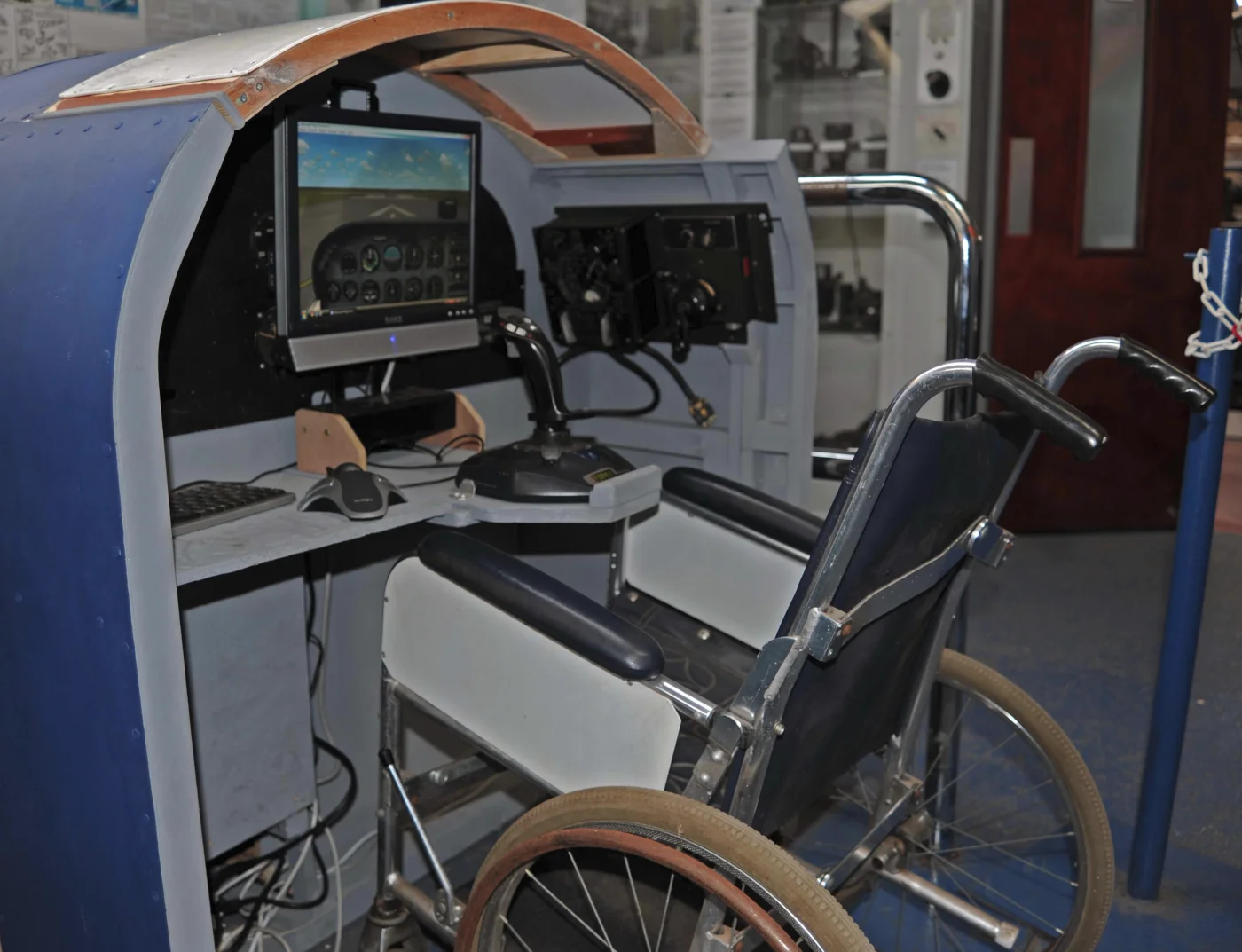
D4 Mk 2 (Jet Provost)
Manufactured around 1955 as a D4 modified to represent the Jet Provost, with higher speeds and simpler engine controls. When acquired, several electro mechanical modules were missing although the radio system was complete. With little chance of acquiring the mechanical units the radio system was therefore used to complete the D4. Eventually we hope to convert this unit to a fixed base trainer. At present it provides a hands on cockpit for school visits and event days.Redifon 101 Jet Provost
Manufactured around 1970 this analogue computer based trainer was used for radio procedure and navigation training. Acquired in derelict condition without electrical power supply pack and hydraulic power pack it is unlikely to “fly”. However we are trying to get some systems and instruments to operate. If sufficient helpers are available it is opened for school visits and event days.
Other Exhibits in this area of the Museum
Support
We have some manuals and spare components but could always find room for more. We also try to give assistance to other Link owners, where possible, and the team can be contacted through the Museum’s main email address. We have had support from Link Spares in the USA where units are common to UK and USA. The D4 resembles the American “Basic Instrument Trainer 45 or 1-CA-1 in some ways.
Other exhibits in the area
Models
The area has a large collection of models of Flying Training aircraft.
Gunsights
A large collection of gunsights from the 1930`s to the 1980`s with some working, this is currently being reworked so none of the sights are currently working, also many labels are not in place.
Navigation and Radio Navigation
A large display of navigation and blind landing equipment from 1920's to current day. An intranet site (only available within the museum) gives details on the equipment on display, we aim to provide this additoinal information on this site sometime soon.
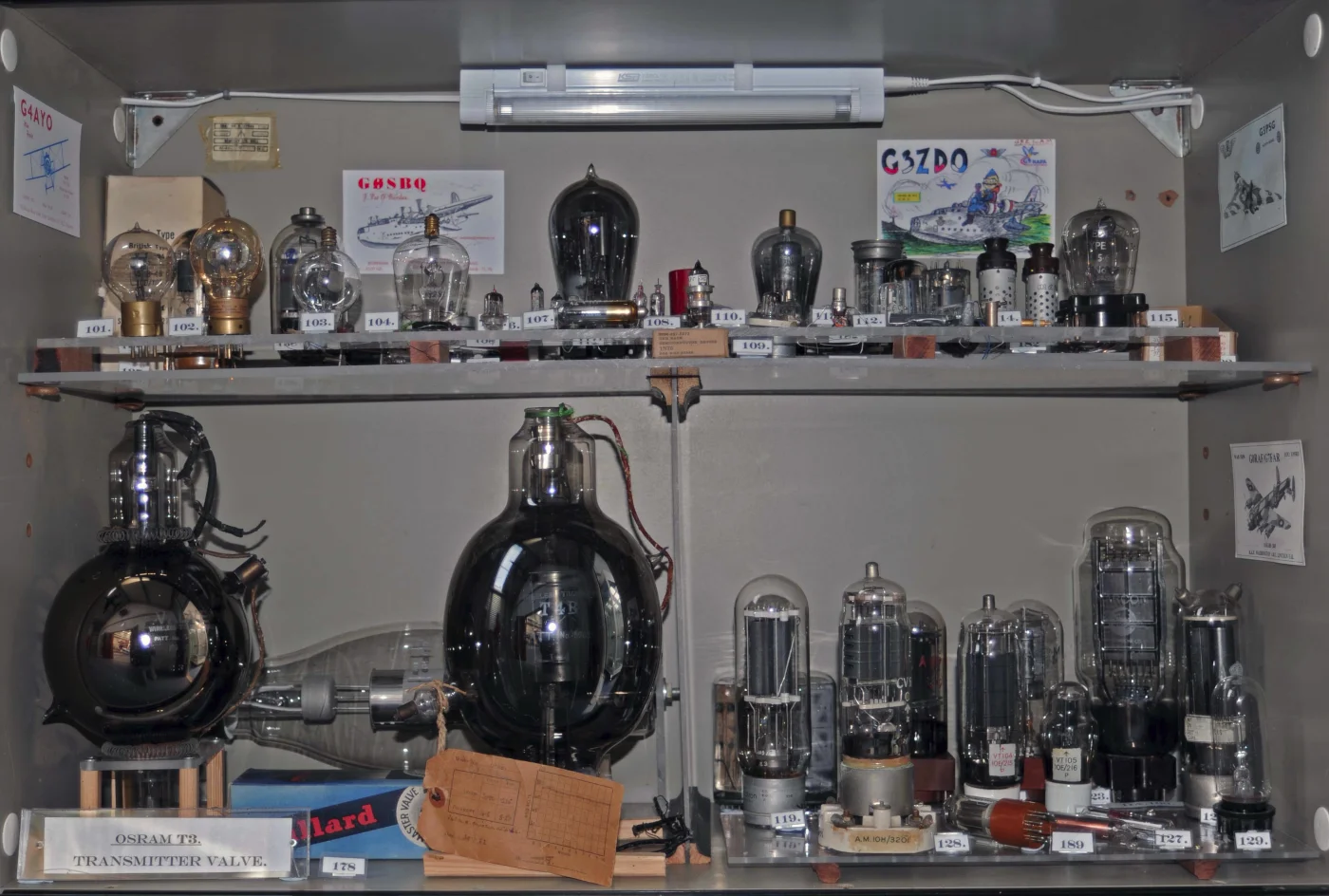
Radio valves from just after World War 1 through early radar valves to the miniatures of the 1960`s.
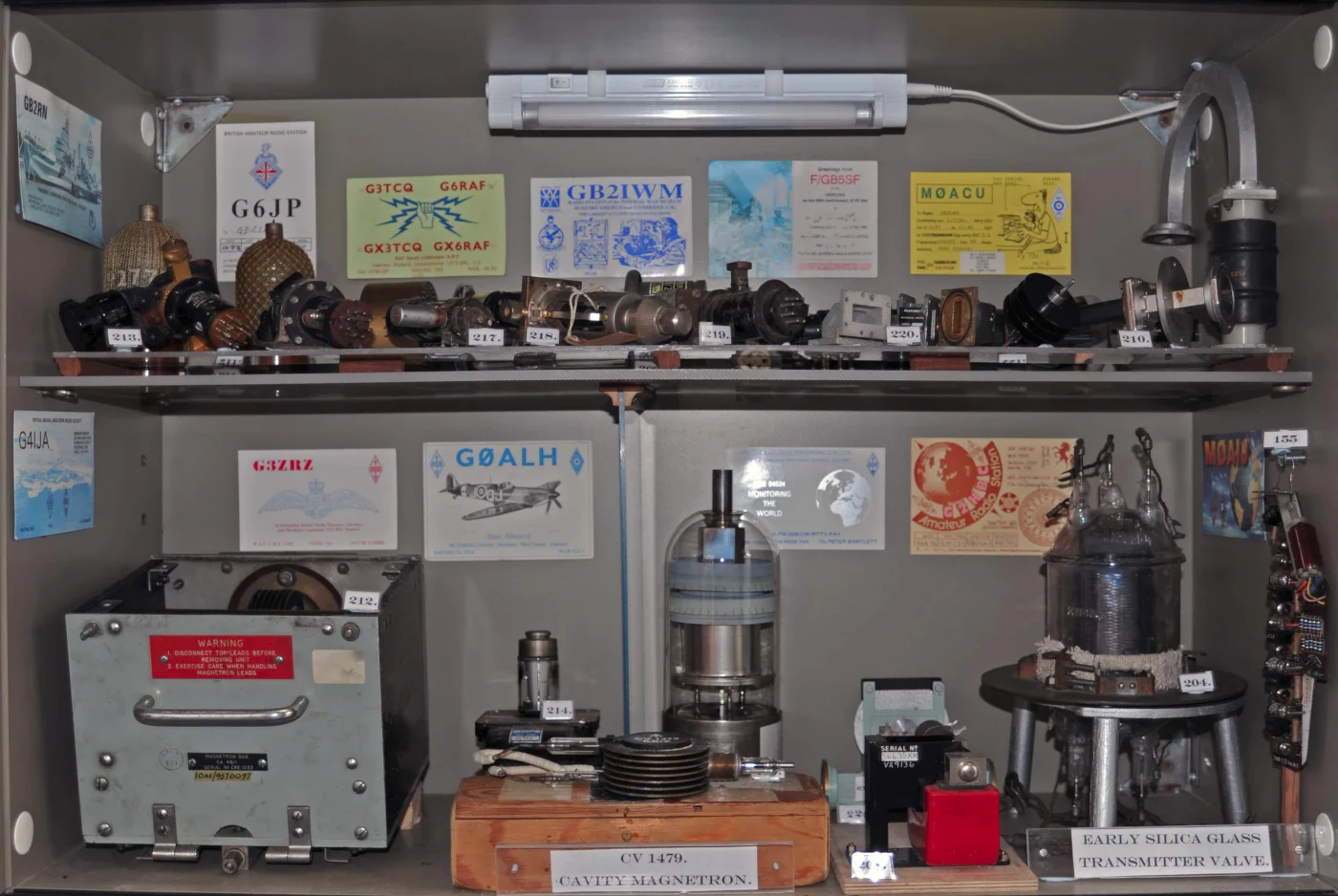
A magnetron complete with magnet from a 1940`s radar and packaged magnetrons from the 1980`s complemented by an example of a military pulse navigation device.