
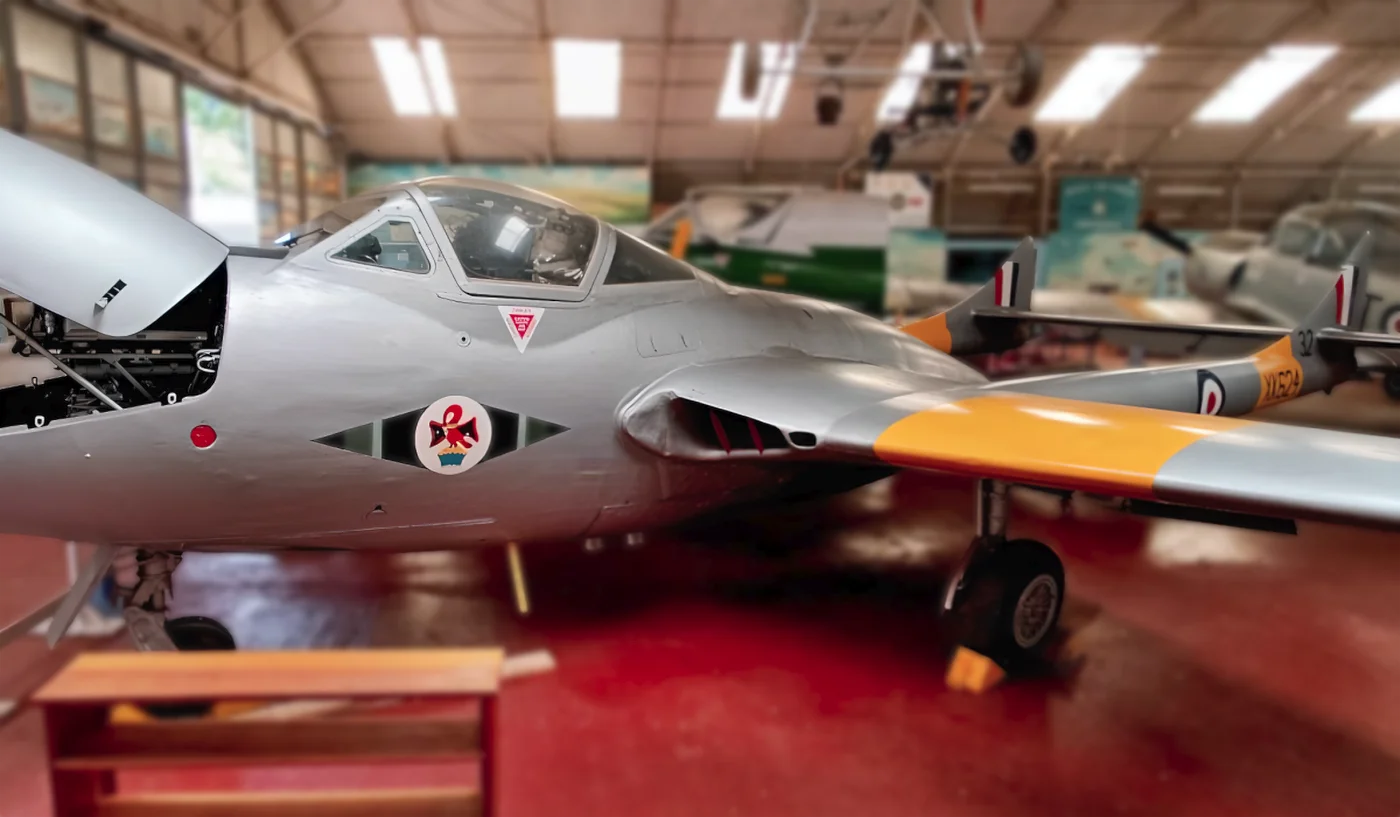
The de Havilland Vampire, Britain’s second jet fighter and first to enter widespread service, left an indelible mark on aviation history. Pilots praised its docile handling characteristics, making it an ideal transition aircraft from piston-engine planes to jets.
Flying the Vampire was described as a smooth and responsive experience. Its distinctive twin-boom design and bubble canopy provided excellent visibility, while its wooden-construction wings contributed to its agility. Powered by a single de Havilland Ghost turbojet engine, the Vampire could reach speeds of up to 540 mph (870 km/h) at sea level and climb to 20,000 ft in about six minutes.
The Royal Air Force (RAF) introduced the Vampire in 1946, where it served in various roles including fighter, fighter-bomber, and trainer. The two-seat trainer variant, the T.11, became a cornerstone of RAF pilot training in the 1950s and early 1960s. Beyond the RAF, the Vampire found success internationally. It served with air forces worldwide, including Australia, India, Sweden, and Switzerland. Some nations, like Sweden, even produced licensed versions.
While primarily a peacetime aircraft, Vampires saw limited combat action. They were deployed during the Malayan Emergency, the Suez Crisis, and the Rhodesian Bush War. Indian Air Force Vampires also participated in the liberation of Goa in 1961. The Vampire’s legacy extends beyond its military service. It played a crucial role in transitioning air forces into the jet age and set several aviation records.
The de Havilland Vampire T.1 holds a special place in aviation history as one of the first jet-powered trainers to enter widespread service. Developed from the single-seat Vampire fighter, the T.1 variant played a crucial role in transitioning pilots from piston-engine aircraft to the jet age.
Pilots who had the opportunity to fly the Vampire T.1 often describe it as a forgiving and pleasant aircraft to handle. The transition from piston-engine trainers to the Vampire was generally smooth, thanks to its docile handling characteristics and straightforward cockpit layout. The cockpit of the T.1 was arranged in a side-by-side configuration, which was ideal for instruction. This layout allowed the student pilot to observe the instructor’s actions directly, facilitating a more effective learning environment compared to tandem seating arrangements.
One of the most striking features of flying the Vampire was its distinctive “bubble” canopy, which provided excellent visibility in all directions. This was particularly advantageous during training exercises and simulated combat maneuvers.
Taking off in a Vampire T.1 was a relatively simple affair. The aircraft accelerated quickly on the runway, and pilots recall a smooth lift-off. Once airborne, the Vampire demonstrated good stability and responsive controls. Its de Havilland Ghost turbojet engine, while not as powerful as some contemporary fighters, provided adequate thrust for training purposes. In the air, the Vampire T.1 was known for its agility. Pilots could perform a wide range of aerobatic maneuvers, including loops, rolls, and tight turns. The aircraft’s distinctive twin-boom design contributed to its stability, particularly during low-speed maneuvers. Landing the Vampire required some adjustment for pilots transitioning from propeller-driven aircraft. The absence of propeller wash over the wings meant that approach speeds needed to be higher, and the aircraft had a tendency to float if excess speed wasn’t bled off before touchdown. However, with practice, pilots found the Vampire to be a predictable and manageable aircraft during the landing phase.
The Vampire T.1 was powered by a single de Havilland Ghost 103 turbojet engine, producing around 3,400 lbf (15 kN) of thrust. This allowed the aircraft to reach a maximum speed of about 540 mph (870 km/h) at sea level and a service ceiling of 42,800 ft (13,000 m). While not as fast as contemporary frontline fighters, the Vampire T.1’s performance envelope was more than adequate for its training role. It could climb to 20,000 ft (6,100 m) in approximately six minutes, demonstrating good climb performance for its era. The T.1 had a range of about 680 miles (1,090 km), which was sufficient for most training missions. It could also carry a modest weapons load, including practice bombs and rockets, allowing for weapons delivery training.
One of the Vampire’s notable features was its wood-and-metal construction. The wing was made primarily of wood, which was unconventional for a jet aircraft but proved to be durable and easy to maintain. This construction method also contributed to the aircraft’s relatively light weight, enhancing its agility and performance.
The Vampire T.1 entered service with the RAF in 1952, replacing the Gloster Meteor T.7 as the standard advanced jet trainer. It quickly became a cornerstone of the RAF’s training program, serving with numerous Flying Training Schools and Operational Conversion Units. The introduction of the Vampire T.1 allowed the RAF to streamline its pilot training syllabus. Student pilots could now transition directly from basic trainers to a jet-powered aircraft, better preparing them for the high-performance fighters they would eventually fly operationally.
RAF squadrons used the Vampire T.1 extensively for various training roles, including instrument flying, night flying, formation flying, and weapons delivery practice. The aircraft’s docile handling characteristics made it an ideal platform for introducing pilots to jet operations. The Vampire T.1 remained in RAF service until the mid-1960s when it was gradually replaced by more advanced trainers like the Folland Gnat and later the BAC Jet Provost. However, its impact on RAF pilot training during the critical early years of the jet age cannot be overstated.
The success of the Vampire T.11 with the RAF led to its adoption by several other air forces around the world. Notable operators included:
- Royal Australian Air Force (RAAF): The RAAF operated Vampire trainers from 1952 to 1970, using them to train pilots for their Sabre and Mirage fighters.
- Indian Air Force (IAF): India acquired Vampire trainers in the 1950s and used them extensively for pilot training. They also saw limited combat use during the 1961 liberation of Goa from Portuguese control.
- Swedish Air Force: Sweden operated a license-built version of the Vampire, including trainer variants, under the designation J 28.
- Swiss Air Force: Switzerland used Vampire trainers until 1990, making them one of the last operators of the type.
- Royal New Zealand Air Force (RNZAF): The RNZAF used Vampire trainers from 1952 to 1972, playing a crucial role in their pilot training program.
While primarily designed as a trainer, the Vampire T.11 and its single-seat counterparts did see some active service in various conflicts:
- Suez Crisis (1956): RAF Vampires deployed to Cyprus during the Suez Crisis, although their role was limited.
- Malayan Emergency (1948-1960): Single-seat Vampires of the RAF and RAAF conducted ground attack missions against communist insurgents in Malaya.
- Rhodesian Bush War (1964-1979): The Rhodesian Air Force used its Vampires in counter-insurgency operations.
- Indo-Pakistani Wars: The Indian Air Force employed Vampires in ground attack roles during conflicts with Pakistan in the 1960s.
While not a frontline combat aircraft by the standards of these later conflicts, the Vampire’s use in active service demonstrates its versatility and the esteem in which it was held by its operators.
The de Havilland Vampire T.1 left an indelible mark on aviation history. As one of the first jet trainers to enter widespread service, it played a crucial role in transitioning air forces worldwide from piston-engine to jet-powered aircraft. Its gentle handling characteristics, combined with jet performance, made it an ideal platform for training pilots in the fundamentals of jet operations.
The Vampire T.1’s long service life and widespread adoption speak to its effectiveness and reliability. Many pilots who went on to fly high-performance fighters and even break speed records began their jet careers in the cockpit of a Vampire. The distinctive shape of the Vampire, with its twin-boom design and bubble canopy, continues to captivate aviation enthusiasts and serves as a tangible link to the early jet age.