
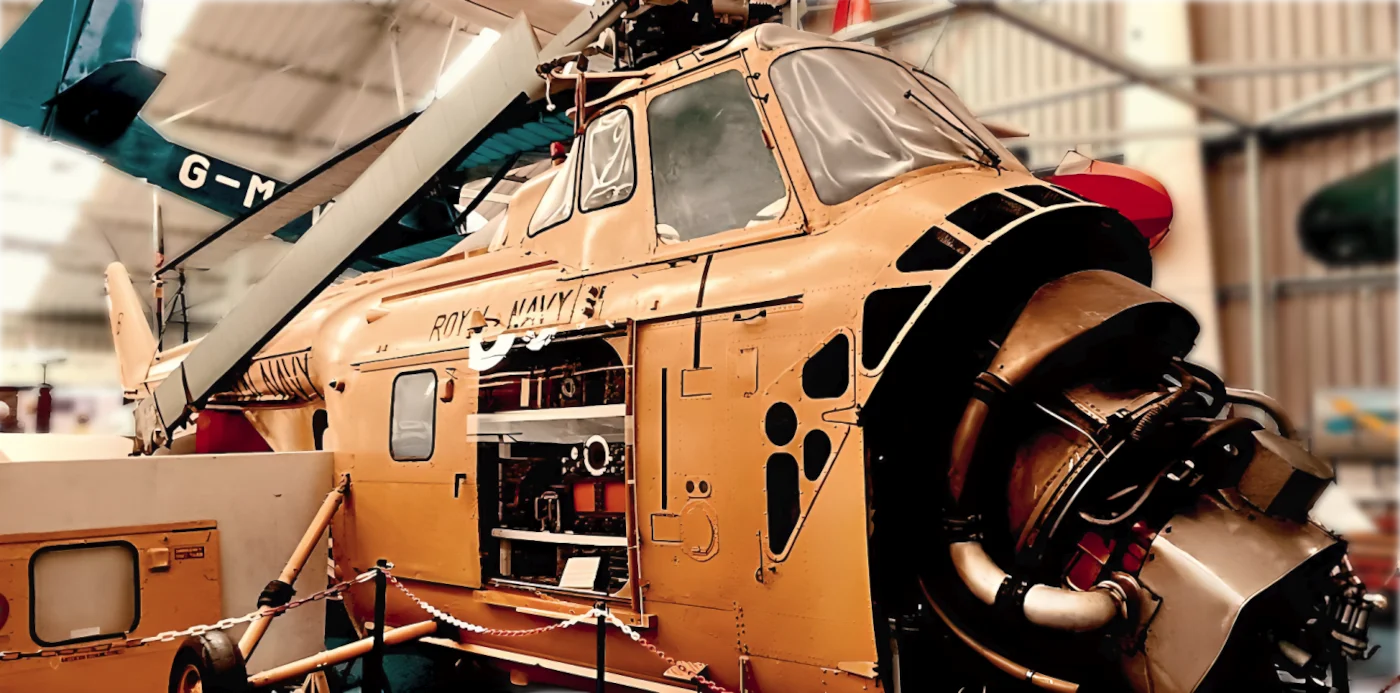
The Westland Whirlwind HAS.7 was a British-built helicopter that played a crucial role in maritime operations during the 1960s and 1970s. As a development of the American Sikorsky S-55, the Whirlwind HAS.7 (Helicopter Anti-Submarine Mark 7) became an integral part of the Royal Navy’s airborne anti-submarine warfare (ASW) capabilities.
Pilots who flew the Westland Whirlwind HAS.7 often describe it as a stable and reliable platform, well-suited to its maritime roles. The aircraft’s design, with its distinctive nose-mounted radial engine, gave it a unique appearance and flying characteristics. Upon entering the cockpit, pilots were greeted by a comprehensive instrument panel tailored for both day and night operations. The side-by-side seating arrangement for the pilot and co-pilot enhanced crew coordination, crucial for complex ASW missions.
Taking off in a Whirlwind HAS.7 was a straightforward process. The powerful Alvis Leonides Major 755/1 radial engine, producing 1,050 horsepower, provided ample lift for the aircraft’s 13,500-pound maximum takeoff weight. Pilots noted the helicopter’s responsiveness to control inputs, allowing for precise maneuvering even in challenging maritime conditions. Once airborne, the Whirlwind HAS.7 demonstrated good stability, an essential characteristic for ASW operations that often required prolonged periods of hovering or low-speed flight. The aircraft’s autopilot system aided in reducing pilot workload during long maritime patrols.
Operating from naval vessels presented unique challenges, which the Whirlwind HAS.7 was well-equipped to handle. Its robust landing gear and powerful engine allowed for safe takeoffs and landings on pitching decks. The aircraft’s relatively compact size made it suitable for operation from smaller escort vessels, expanding its utility within the fleet.
One of the most critical aspects of flying the Whirlwind HAS.7 was its performance in adverse weather conditions. The helicopter’s weather radar and instrument flight capabilities allowed it to operate effectively in poor visibility, a common occurrence in its maritime environment. Landing the Whirlwind HAS.7, particularly on moving ship decks, required skill and precision. Pilots appreciated the aircraft’s stability during the approach and its responsiveness to control inputs, which allowed for safe landings even in challenging sea states.
Landing the Whirlwind HAS.7, particularly on moving ship decks, required skill and precision. Pilots appreciated the aircraft’s stability during the approach and its responsiveness to control inputs, which allowed for safe landings even in challenging sea states.
The Westland Whirlwind HAS.7 was designed primarily for anti-submarine warfare, but its versatility allowed it to perform a variety of maritime roles. Its key capabilities included:
- Anti-Submarine Warfare: Equipped with dipping sonar and able to carry depth charges or torpedoes, the Whirlwind HAS.7 was an effective submarine hunter.
- Search and Rescue: With a spacious cabin and rescue hoist, it could perform air-sea rescue missions effectively.
- Utility Transport: The Whirlwind could transport personnel and cargo, serving as a vital link between ships and shore facilities.
- Reconnaissance: Its endurance and sensor suite made it suitable for maritime patrol and reconnaissance missions.
Performance-wise, the Whirlwind HAS.7 had a maximum speed of about 109 knots (125 mph or 201 km/h) and a range of approximately 334 nautical miles (385 miles or 619 km). It could operate at altitudes up to 14,000 feet, although its primary operating envelope was much lower for maritime operations. The aircraft’s endurance of over three hours made it well-suited for extended ASW patrols. Its payload capacity allowed it to carry a variety of weapons and sensors, including depth charges, torpedoes, radar, and dipping sonar.
One of the Whirlwind HAS.7’s most significant capabilities was its ability to operate in all weather conditions, day or night. This made it a reliable asset for the Royal Navy’s round-the-clock maritime operations.
The Westland Whirlwind HAS.7 entered service with the Royal Navy in 1957, replacing earlier Whirlwind variants and other ASW platforms. It quickly became a mainstay of the Fleet Air Arm’s helicopter force, equipping numerous squadrons throughout its service life.
Key Royal Navy squadrons that operated the Whirlwind HAS.7 included:
- 700 Naval Air Squadron: The intensive flying trials unit, which helped develop tactics and procedures for the Whirlwind’s ASW role.
- 706 Naval Air Squadron: The Whirlwind operational conversion unit, responsible for training pilots and aircrew.
- 737 Naval Air Squadron: A front-line ASW squadron that operated from various Royal Navy vessels.
- 771 Naval Air Squadron: Primarily a search and rescue unit, showcasing the Whirlwind’s versatility.
The Whirlwind HAS.7 played a crucial role in maintaining the Royal Navy’s ASW capabilities during a period of heightened Cold War tensions. It operated from a variety of vessels, including aircraft carriers, commando carriers, and smaller escort ships, providing flexible air support to the fleet.
While primarily associated with the Royal Navy, the Westland Whirlwind also saw service with other operators:
- Royal Air Force: The RAF operated Whirlwind variants, including some similar to the HAS.7, for search and rescue duties around the UK coastline.
- Danish Air Force: Denmark acquired a small number of Whirlwind HAS.7 aircraft for SAR duties in Greenland.
- Brazilian Navy: Brazil operated ex-Royal Navy Whirlwind HAS.7s for a brief period in the 1970s.
The Westland Whirlwind HAS.7 saw active service in various operations and conflicts during its career:
- Suez Crisis (1956): While not directly involved in combat, Whirlwinds provided support to Royal Navy operations in the region.
- Cod Wars (1958-1976): Whirlwind HAS.7s were deployed during the fisheries disputes between the UK and Iceland, providing reconnaissance and support to Royal Navy vessels.
- Falklands Conflict (1982): Although being phased out by this time, some Whirlwind HAS.7s were hastily recommissioned to support operations in the South Atlantic, primarily in a transport and utility role.
- Cold War Operations: Throughout its service life, the Whirlwind HAS.7 played a crucial role in tracking Soviet submarines and maintaining NATO’s maritime defenses.
The Westland Whirlwind HAS.7 left an indelible mark on British naval aviation. It bridged the gap between early post-war helicopters and more advanced types like the Westland Sea King, which eventually replaced it in the ASW role. The Whirlwind HAS.7’s contribution to the development of shipborne helicopter operations cannot be overstated. It helped establish tactics and procedures for maritime helicopter operations that would influence naval aviation for decades to come. Many of the lessons learned from operating the Whirlwind HAS.7 were applied to subsequent helicopter designs. Its versatility demonstrated the value of a multi-role maritime helicopter, a concept that continues to shape modern naval aviation.
The Westland Whirlwind HAS.7 was a vital asset for the Royal Navy during a critical period of the Cold War. Its reliability, versatility, and effectiveness in the ASW role made it a respected and valued aircraft among its crews. While it may not have the fame of some of its contemporaries, the Whirlwind HAS.7’s contribution to maritime aviation and naval operations ensures its place in aviation history.