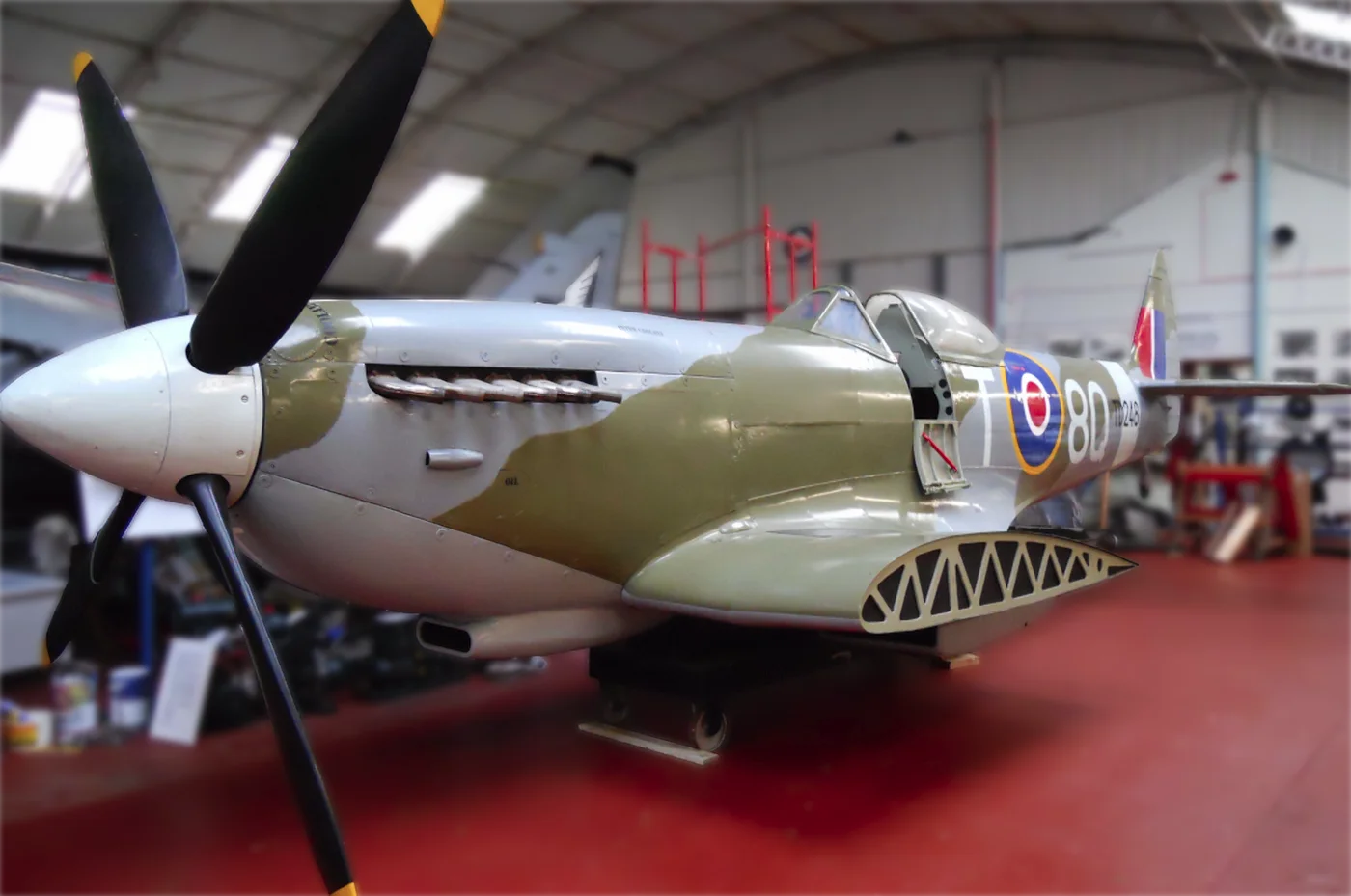
Designed by RJ Mitchell and first flown in 1936, the Spitfire is the most famous aeroplane of all time, immortalised with the Hurricane in the Battle of Britain. Over 22,700 were built (including Seafires), generating some 50 operational variants. It was the only Allied aeroplane to remain in production and development throughout World War II. Designed for low altitude combat, this mark was virtually a MK IX airframe with an American-built Rolls-Royce engine and entered service in the autumn of 1944; the rear-view fuselage and bubble canopy were added in February 1945. Few remained in RAF service by 1953 even though the mark had the highest production total at 1,054.
The Supermarine Spitfire LFXVIe represents the culmination of wartime development for one of the most iconic fighter aircraft in history. As a low-altitude variant of the Spitfire XVI, this aircraft combined the sleek lines of earlier models with advanced technology and powerful engines, creating a formidable fighter that continued to serve well into the post-war era.
Pilots who had the privilege of flying the Spitfire LFXVIe often speak of it with a mixture of respect and affection. The aircraft was known for its exceptional handling qualities, which had been refined through years of development and combat experience. Upon climbing into the cockpit, pilots were greeted by a familiar layout, largely unchanged from earlier Spitfire models. The bubble canopy, introduced in later variants, provided excellent visibility, crucial for both combat and general flying.
Taking off in a Spitfire LFXVIe was an exhilarating experience. The powerful Packard Merlin 266 engine, a license-built version of the Rolls-Royce Merlin, provided ample power for a quick acceleration and climb. Pilots needed to be mindful of the significant torque effect during takeoff, which required right rudder input to keep the aircraft straight. Once airborne, the Spitfire LFXVIe truly came into its own. Its elliptical wing design, a hallmark of the Spitfire series, contributed to its exceptional maneuverability. Pilots could perform tight turns and rolls with ease, making the aircraft highly effective in dogfights.
At low altitudes, where the ‘LF’ (Low-altitude Fighter) variant was optimized to operate, the Spitfire LFXVIe was in its element. The aircraft’s responsiveness and power allowed pilots to exploit ground-level tactics effectively, whether for interception, ground attack, or reconnaissance missions.
One of the most notable characteristics of flying the Spitfire LFXVIe was its harmony of controls. The ailerons, elevator, and rudder were well-balanced, allowing for precise and intuitive handling. This made the aircraft both a formidable fighter and a joy to fly.
Landing the Spitfire LFXVIe required skill and attention. The narrow-track undercarriage, while contributing to the aircraft’s sleek profile, made ground handling more challenging compared to some contemporary fighters. Pilots needed to be cautious of potential ground loops, especially in crosswind conditions.
The Spitfire LFXVIe was powered by the Packard Merlin 266 engine, producing up to 1,720 horsepower with water-methanol injection. This allowed the aircraft to reach a maximum speed of around 404 mph (650 km/h) at low altitude, making it one of the fastest piston-engine fighters of its time. The ‘LF’ designation indicated that this variant was optimized for low-altitude performance. Its engine was tuned to deliver maximum power at lower altitudes, typically below 20,000 feet. This made the LFXVIe particularly effective for interception, ground attack, and low-level reconnaissance missions.
The aircraft had a service ceiling of approximately 41,500 feet (12,600 meters), although its optimal performance envelope was at much lower altitudes. It could climb to 20,000 feet in about 6 minutes, demonstrating impressive climb performance.
Armament on the Spitfire LFXVIe typically consisted of two 20mm Hispano cannons and two .50 caliber Browning machine guns. This armament provided a good balance of firepower and ammunition capacity, effective against both air and ground targets.
One of the significant advancements in the LFXVIe was the introduction of a bubble canopy, which greatly improved visibility compared to earlier Malcolm hood designs. This enhanced situational awareness for pilots, a crucial factor in both air combat and low-level operations.
The Spitfire LFXVIe entered service with the Royal Air Force in the latter stages of World War II, around 1945. While it arrived too late to see significant combat during the war, it played a crucial role in the immediate post-war period. RAF squadrons equipped with the LFXVIe were primarily tasked with home defense, interception duties, and tactical reconnaissance. The aircraft’s low-altitude performance made it particularly suitable for quick reaction intercept roles, able to rapidly climb to engage potential threats. In the post-war years, as the RAF transitioned to jet-powered aircraft, the Spitfire LFXVIe continued to serve in various capacities. It was used extensively for training, helping pilots transition from basic trainers to more advanced aircraft. The handling characteristics of the Spitfire made it an excellent platform for teaching advanced flying skills.
Several RAF squadrons continued to operate the LFXVIe into the early 1950s, particularly in overseas commands where the infrastructure for jet operations was not yet fully developed. The aircraft’s versatility allowed it to fulfill multiple roles, from fighter duties to reconnaissance and even light ground attack.
The excellence of the Spitfire LFXVIe was recognized beyond the RAF, and several other air forces operated the type. These air forces found the Spitfire LFXVIe to be a capable and versatile aircraft, bridging the gap between wartime piston-engine fighters and the jet age:
- Royal Canadian Air Force (RCAF): The RCAF operated Spitfire XVIs, including low-altitude variants, in the immediate post-war period. They were used for training and home defense duties.
- Royal Danish Air Force: Denmark acquired a number of Spitfire LFXVIe aircraft in the late 1940s, using them as their primary fighters until the introduction of jet aircraft.
- Royal Netherlands Air Force: The Dutch operated Spitfire XVIs, including low-altitude versions, in the immediate post-war years for air defense and training roles.
- Belgian Air Force: Belgium also acquired Spitfire XVIs, using them for similar roles as other European air forces in the post-war period.
While the Spitfire LFXVIe came too late to see combat in World War II, it did participate in several post-war conflicts and operations:
- 1948 Arab-Israeli War: Israeli forces operated several Spitfire LFXVIes acquired through various means. These aircraft played a crucial role in establishing air superiority for the fledgling Israeli Air Force.
- Malayan Emergency (1948-1960): RAF Spitfires, including LFXVIe variants, were used for ground attack and reconnaissance missions against communist insurgents in Malaya.
- Korean War (1950-1953): While not directly involved in combat, RAF Spitfire LFXVIes based in Hong Kong performed air defense duties, protecting the colony from potential threats related to the nearby conflict.
- Suez Crisis (1956): Although the conflict primarily involved jet aircraft, some Spitfire LFXVIes were still in service with RAF squadrons in the Middle East and participated in peripheral roles.
The Supermarine Spitfire LFXVIe represents the pinnacle of piston-engine fighter development. It combined the legendary handling characteristics of the Spitfire series with advanced technology and powerful engines, creating an aircraft that remained competitive even as the jet age dawned. The LFXVIe’s impact extended beyond its military service. It played a crucial role in training a generation of pilots, bridging the gap between wartime flying techniques and the new skills required for jet aircraft. Many pilots who later flew early jet fighters began their careers in aircraft like the Spitfire LFXVIe.
Our Spitfire LFXVIe TD248
In July 1945, TD248 (code 8Q-T) joined 695 Squadron on anti-aircraft co-operation duties at Bircham Newton, Norfolk, moving to nearby Horsham St Faith in August 1945; later it was coded 4M-E. Renumbered No 34 in February, 1949, the squadron was disbanded in June 1952 and the duties transferred to 2 Civilian Anti-Aircraft Co-Operation Unit at Little Snoring, Norfolk, operated by Marshall’s of Cambridge; TD248 joined the unit in August 1951 with code T.
Retired in May 1954 and stored at Cosford, it was later issued to 610 Squadron RAuxAF at Hooton Park, Cheshire as a parade quardian with code DW-A. Later, it went to RAF Sealand and was displayed outside the Officers’ Mess for some years.
TD248 was one of five Spitfires released to Historic Flying Ltd. in 1988 by the MOD in exchange for fibreglass replicas for gate guardians plus two rare aircraft for the RAF Museum. The original set of fuselage skin panels, cowlings and other manufacturer’s components discarded during its rebuild to flying condition were purchased by Museum member lan Hancock. These have been re-assembled on a frame specially designed and built by member Ken Huckle, with other work undertaken by member Vic Banham.