In the latter half of the 1950s, a new breed of fighter was tearing across American skies. With its distinctive swept wings, streamlined fuselage, and the banshee wail of its J57 turbojet engine, the F-100 Super Sabre was the face of the U.S. Air Force’s transition into the jet age. Its later D model variant would go down as one of the most iconic fighters of the century. The three principle variants were the F-100A Interceptor; the F-100C and D fighter-bomber, and the F100-F two-seat trainer and operational fighter. It was the USAF’s first operational fighter capable of flying faster than the speed of sound (760mph) in level flight.
Strap yourself into the cockpit and you were surrounded by a dizzying array of analog instruments and gauges. The control stick between your legs had a decidedly mechanical feel compared to modern fly-by-wire jets. Get cleared for takeoff and you opened up that J57 engine – putting out over 16,000 pounds of thrust. The Super Sabre would accelerate dramatically, pinning you back in the ejection seat. Retracting the landing gear allowed it to reach its blistering top speed of over 900 mph.
Flying the F-100D was an incredible adrenaline rush. Despite being labeled a “century series” fighter, it handled more like a missile than an aircraft at times. Starting in the mid-1950s, a whole new generation of young American pilots got their first true taste of flying a jet at maximum performance in the Super Sabre’s cockpit.
To fully appreciate the F-100D, it’s important to look at how it evolved from the original F-100A model that preceded it. When North American Aviation began design work in 1951, the company was tasked with building an air superiority day fighter to replace the venerable F-86 Sabre. The new jet needed to have outstanding performance by utilizing an afterburning engine and swept wings.
The F-100 took its first flight in 1953 and immediately impressed with its speed and acceleration capabilities. However, early models were unpopular with pilots due to severe control problems at high speeds and angles of attack caused by the aircraft’s tendency to become ultra-maneuverable in certain flight regimes a phenomenon known as “tuck under.”
The quintessential D model arrived in 1956 equipped with the uprated J57-P-21A afterburning turbojet generating nearly 50% more thrust. An automatic pitch damper and a more powerful electrical system were also added. These refinements turned the Super Sabre into an outstanding dogfighter and air-to-ground striker rolled into one package. The F-100D could pull a blistering 7.33 G’s in a tight turn at maximum performance. It carried a potent punch with four 20mm cannon along with the ability to carry both nuclear and conventional bombs and rockets. An inflight refueling probe gave the Super Sabre a practical operating range of over 1,800 miles.
Perhaps most importantly, the inertia coupling and electronic control system of the D model helped overcome the “tuck under” dangers of earlier variants. Speed hold components prevented the fighter from going past Mach 1.3 without the pilot’s input. The pitch damper greatly improved high-speed stability and stall recovery characteristics.
Piloting the F-100D remained a visceral and demanding experience, however. Without fly-by-wire flight controls, mastering the incredibly sensitive controls at an aircraft stressed to near its design limits took rare piloting skills. The Super Sabre had a well-earned reputation as a “bastard to fly” in the words of many pilots. With its daunting cockpit and penchant for violently deploying its drag chute during landing, the F-100D regularly separated pilots into two camps – those who loved it and those who hated it. It demanded the utmost respect, but also inspired fierce loyalty from pilots brave enough to tame it.
Veteran aviators remember wrestling the Super Sabre’s side-stick through a hard turn at 6 or 7 G’s as the aircraft shuddered and strained, seemingly on the verge of coming apart. Afterburner lights would blaze red hot during a dive to mark the shock cone as the fighter went supersonic. Hydraulic motors whirred to life during bombing runs as the jet extended its heated leading edges for low-level penetration.
Strapping into the cockpit was an act of courage and the ultimate validation of one’s skills. Though far from perfect, the Super Sabre had a way of making pilots feel truly alive when they heard that J57 howling behind them. Those who could keep the “Hun” held in check during low-level bombing runs or grueling dogfights joined a rare air force fraternity of the fearless. To fly the F-100D was to cheat death in a feat of modern gladiatorial aerial combat.
Despite being initially designed as a day fighter, the F-100D saw extensive action over Vietnam as a multi-role aircraft. In 1965, it became one of the first U.S. fighter-bombers to enter combat in Southeast Asia. Its combination of speed, range, and ordnance payload made the Super Sabre an ideal aircraft for hit-and-run strikes against communist ground forces and supply lines.
The Vietnam War proved a trial by fire as F-100 pilots pushed the jets to their limits in the new arena of aerial combat over the jungles and mountains. Night one-on-one dogfights against Vietnamese MiG-17s and MiG-21s were a startling wake up call after years of unchallenged air supremacy. Dozens of F-100s were lost to groundfire as pilots grimly learned the realities of delivering ordnance in a surface-to-air threat environment.
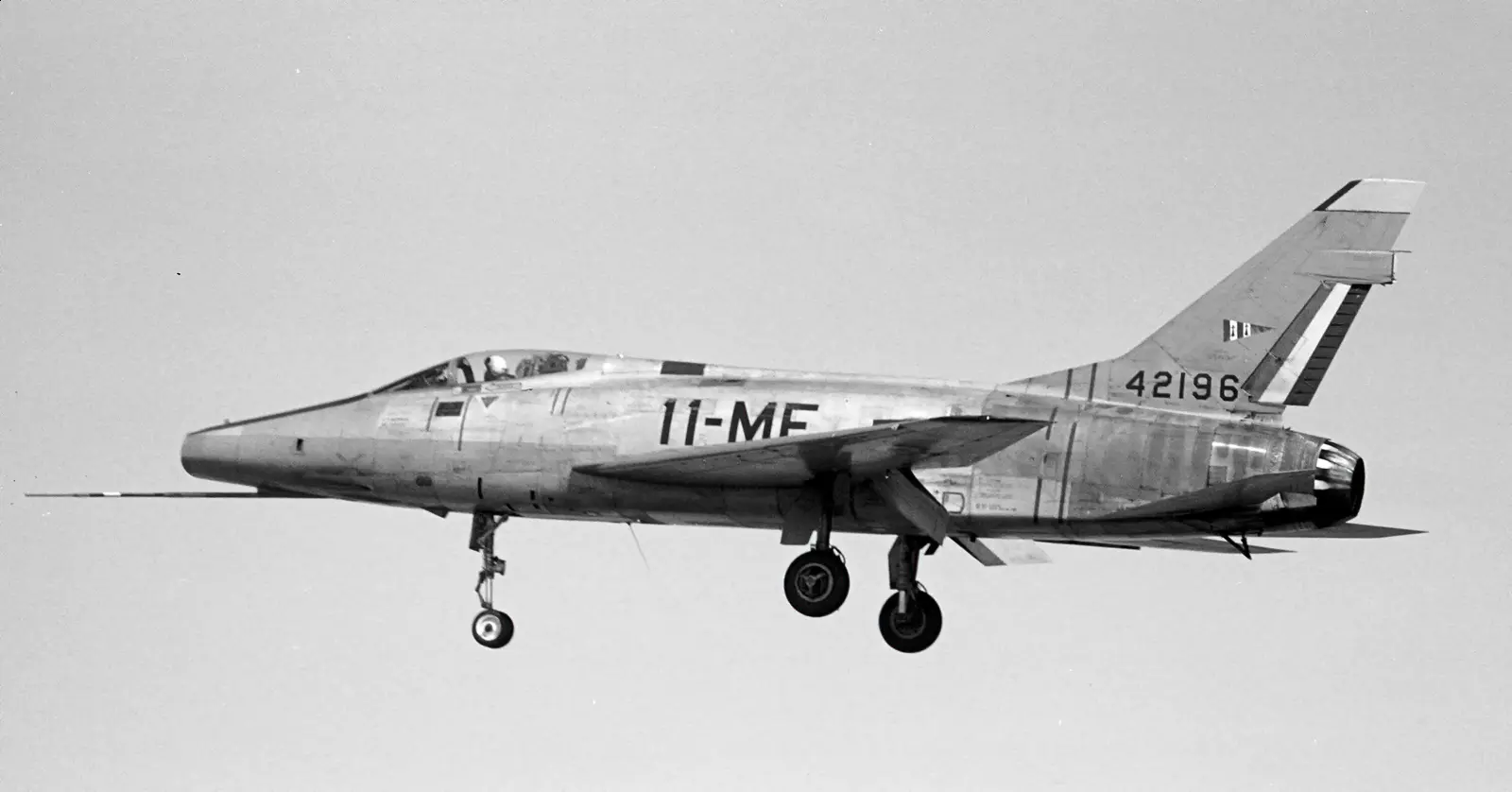
Eleven years after first entering Southeast Asia, the F-100 flew its last combat sortie over Vietnam in 1971. By then, most of the surviving D models were relegated to training roles or supplied to a number of NATO nations under the Mutual Defence Aid Programme including Denmark, Turkey and France; others were made available to the Nationalist Chinese air force and Taiwan. The Air Force began phasing out the iconic “Hun” as a new generation of fighters like the F-4 Phantom II came online. In the end, the F-100D had more than proven its worth as a rugged, high-performance fighter and striker platform. By the time it’s production ended in 1959, 2,294 F-100’s were built.
Nearly 60 years after its initial introduction, aviation enthusiasts and historians still celebrate the F-100D and the critical role it played during the Cold War. While lacking the outright speed of the Century Series F-104 Starfighter, the Super Sabre more than compensated with its versatility and ordinance payload. The F100 remains a thrilling bridge between the piston-engine era and the sophisticated fly-by-wire fighters of today. Current and former military pilots look back with a mixture of awe and trepidation on their time spent wrangling the cantankerous Super Sabre during its glory days. Those fortunate enough to coax that swept-wing avenger into its full performance envelope experienced flying at its most visceral and raw. The F-100D wasn’t just an aircraft, it was a demanding partnership that separated the elite from the ordinary.
Today, most remaining F-100Ds reside as museum pieces or “gate guardians” holding silent vigil outside of air bases and VFW posts. Their faded aluminum airframes stand as reminders of a bygone era when America’s first-line fighter squadrons mastered the audacious leap into supersonic jet warfare. Above all else, the Super Sabre was a tribute to the bravery and skills of the human pilots who tamed it. When you gaze up at that shark-mouthed intake and swept-back wings, you can almost feel the Ghost of the Jet Age rumbling to life. Close your eyes and you can imagine the shriek of full afterburner as those J57 engines lit the skies one more time. The F-100D may now be retired, but the memories and legend it forged over half a century ago still burns brightly for a passing breed of warriors – the Huns.
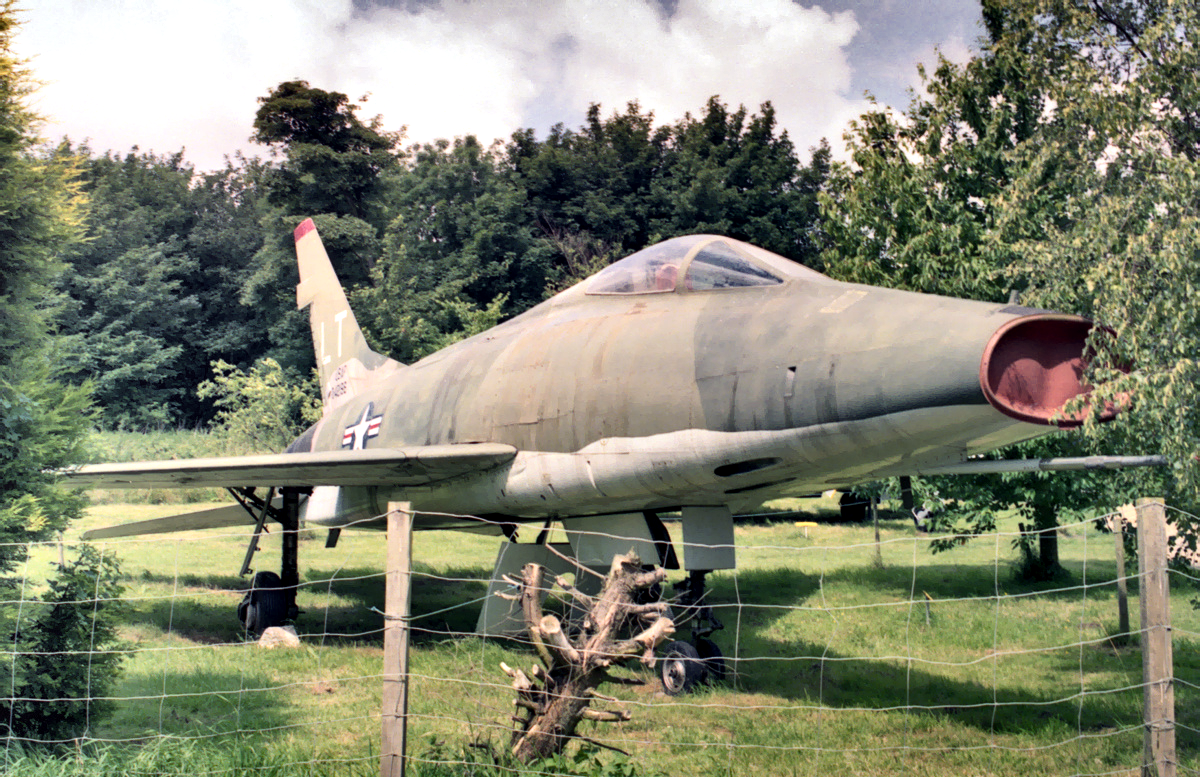
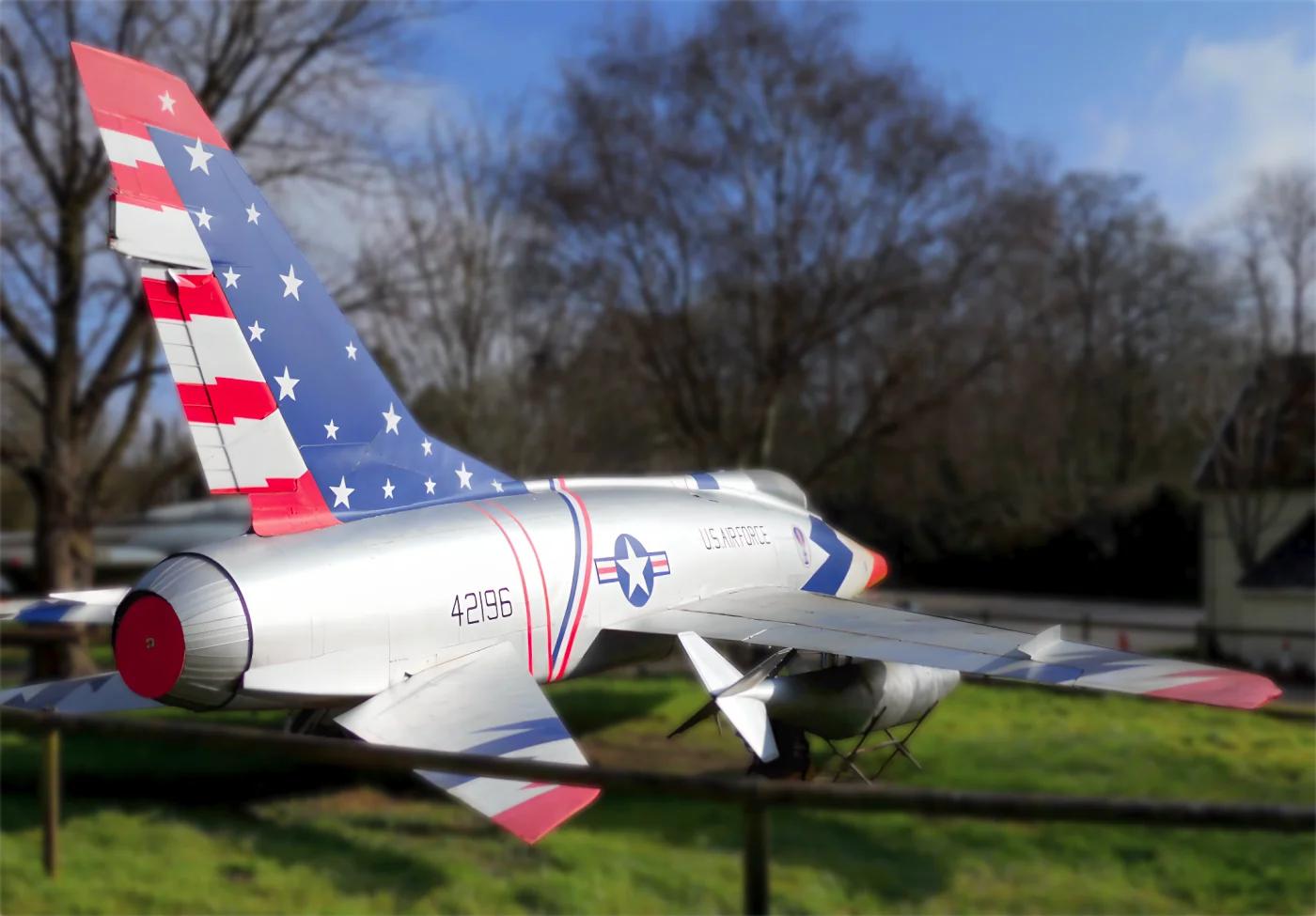
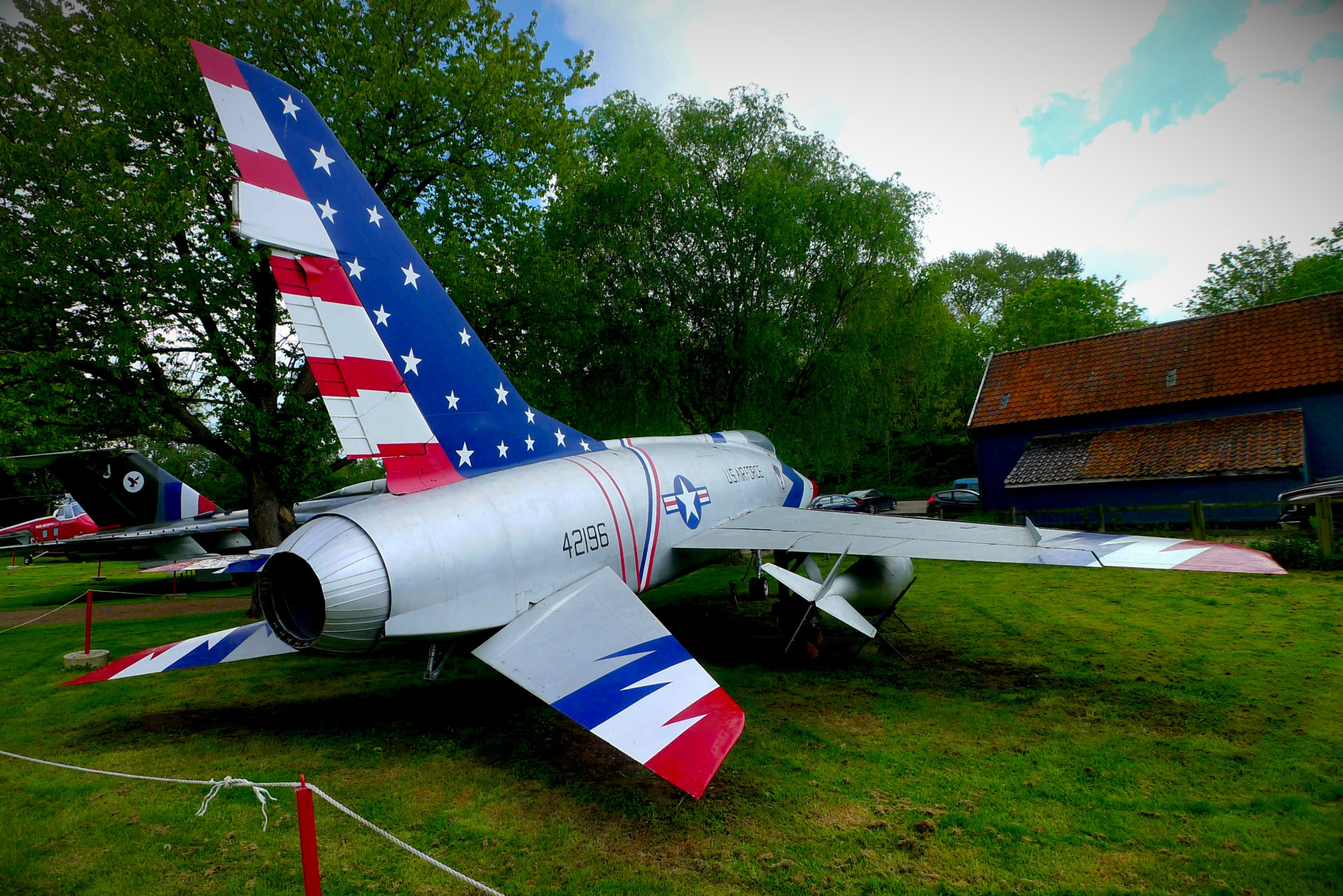
Our F-100D 5-42196
This aircraft served with the USAF and then the French Air Force.
Initially assigned to the 45th Day Squadron at Sidi Slimane in French Morocco and then to the 48th Fighter Bomber Wing (later Tactical Fighter Wing) when that unit was in France. Served with EC2/11 Vosges’ of the French Air Force in France and Germany, and then EC4/11 ‘Jura’ in Dibouti.
Returned to RAF Sculthorpe, Norfolk, and placed on loan to the Museum by the USAF in 1978. The aircraft is displayed in the colours of the US “Skyblazers” aerobatic team.