In its operational prime, the Javelin gave the RAF a powerful high-speed interceptor edge during most of the 1960s. But as with most aviation leaps, the dawn of intercontinental ballistic missiles rendered its high-altitude, high-speed performance increasingly obsolete. The Javelin was quickly outclassed by new surface-to-air missiles and fighters like the agile Mach 2 capable English Electric Lightning. But, for a brief shining period, the Gloster masterpiece afforded unrivaled speed capabilities – even touching the edges of the hypersonic regime. It took generations of aviation advances like the area-rule fuselage, delta wing planform, afterburning turbojets and ejection seats and molded them into an aluminum crucible of raw power forged in Britain’s proud aeronautics tradition.
In the late 1950s, an audacious new jet fighter arrived to guard British airspace with an unprecedented blend of brute acceleration and blistering climb rate. The Gloster Javelin cut an unmistakable silhouette with its bulbous intakes, stout fuselage, and thick delta wings. For the Royal Air Force pilots who strapped into the cockpit, it promised an exhilarating yet demanding ride on the cutting edge of aviation at the time.
From the moment the pair of Armstrong Siddeley Sapphire turbojet engines spooled up with an ear-splitting howl, you could sense the almost feral power waiting to be unleashed. The Javelin’s cockpit was remarkably roomy for the era, with an array of conventional flight instruments and limited automation compared to later jets. But the augmented flight controls provided a relatively straightforward experience that belied the extreme capabilities of this radical aircraft. With a firm hand on the sidestick, you opened up the enormous thrust available from those two engines and the Javelin would accelerate dramatically – pinning you back against the ejection seat. Despite its considerable heft of over 50,000 lbs fully loaded, this brutish delta could shatter the sound barrier with ease thanks to its severe 53-degree wing sweep.
Yet the real party trick came during the Javelin’s ability to execute a tactical spiral-climb to altitude that was second to none. In one searing vertical zoom, the fighter could scream from takeoff to 50,000 feet in under five minutes while exceeding Mach 1. Few other operational aircraft of that era could match its blistering rate of climb.
While blindingly fast in a straight line and able to rapidly outclimb any adversary, the Javelin suffered from tricky control issues at high speeds and angles of attack. Its vicious nose-up pitching tendencies, lack of roll control, and poor turning capability made it completely unsuited for traditional dogfighting. Wrangling its violent snap-roll behavior took almost superhuman efforts on the control stick.
Despite these shortcomings, the Javelin developed a cult following among RAF and Fleet Air Arm crews for whom it represented the pinnacle of brute aviation power. Those blessed with the skills and courage to fully exploit its capabilities experienced flying at the visceral extremes of Mach and G-loading unlike anything else of its era. For them, strapping into the belly of this beast blended the thrills of aviation’s supersonic future with the unforgiving, uncompromising demands of its past.
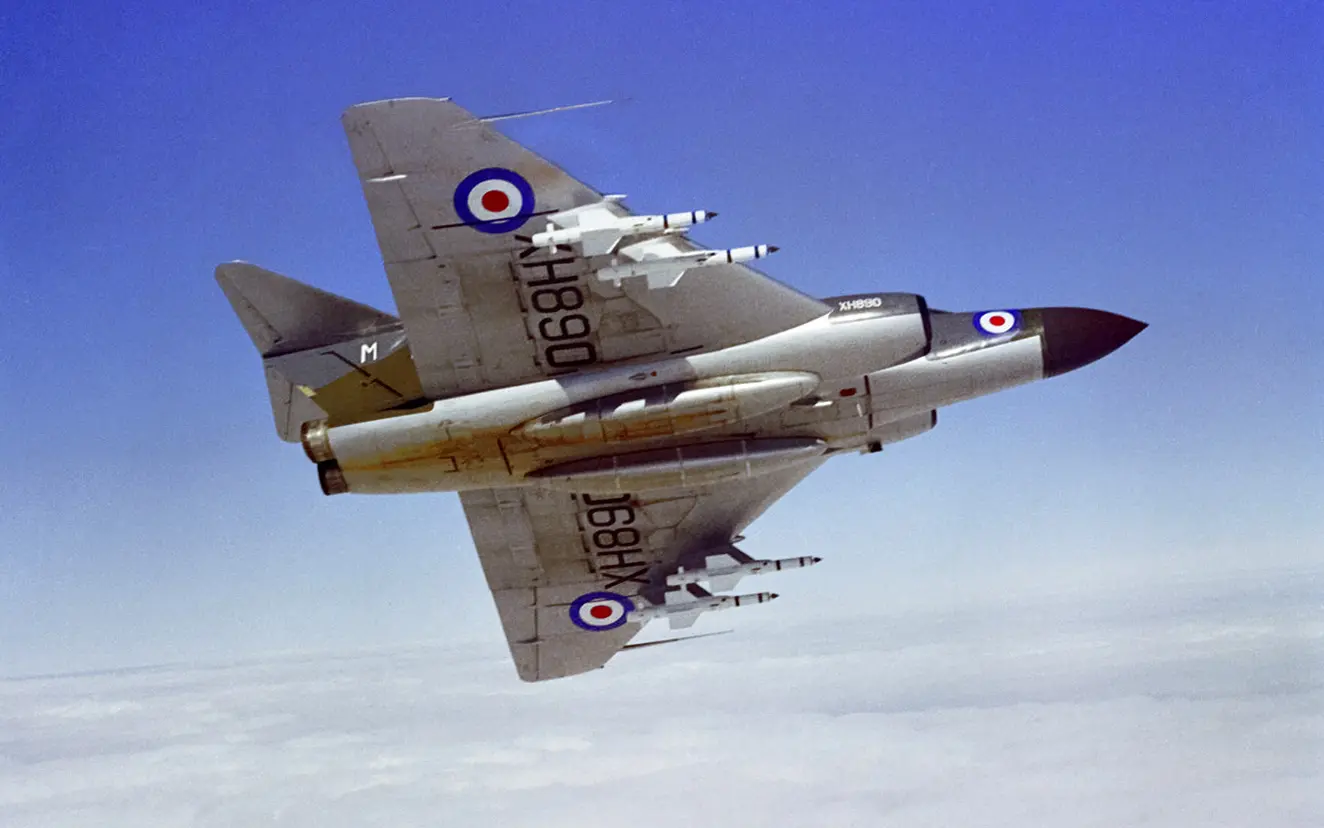
The Javelin was the world’s first twin jet delta-wing fighter. It was designed for long endurance flights to intercept enemy bombers at high altitudes and at high subsonic speeds. Electronic and radar devices gave it an all-weather, night and day, operational capability; it entered RAF service in February 1956.
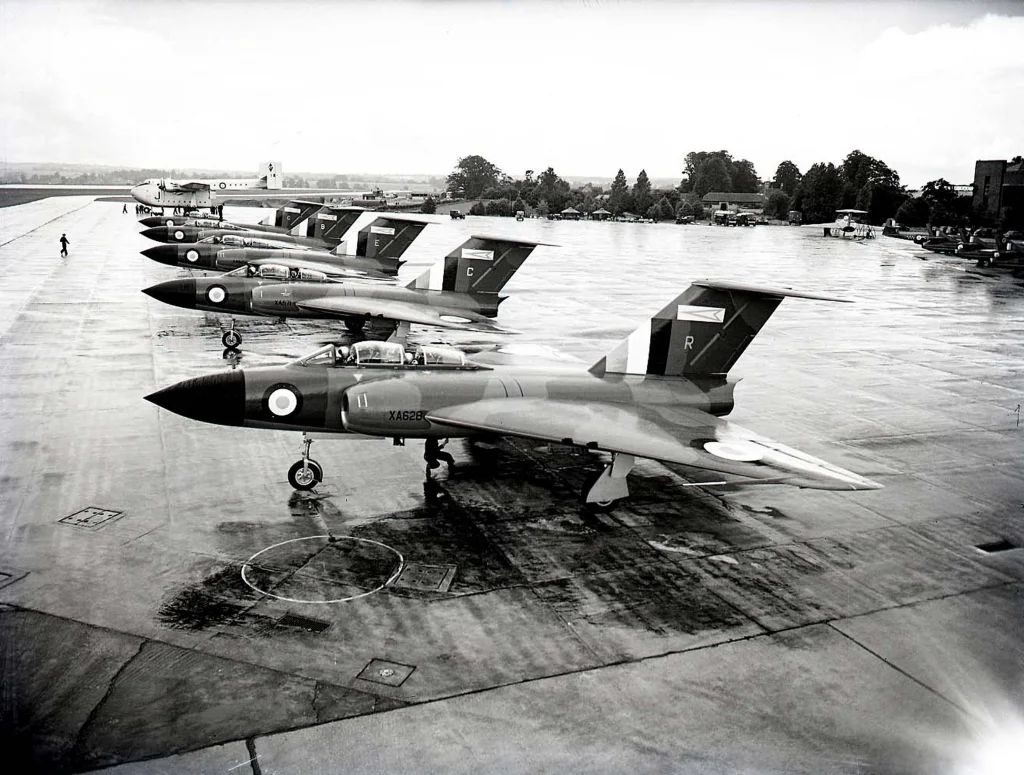
To truly appreciate the titanic Javelin, one must go back to the austere years following World War II when most of Britain’s aviation industry lay in ruins. In 1947, the RAF issued requirements for a new high-altitude fighter to protect the nation from nuclear-armed bombers. The nascent threat of supersonic attack meant any new aircraft would need to rely on raw speed above all else. Several prototypes were evaluated with radical new design elements like swept wings, afterburning engines, and area-ruling to achieve supersonic performance. The Gloster Aircraft Company’s amazingly sleek design combined all of these features into a large delta-wing format optimized for blazing speed and a stratospheric operating ceiling.
The resulting Javelin prototype first took flight in 1951 powered by two afterburning Armstrong Siddeley Sapphire engines generating over 23,000 lbs of thrust. It leveraged Gloster’s research into using a tailless, thin delta-wing shape to push transonic aerodynamics into the supersonic realm. An all-new ejection seat, airbrakes, and reinforced air intakes rounded out its forward-looking features.
Test pilots immediately discovered the Javelin demonstrator could exceed Mach 1 in level flight as hoped. But they also uncovered some disturbing flaws – most notably its severe stall issues and pitch-up behavior at high speeds and angles of attack. The Javelin had a nasty and unpredictable habit of abruptly departing controlled flight whenever pushed beyond Mach 1.
Still, the RAF desperately needed the Javelin’s incredible performance potential to stay ahead of Soviet bombers. So the fighter entered service in 1956 as an interceptor despite these dangerous idiosyncrasies. To help mitigate control problems, the Javelin featured a fin-assisted servo tab system. But fundamentally, the laws of aerodynamics meant its massive delta wings and that bulky fuselage generated incredible drag and pitch-up effects once pushed past Mach 1. For the first few years, the RAF trained crews to avoid supersonic speeds and rely on the Javelin’s unmatched rate of acceleration and climb on interception profiles. Radar support would vector the heavy fighter from low altitudes to the bomber stream height before carrying out its attack runs. While suboptimal, it allowed the Javelin to utilize its brute power while avoiding dangerous corners of the flight envelope.
The final operational variant was the F(AW).9R with a 20ft, detachable in-flight refuelling probe high on the starboard side of the forward fuselage – not present on our aircraft. Changes also included fitting an autopilot, and jet-pipes fitted with variable-area nozzles.
This all changed with the arrival of the improved FAW.9 and FAW.9R variants from 1959 onward. These new Javelins incorporated upgraded engines, an extended wingtip for improved roll control, and most importantly, a new controllability augmentation system to help counteract compressibility effects. For the first time, pilots could fly their Javelins at supersonic speeds while retaining some semblance of control. Of course, “some semblance” was the operative phrase. Even with the new stability aids, handling the Javelin proved to be a harrowing experience requiring incredible physical exertion and focus. Pilots pulling high G-forces would find themselves wrestling the sidestick just to keep the jet’s pitching and lurching under control. With controls going frighteningly solid, it felt like straining against a massive flywheel to make even slight adjustments as the Javelin approached its terminal Mach numbers. One former squadron commander vividly recalled the violent thumping and shaking as the airframe reached peak aerodynamic heating and compressibility effects.
Yet the Javelin’s extreme performance was also deeply intoxicating for those who could learn to anticipate and counter its wild gyrations. In the able hands of elite aviators, this plump delta could be throttled to its limit with a deft touch, executing blistering acceleration runs while riding its own shockwave. Pilots favored the unrestricted visibility and clean cockpit ergonomics compared to the F-106 contemporary. The Javelin afforded a uniquely visceral piloting experience – each scream of the engines and shudder of controls transmitting its banshee power directly to the human behind the stick. The sensation of slicing through the stratosphere at Mach 1+ left a lasting impression on those who achieved such aviation mastery.
Despite its sleek delta-wing appearance, the Javelin was at heart a throwback to an earlier age of brute aviation force before fly-by-wire computers and relaxed stability concepts. While blisteringly fast, it presented an uncompromising challenge to control at those speeds. Only iron-willed aviators willing to wrestle its sharp handling quirks and violent departures from controlled flight could truly exploit the full performance envelope. There’s a timeless romance to that idea of a powerful yet unforgiving supersonic steed tamed by remarkable human skill. And those who managed the feat could take pride in belonging to an exclusive cadre – the “Javelin men” who wrote their names in the pantheon of ultimate aviators.
When the last FAW.9Rs left RAF service in 1968, they marked the end of an era. Many of the same stall-prevention and control features first pioneered on the Javelin found their way into aircraft like the Concorde supersonic transport. But the delta wing interceptor itself would be remembered as a high water mark of blistering straight-line performance combined with cantankerous handling characteristics. Long retired, the remaining Javelin’s on display give few hints of the remarkable capabilities once extracted by those bold enough to light their afterburners. To modern eyes, the jet seems a tad ungainly with its stout fuselage, bulging intakes, and angled wings. Only those who dared sample its torrid acceleration and outrageous pitch-up antics can attest to the brutal power pulsing just beneath that unlikely surface.
For the former RAF and Fleet Air Arm aviators who mastered the Javelin’s quirks and controllability hardships, strapping into that delta-wing demon was a borderline religious experience. They will say the thrill of that vertical zoom clawing for the coffin corner of its performance envelope was like no other. It remains among aviation’s most vivid reminders that feats of bravery and technical excellence always arise to match the challenges that machines pose to our mortal limits. The Javelin’s howling engines were simply the clarion call for a new generation of airmen to achieve the seemingly impossible.
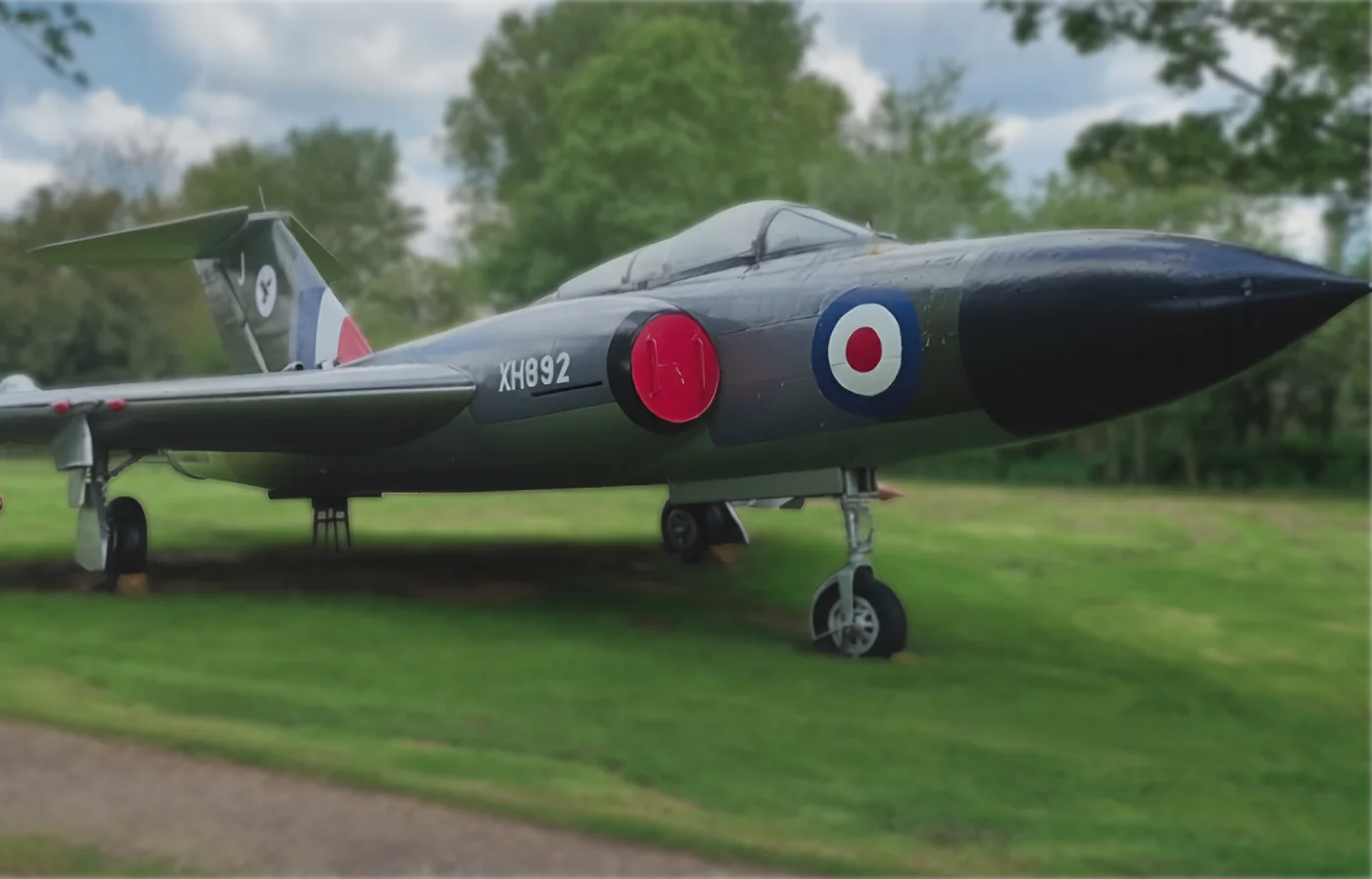
Our Javelin XH892
Built originally as an R(AW).7, this aircraft was stored at 5MU Kemble from April 1958 to July 1959 before conversion to F(AW).9 (F/R) standard. It joined 23 Squadron at RAF Coltishall, Norfolk, in 1960 and flight refuelling was practiced by this unit with the Valiants of 214 Squadron at Marham.
In 1962 the squadron moved briefly to Horsham St Faith, with conversion to FAW.9R standard and modification to carry four 230 gallon drop tanks, before returning to Coltishall. It was briefly deployed to Singapore, then to Leuchars, Scotland, before joining 64 Squadron at Binbrook in October 1964, and then in 1965 to 29 Squadron in Cyprus. Whilst with the latter, it was deployed for nine months in support of the Zambian Government against neighbouring Rhodesia who had declared UDI.
By 1967, the aircraft was in storage at 27 MU Shawbury but was then allocated to the RAF Museum as instructional airframe 7982M, going to its reserve collection at RAF Colerne; it was there from 1973 until the site closed down. The aircraft was sold in 1976 and moved to the IWM Duxford airfield, and finally came to Flixton in 1983