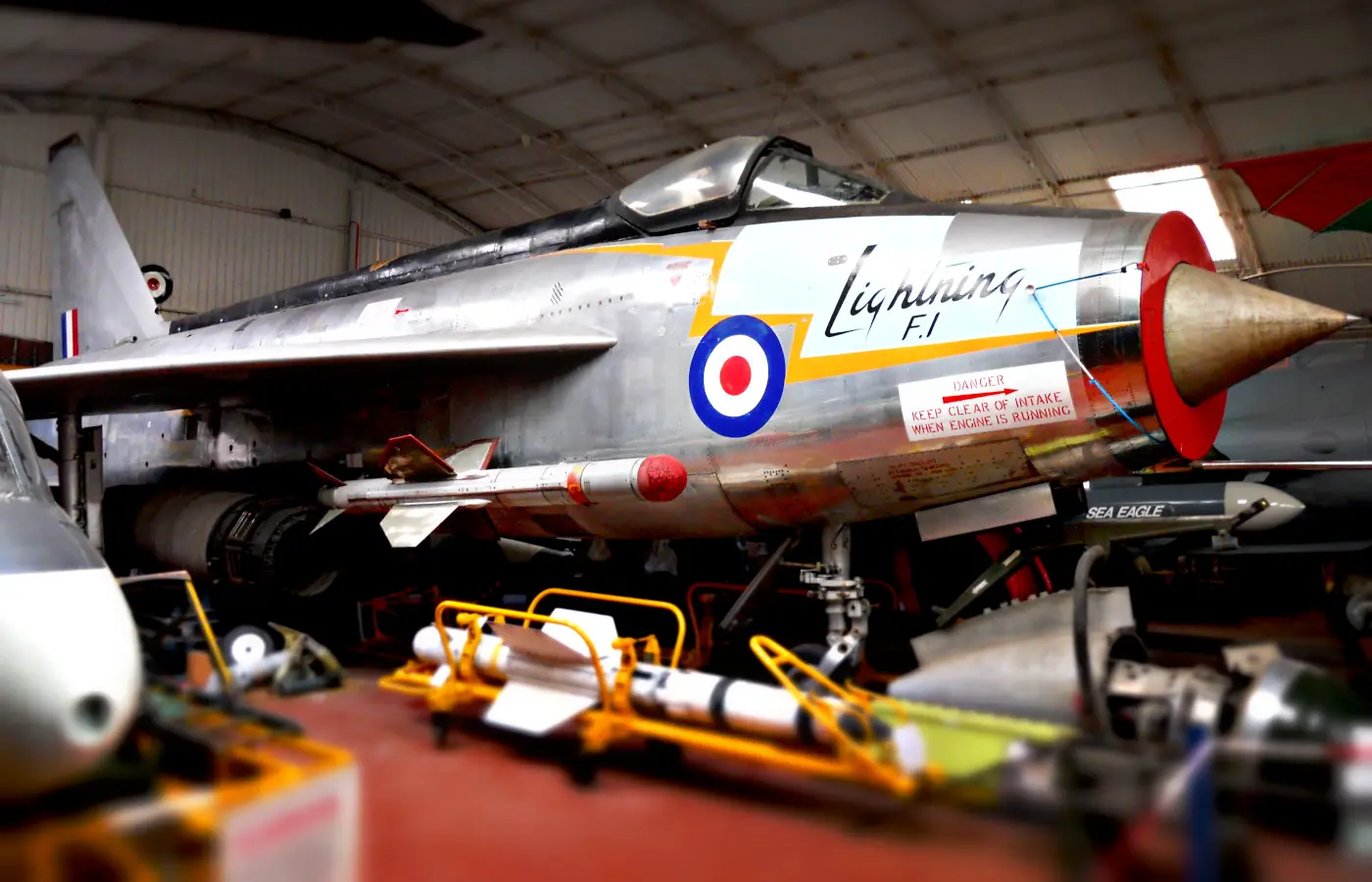
In the early 1960s, a sleek swept-winged monster began streaking across British airspace, startling civilians with thunderous sonic booms. The English Electric Lightning had arrived, and it was the most advanced interceptor the Royal Air Force had ever fielded. Behind that distinctive needle-nosed fuselage sat a piloting experience unlike any other.
From the moment you settled into the cockpit, you could sense the Lightning’s brutal power waiting to be unleashed. The dials and gauges had an almost utilitarian simplicity compared to the cluttered panels of American jets. Flip the starter switch and a pair of Rolls-Royce Avon turbojet engines roared to life with over 23,000 lbs of thrust between them. Ram up the twin throttles and the Lightning would instantaneously surge forward like a flesh-and-blood missile. With afterburners engaged, this Cold War interceptor could exceed Mach 2 – twice the speed of sound – in level flight. In a blistering 2.8 minutes, the Lightning could streak from a standstill brake release to an altitude of 36,000 feet and a speed of Mach 1.5. At those death-defying velocities, the swept wing would glow red hot from the effects of aerodynamic heating.
The harsh realities of pushing an aircraft that far past the sound barrier manifested in other punishing ways for pilots too. Extreme velocities generated tremendous inertial forces inside the cockpit. The human body was subjected to over 6 Gs of acceleration under full afterburner – more than enough to cause tunnel vision or temporary blackouts.
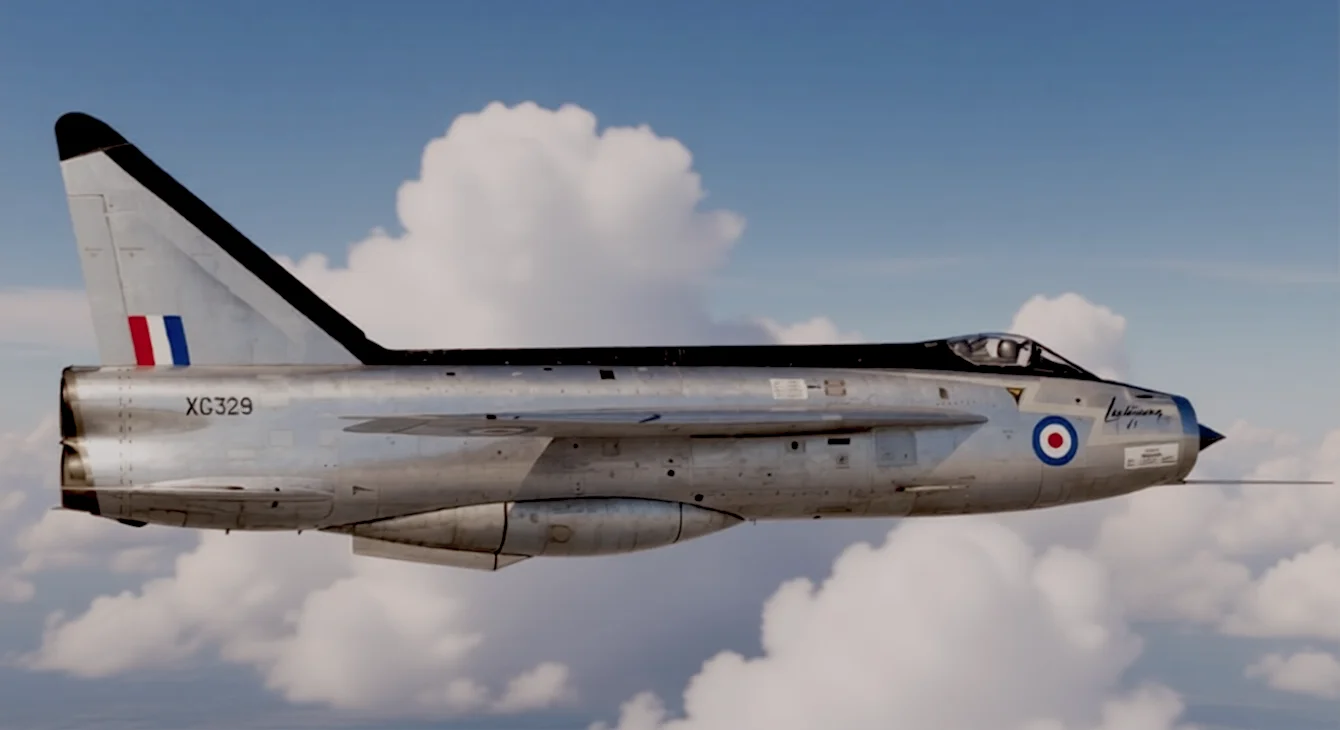
Our Lightning XG329 in flight:
The Lightning demanded a special breed of iron-willed aviators to tame its ferocious power. Its amazing performance came at the cost of being incredibly unforgiving to fly. Unlike its contemporaries like the F-4 Phantom II, the Lightning had no flight computer or augmented stability controls. It was a purely manual aircraft from start to finish. Within ten seconds of afterburner activation, pilots had to take over full control using nothing but their wits and reflexes. The Lightning teetered on the edge of avionic control with searing performance rendering it almost unflyable at times. Only exceptional piloting skill and constant adjustment on the control column could keep it from veering into a deadly departure from controlled flight.
These challenges were deeply ingrained into the Lightning’s basic design from the very start. In the early 1950s, the British Air Ministry foresaw the emerging threat of nuclear-armed Soviet bombers and identified the need for a dedicated interceptor to counter it. Engineers at English Electric set out to build the most streamlined airframe possible around two powerful afterburning engines. The resulting Lightning F.1 prototype was aviation brilliance distilled into its purest form – a monstrous pair of engines mated to a svelte fuselage and razor-sharp wings. With the wings positioned far back and topped with powerful elevons, the Lightning could achieve its unrivaled rate of acceleration and climb. But the same design also made for incredible stall vulnerability if the pilot was anything less than perfect.
Early test pilots found themselves constantly battling to keep the Lightning’s vicious stall and spin behavior under control. Without a doubt, this was the most uncompromising and dangerous aircraft the RAF had ever fielded. But it also promised interception speeds fast enough to reliably chase down nuclear-armed bombers before they reached British airspace, giving the Lightning an indispensable strategic value. It took nerves of steel, stamina, and sheer piloting skill to master that radical performance edge. But those who did mastered aerial command over speed itself. They truly joined the ranks of what test pilot Bill Waterton once called “the fraternity of the highest brinkmanship.“
The F.1 entered service in 1959 as the leading edge of the V-Force deterrent against Soviet aggression. Along with nuclear-tipped air-to-air missiles, the Lightning carried two powerful 30mm Aden cannon and underwing housings for unguided rocket pods. It was not designed for close-quarters dogfighting, but rather to obliterate targets from a distance with its terrific straight-line speed and awesome firepower.
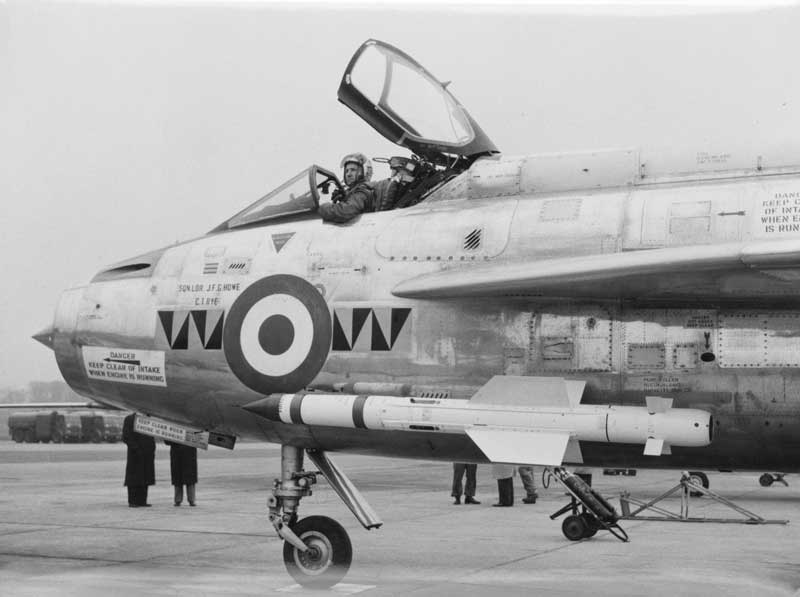
For pilots lucky enough to fly the Lightning, every takeoff and landing felt like tempting fate. The aircraft’s wide undercarriage made ground handling tricky. Its immense acceleration regularly slammed crews into their seats with gut-churning force. And its tight turning circle always threatened to depart controlled flight if not flown with razor precision. Still, for all its flaws and challenges, the Lightning inspired an almost fanatical devotion from its aircrews. There was a strange and primal appeal to wrestling with four tons of blistering titanium fury. Fly it to its limits and you joined a select corps of warriors who experienced true mastery over the machine.
One American test pilot assigned to evaluate the Lightning likened the sensation to “being permanently nailed to the front of a freight train.” Yet only those with “the iron hand and a very delicate touch” could handle its intolerable pitch-up characteristics. But for those who could tame it, the rewards were like nothing else in aviation. Climb out and engage afterburners and you were at the white-knuckled helm of a supersonic streak of white fury. The Lightning was said to ride its own shock wave, literally surfing the sonic boom it generated like a fiery bronco released from the gates of hell.
In skilled hands, the interceptor’s modest range could be greatly extended through a pioneering tactic called “cruise-climbing.” This involved performing a continuous zoom climb while economizing fuel until reaching interception altitude and speed. At over 50,000 feet, the Lightning could rocket across hundreds of miles of British airspace at ease.
Every aspect about the Lightning was pure overkill, but that was the entire point. This swept-winged monster was conceived as a deterrent with extremes of speed and ferocity designed to hopefully never need to be tested in battle. It was a wild mustang of the skies meant to deter both tyranny and nuclear armageddon through its steel-willed vigilance. Though it shunned traditional aerial engagements, the Lightning’s hawkish looks, fearsome reputation, and haunting howl of afterburner thunder left no doubt of its warlike purpose.
Despite its utter mastery of speed, the Lightning had an operational service life bookended by major technological shifts. In 1965, before the United States even committed ground troops to Vietnam, the Lightning was rendered obsolete in the face of Soviet nuclear stalemate doctrine. The need for manned interception of manned bombers faded, slowly relegating the Lightning to a limited ground attack role during the 1960s and 70s. But what it lacked in longevity, the Lightning more than made up for in establishing Britain’s place at the forefront of aviation performance.
For a relatively short but brilliant period, the English Electric Lightning interceptor ruled over the skies of the United Kingdom. While it never fired a shot in anger, it remained eternally poised to combat aerial aggression at trans-sonic velocities. For the young men of the RAF who tamed this ferocious beast, theirs was an elite aviation membership where mortal risks were rewarded with the glory of absolute speed supremacy. Even fifty years after its front-line retirement, the Lightning still casts a hypersonic spell of awe and wonder. Just as it did in its 1960s heyday, the shriek of those afterburning Avon engines cutting across the clouds serves as the banshee wail of a force to be feared. It was a portent of Mach 2 annihilation ascending through the stratosphere on wings of graphite and steel.
Little has changed in the Lightning’s aggressive crouching stance as it awaits the throaty roar of full reheat and release for one last vertical zoom. The big difference is the graying ex-pilots who now run palms along its titanium flanks – marveling at how they once rode such an outrageously capable instrument of air domination with unflinching bravery. To a man, they’ll say there was nothing in the sky that could match the raw terror and exhilaration of a Lightning in full flight. While aviation progressed swiftly with missiles and flyby-wire computers, this audacious design represented the absolute visceral limits of piloted aircraft performance. And for those precious few who strapped into the bucking ejection seat and throttled its thrust levers into that envelope of glory, they knew what it meant to soar as gods of the stratosphere in an unmatched symphony of speed, power, and aerial supremacy. The Lightning was the ultimate throat-throttling shockwave of what humans and machines could achieve when clawing for the outermost fringes of speed.
Out Lightning XG329
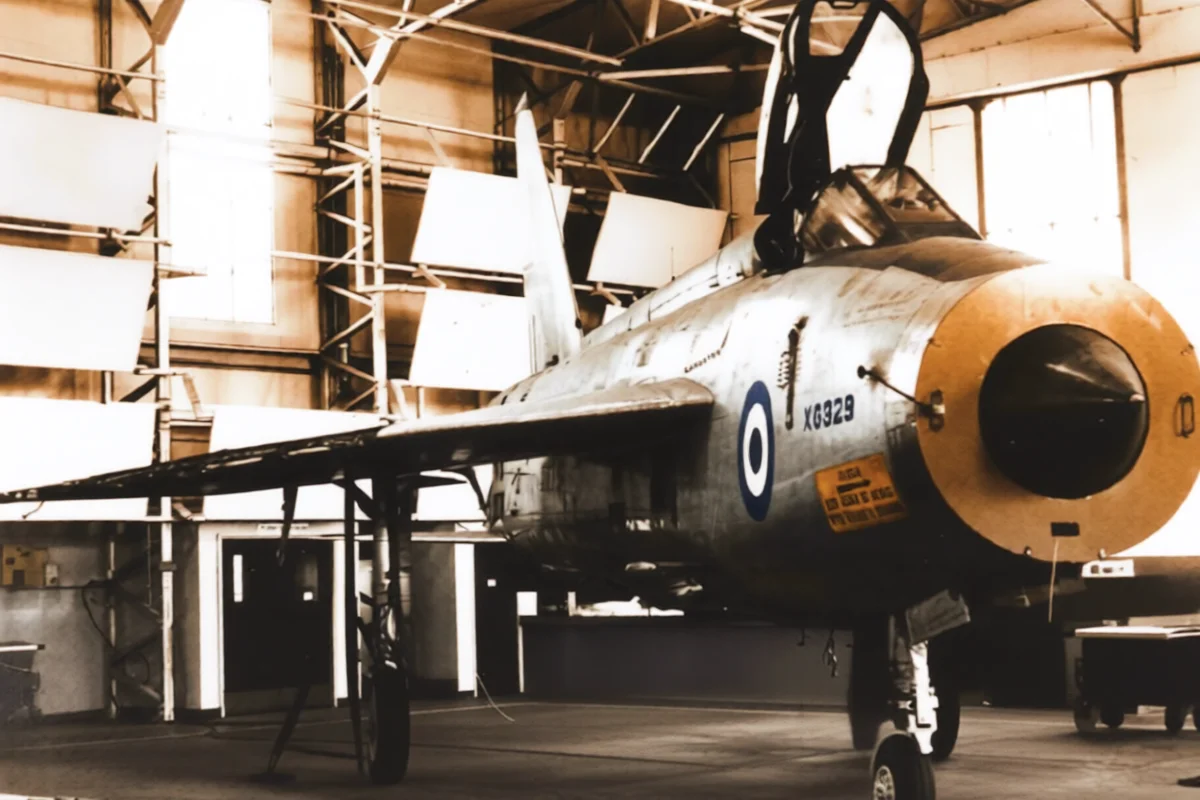
(FLYING HISTORY OF A DEVELOPMENT AEROPLANE) (CONSTRUCTOR’S NO.95018 – 12 OF 20 MANUFACTURED)
THE FOLLOWING FLIGHT DETAILS HAVE BEEN COMPILED FROM THE LOG BOOK ENTRIES OF NUMEROUS TEST PILOTS BUT THERE ARE GAPS. MISSING INFORMATION WOULD BE APPRECIATED
| Date | Details | Flight | Test Pilot |
|---|---|---|---|
| 30.04.1959 | First Flight and Delivery from Samlesbury | R.P. Beaumont | |
| 02.05.1959 | Test Flight | 0:32 | T. Ferguson |
| 13.05.1959 | Test Flight | 0:27 | T. Ferguson |
| 13.05.1959 | Test Flight | 0:09 | T. Ferguson |
| 14.05.1959 | Test Flight | 0:29 | T. Ferguson |
| 18.05.1959 | Test Flight | 0:41 | T. Ferguson |
| 26.05.1959 | 640 and Fuel Clearance | 1:35 | R.P. Beaumont |
| 30.05.1959 | Long endurance cruise M.9/40,000 | J. Dell | |
| 15.12.1959 | Test Flight | 0:43 | B. Knight |
The above information has beeen gathered from many different archive sources, including the Flying Log Books of surviving Test Pilots but it is incomplete. Even so, it is rare to be able to provide this amount of historical data. Additional information about this aircraft is always welcome, especially access to Log Books of Pilots who flew her; particularly the late Desmond de Villiers and John Squier.
Later History
07.02.1967 – Full details of outstanding unserviceable items are recorded on A&AEE Form 700/H/Serial 25 entered up on A&AEE Form 700/H/Serial 26
05.11.1968 – Aircraft Released
18.11.1968 to 02.06.1969 – For this final period, the Aircraft Servicing Form 700/H – Serial 26- from the A&AEE at Boscombe Down uniquely survives – plus many of the official servicing record cards for components, engines and airframe. Sadly, the earlier Forms 700 were not retained at A&AEE so likely destroyed but some information may exist in the Public Records Office at Kew. However, the original, typed, Pilot Notes for this aircraft were found in the cockpit, still hanging on a piece of string from the cockpit light.
01.05.1969 – XG329 transferred to the Ministry of Defence.
02.06.1969 – Final flight brought total flying hours to 315 – hardly run-in! This flight was to the RAF College Cranwell in Lincolnshire, there to become a non-flying instructional airframe; it was allocated serial 8050M. The aircraft was a long-term resident in the Aircraft Hall, Engineering Section, on jacks, and used to train young engineering officers in the principles of raising and lowering aircraft hydraulic system functionals, undercarriage operation and associated safety precautions. Unfortunately, whilst at Cranwell some of the exterior panels were removed and discarded so replacements have been fabricated as the dimensions differed from production aircraft. Some flight instrumentation and the control column had also been removed from the cockpit so replacements have been sourced.
22.09.1986 – Aircraft purchased by station personnel at RAF Swinderby in Lincolnshire and airlifted there by a 7 Squadron Chinook helicopter; technically its last flight! Used then as a backdrop to Passing-Out Parades in No.2 Hangar.
April 1993 – Closure of RAF Swinderby announced and aircraft XG329 offered for sale. Purchased by Air Atlantique but not removed as immediately found to be inappropriate for its collection. Purchased by lan Hancock – the first of his aircraft to be based here at Flixton.
22.09.1993 Aircraft dismantled by a team led by Barry Pover, with aircraft engineers Bob Gadd and Bas Livesey, plus 5 members from Barry’s Lightning Flying Club, which was then based in Plymouth. Bas was an apprentice at English Electric and on the team that had built XG329 – sadly he died in 1998.