
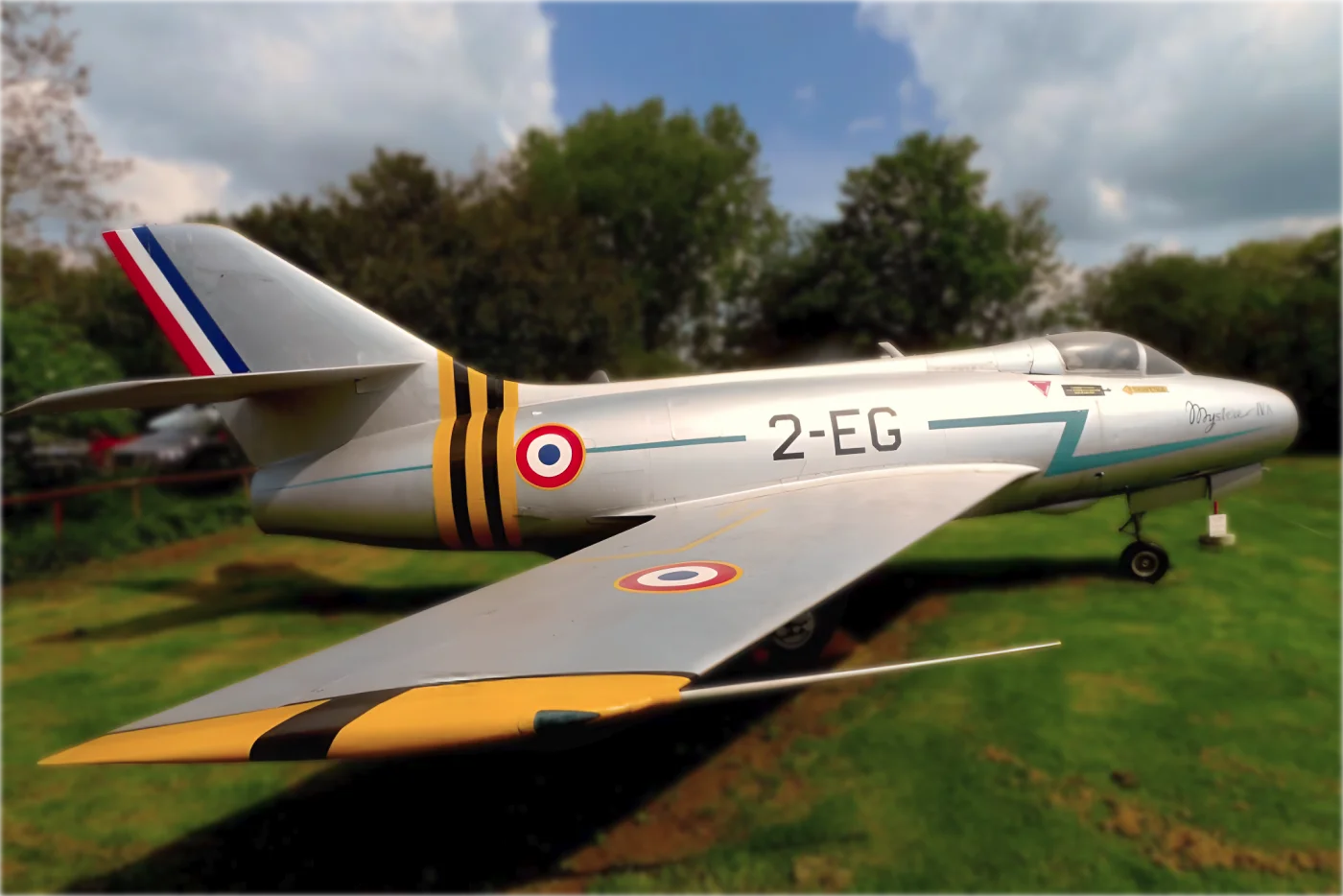
In the latter half of the 1950s, a new French fighter began tearing across European skies with a distinctive swept-wing design. With its slender fuselage, rakish lines, and the piercing howl of its Hispano-Suiza Verdon turbojet engine, the Dassault Mystere IVA cut an imposing figure as one of the first European-built supersonic interceptors of the jet age.
Slipping behind the control stick, you found yourself surrounded by a array of analog flight instruments and gauges typical of the era. Despite its state-of-the-art design for the time, the Mystere IV’s cockpit layout maintained a remarkably straightforward and uncluttered feel compared to modern fighter jets.
For the young cadre of pilots from France’s Armee de l’Air who first climbed into the Mystere’s cockpit in the late 1950s, it was a visceral coming of age in the fledgling years of supersonic jet aviation. More maneuverable than the American F-100 Super Sabre and faster than the British Hunter, the “Mystere” or “Mystery” in English encapsulated the radical new aviation frontier opening up in those heady post-war years.
To fully appreciate the Mystere IVA, it’s important to understand the origins that spawned this revolutionary fighter design from the drawing boards of Dassault Aviation in the early 1950s. As World War II drew to a close, French designers realized their new jet warplanes would need a radically different approach compared to propeller-driven aircraft of the past. Transonic and supersonic flight regimes required aerodynamic refinements like swept-wings to prevent shock wave buildup. With this in mind, Dassault developed the Mystere II prototype as France’s first swept-wing fighterjet designed for high-speed performance using new aviation concepts like area-ruling for supersonic flight. Though successful, the Mystere II was ultimately outclassed by other contemporary straight-wing designs like the American F-86 Sabre and Soviet MiG-15.
This led to the significantly improved Mystere IV which was built around the newly developed Hispano-Suiza Verdon turbojet engine and an even more refined fuselage and swept delta wing. First flying in 1952, the Mystere IV promised to be a true game-changer in European fighter design. With its supercritical 45-degree wing sweep, the new fighter could exceed Mach 1 in level flight. Other cutting-edge improvements included a reinforced fuselage heat shield, an all-moving tailplane, and armament of twin 30mm cannon. Despite these impressive capabilities on paper, Dassault engineers quickly realized the Mystere IV prototype had stability and control issues – especially during high speed maneuvering and when fired upon. The short endurance and lack of radar were also glaring weaknesses that generated demand for a more robust, combat-capable variant.
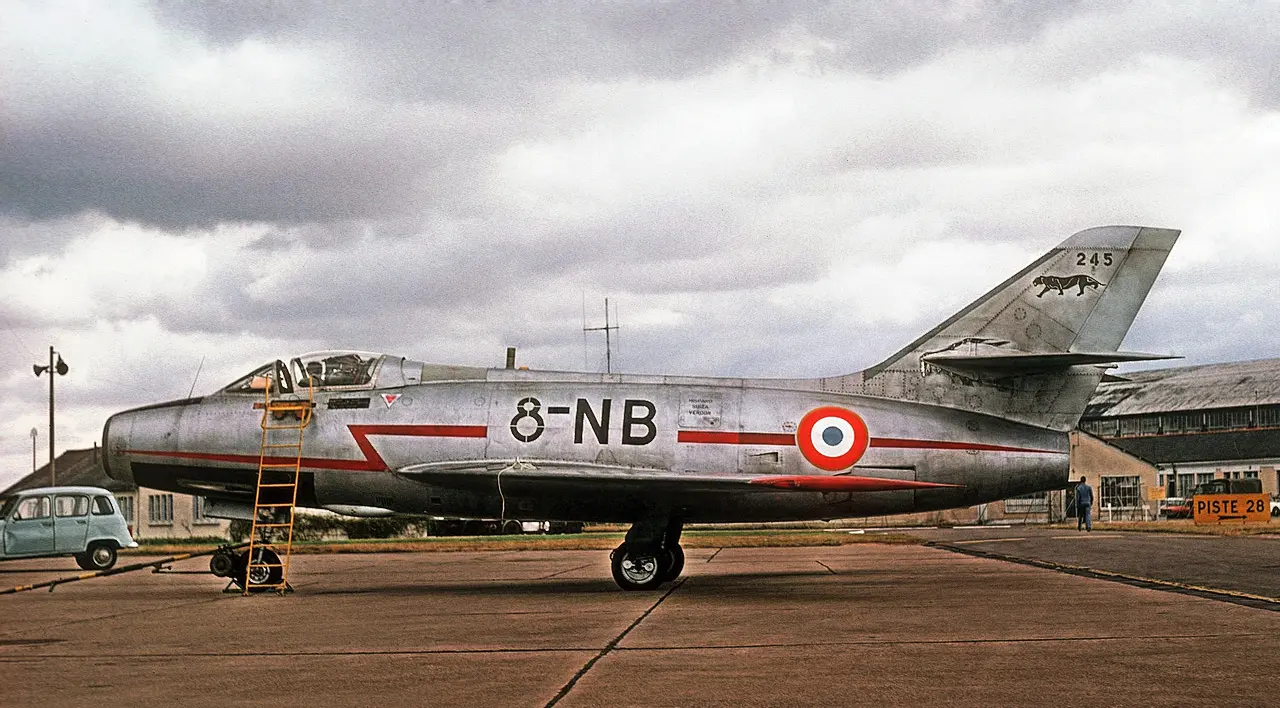
Our Aircraft 8-NB (ours is painted with the registration 2-EG) in its operational days at Chateaudun LFOC in France.
Enter the improved Mystere IVA production model which first entered service in early 1957. To meet the demands of frontline service, the IVA featured a more powerful Verdon turbojet, an advanced Aimee radar system, provisions for auxilliary fuel tanks, and most importantly, the addition of an all-new stability augmentation system to help tame the aircraft’s vicious pitch-up behavior at high speeds. With a combat radius over 300 miles and newly installed cannon reving, the Mystere IVA gave the Armee de l’Air its first truly capable all-weather interceptor aircraft. Pilots accustomed to the docile flight characteristics of trainers or piston-engine fighters found the Mystere “a brute to handle.” But for those who could master its tricky controls and counterintuitive handling at high Mach, it was an unparalleled experience in wrangling blistering straight-line performance.
Tales swirled of young Mystere IVA fliers coping with brutal acceleration forces, violent control inputs, and the dizzying effects of compressibility during screaming supersonic intercepts. It took every ounce of their willpower to muscle the sleek fighter into the high transonic and supersonic corners of its flight envelope, coaxing it through that crucial sound barrier like threading a needle with a very stubborn stallion. At those extreme velocities, the Mystere exuded a brutal purity as an interceptor machine optimized for raw speed over all else. Contemporaries like the F-104 Starfighter or Lightning interceptor had the luxury of advanced flight control systems and ballistic profiles. But flying the French fighter was largely a manual effort of ensuring the aircraft didn’t rip itself apart. One slip of the control stick could spell instant doom.
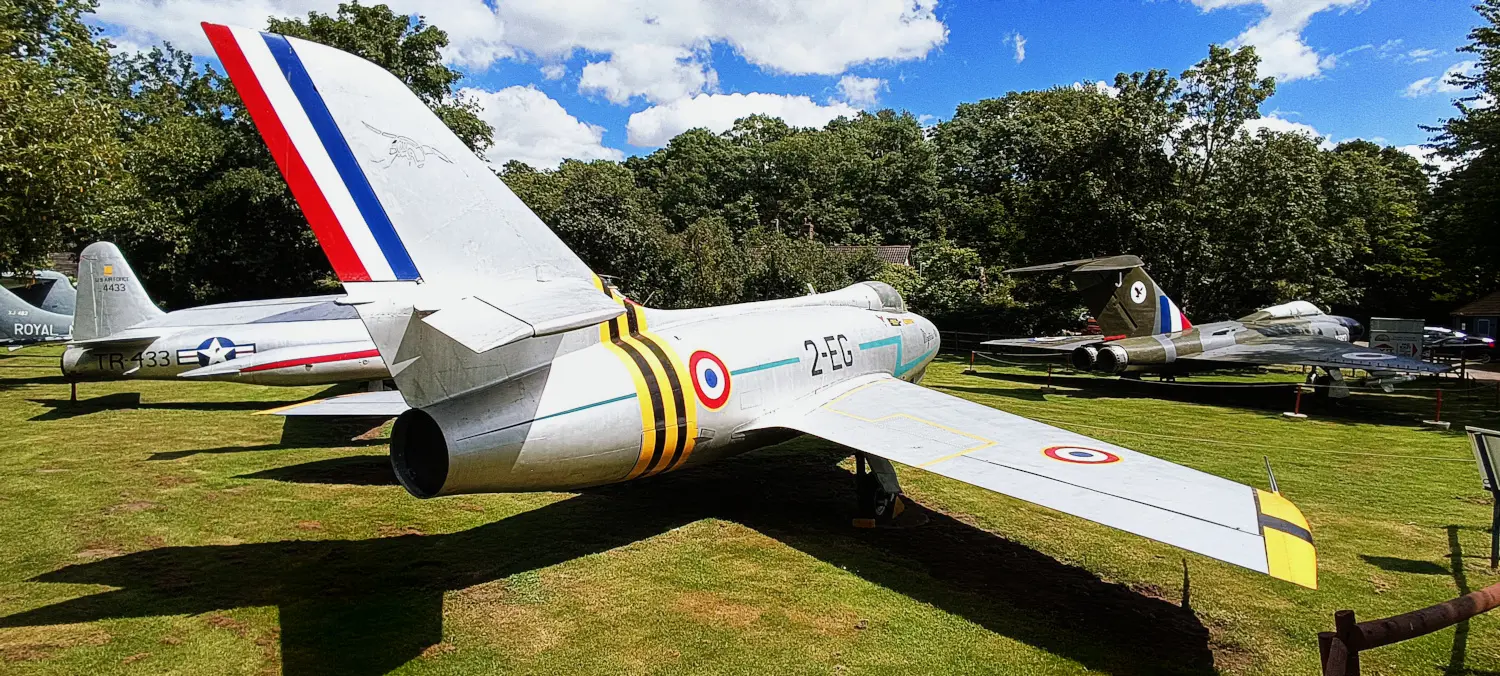
Former pilots recount the Mystere IVA pitching and bucking in their grasps like a wild animal while shattering the sound barrier. The old school hydraulic controls demanded perpetual micro-adjustments to keep the fighter on an even keel as it surfed its own sonic shockwave. Its short conical nose paid dividends in limited forward visibility during final intercept and gunfire runs. But the immense propulsion forces also meant pilots had to constantly stuff the control stick forward to counteract the incredible engine-induced pitch-up at those incredible velocities.
First and foremost, the Mystere was a product of true warbird mentality that favored brute force performance over automated luxuries. Everything from its stripped down cockpit aesthetics to its uncompromising swept-wing design signaled a jet meant to go fast and hit hard – finer points be damned. It had been purpose-built to climb and accelerate like a vertically-launched missile for one simple objective – to attack and destroy any hostile aircraft before they could reach French airspace.
A procurement order for 225 production models was placed by the USAF in April 1953, followed by a French order for 100. The type entered service in 1955. Altogether, 421 were built including orders from India and Israel. The latter country used them in combat against Egyptian MiG-15s in the Sinai campaign in 1956 and again in 1957.
When the Mystere entered service during the late 1950s, it constituted a stark warning shot against the backdrop of Cold War tensions that France was ready to field its own fearsome new interceptor against any provocation from the Soviet sphere. In some respects, the IVA was a perfect reflection of the fiercely independent Gallic spirit of that era – brilliant but stubborn, raw but effective, and dripping with futuristic mystique even as it clung to proven aeronautical concepts. But the Mystere’s arrival also proved curiously anti-climactic, at least on the European mainland. For all its advanced performance, the IVA spent nearly its entire service tenure monitoring friendly skies while the United States and Soviet forces did most of the saber rattling on the world stage.
This role of aerial constable ultimately proved the fighter’s main task until the IVA was supplanted by newer Dassault designs like the Mirage III starting in the mid 1960s. When the last Mystere IVAs were withdrawn from service in 1983, they’d served over a quarter century on the frontlines as France’s first true supersonic interceptor. Its high-altitude speed capabilities ensured the Mystere IVA would be remembered as the vanguard of modern jet aviation in Europe. And yet the aircraft seemed almost a quaint throwback in some ways – a jet equally adept at shattering the sound barrier as it was ripping the airframe apart with its outrageous acceleration and torque. There was a visceral appeal to this “Jekyll and Hyde” duality that endeared many aircrews to their demonic mistress.
Even today, aviation aficionados around the globe rhapsodize about the Mystere’s paradoxical mixture of revolutionary innovation combined with rudimentary construction. While one of the first high-speed fighter designs to incorporate features like a delta wing and area-ruling, its manual control linkages, ejection seats and armaments were straight out of World War 2 aviation.
So while its top speed and delta wing foretold the coming jet revolution, the Mystere IVA’s handling quirks and unforgiving flight characteristics hearkened back to an age when piloting skills meant life or death in any situation. Its shrill turbojet whine made it sound like a runaway banshee as it executed a sonic boom acceleration run. Flying it at those high Mach numbers, its controls grew so heavy that only a pilot with superhuman strength and dexterity could hope to tame its vicious pitch up and roll tendencies.
Most combat pilots would take a hard pass on wrangling a high maintenance thoroughbred like the Mystere in the modern era of unstable, computer-aided flight control systems and relaxed stability designs. But for the bold few who dared claw their way into its transonic regimes during its 1950s and 60s heyday, the Mystere IVA represented a last furious gasp of antiquing “seat of the pants” jets before aviation advanced beyond the physical limitations of humans. Strapping into that fighter was a singular test of courage, leaving no room for error at the outrageous speeds it could achieve. The Mystere reminded us that pure bravery and skill will always be required to conquer the sound barrier.
Dassault Mystère IVA — Serial 8-NB (later 2-EG)
Mystère IVA serial 8-NB, later re-coded 2-EG, served with the Armée de l’Air during the 1950s and 60s as part of France’s post-war fighter force. Originally assigned to Escadron de Chasse 1/8 “Maghreb”, based at Nancy-Ochey Air Base, this aircraft played a role in France’s NATO tactical air posture during the Cold War.
The aircraft later served with EC 2/2 “Côte d’Or”, and its tail code changed accordingly to 2-EG. As with many Mystère IVAs, it was primarily employed in a fighter-bomber role, with secondary use in weapons and tactics training.
Following retirement from operational duty, rather than being scrapped or exported, this airframe was preserved and eventually transferred to the United Kingdom, where it found a home in May 1978 at RAF Sculthorpe in Norfolk and was then placed on loan to our Museum by the USAF.
Today, Mystère IVA 8-NB (2-EG) is on public display in the museum’s outdoor collection. It retains its original French markings and makes for an unusual and distinctive exhibit in a British aviation museum, offering a rare glimpse of French Cold War design and technology. It is displayed in markings of 2-EG, appropriate to an aircraft of the French Air Force operating during the Suez crisis. Its presence also symbolises the broad NATO cooperation of the era, even if it was never operated by British forces.