
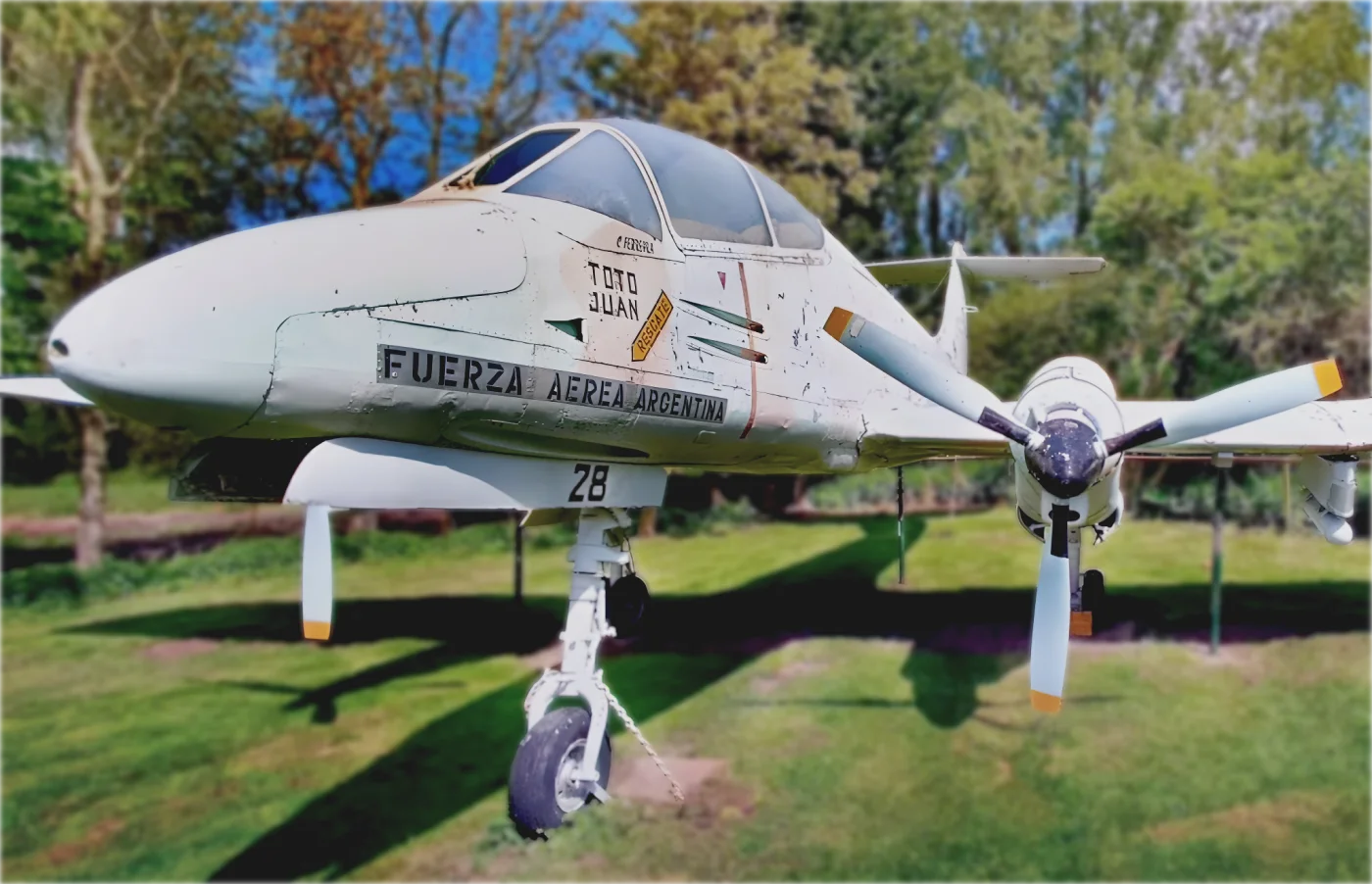
The FMA IA 58 Pucará, a twin-turboprop ground-attack and counter-insurgency (COIN) aircraft, stands as a testament to Argentina’s aerospace industry. Developed by the Fábrica Militar de Aviones (FMA), the Pucará, meaning “fortress” in Quechua, lived up to its name during its most famous deployment in the Falklands War. This article explores the aircraft’s history, flying characteristics, capabilities, and its significant role in the 1982 conflict.
The Pucará’s story begins in the 1960s when the Argentine Air Force identified a need for a rugged, versatile aircraft capable of operating from unprepared airstrips. The FMA, under the leadership of Brigadier Héctor Eduardo Ruiz, began design work in 1966. The result was an aircraft that combined the slow-speed performance necessary for close air support with the durability required for austere operations. The first prototype flew on August 20, 1969, with production beginning in 1974. The Pucará quickly gained a reputation for reliability and versatility, qualities that would prove crucial in its operational career.
Climbing into the Pucará’s cockpit, pilots are greeted by a compact, well-organized environment typical of attack aircraft. The tandem seating arrangement places the pilot in the front seat with the observer/weapons operator behind. This configuration provides the pilot with excellent forward visibility, crucial for low-level operations and target acquisition. The instrument panel in the front cockpit is logically arranged, with flight instruments centrally located and engine gauges easily visible. The control stick, positioned between the pilot’s legs, falls naturally to hand. The throttle quadrant, located to the pilot’s left, allows for precise power management of the two Turbomeca Astazou XVIG turboprop engines. Communication between the crew members relies on the intercom system, as direct visual contact is limited by the tandem layout. The rear cockpit, occupied by the observer/weapons operator, has a more limited view but is equipped with essential flight instruments and specialized equipment for navigation and weapons management. This arrangement allows for an efficient division of tasks during combat missions, with the pilot focusing on flying and the rear crew member handling navigation, communication, and weapons systems.
As the Pucará accelerates down the runway, pilots appreciate the aircraft’s robust landing gear, designed for rough field operations. The take-off roll is relatively short, typically around 800 meters at maximum take-off weight, showcasing the Pucará’s STOL (Short Take-Off and Landing) capabilities. Once airborne, the climb rate of approximately 1,900 feet per minute allows for quick ascents to operational altitudes. The aircraft’s high wing design provides excellent ground visibility during the climb, a crucial feature for its close air support role.
At typical operating speeds, the Pucará exhibits stable and predictable handling characteristics. The controls are well-harmonized, allowing for precise maneuvering. The aircraft’s design prioritizes low-speed handling, crucial for its ground attack mission.
One of the Pucará’s most notable features is its ability to fly slowly without compromising stability. This capability allows pilots to loiter over target areas for extended periods, ideal for reconnaissance and precision strike missions. The twin-engine configuration provides an added layer of safety, with the Pucará capable of maintaining altitude on a single engine. This redundancy proved valuable in combat situations, enhancing the aircraft’s survivability.
Approaching for landing, the Pucará’s STOL capabilities come to the fore. The effective flaps and robust landing gear allow for approaches to short, unprepared strips. Pilots appreciate the excellent visibility over the nose during the landing phase, crucial for operations in austere conditions. The aircraft’s crosswind handling is generally good, thanks to its tricycle landing gear configuration and responsive controls. The propellers’ reverse thrust capability enables short landing rolls, further enhancing the Pucará’s ability to operate from forward airfields.
The Pucará’s design philosophy prioritized versatility and durability over pure performance. This approach resulted in an aircraft uniquely suited to its intended roles. Key performance figures:
- Maximum speed: 500 km/h (310 mph) at sea level
- Cruise speed: 430 km/h (267 mph)
- Range: 1,000 km (620 miles)
- Service ceiling: 10,000 m (32,800 ft)
- Rate of climb: 9.1 m/s (1,791 ft/min)
The Pucará’s armament was impressive for an aircraft of its size:
- Two 20 mm Hispano-Suiza HS.804 cannons in the lower fuselage
- Four 7.62 mm FN Browning machine guns in the wings
- Up to 1,500 kg (3,307 lb) of weapons on three hardpoints
This armament mix allowed the Pucará to engage a wide range of targets, from infantry to light armored vehicles. The aircraft could carry bombs, rocket pods, and even air-to-air missiles, though the latter were rarely used.
The Pucará in the Falklands War
The Falklands War of 1982 thrust the Pucará into the international spotlight. Argentina deployed a significant number of these aircraft to the Falkland Islands, where they played a crucial role in the conflict. At the outbreak of hostilities, Argentina quickly moved Pucarás to the islands. Operating primarily from Port Stanley Airport and auxiliary strips on East Falkland, these aircraft were tasked with providing close air support to Argentine ground forces and conducting reconnaissance missions.
The Pucará’s first combat mission occurred on May 1, 1982, when two aircraft attacked British forces near Port San Carlos. Throughout the conflict, Pucará pilots demonstrated remarkable courage, often flying at extremely low altitudes to evade British air defenses and deliver accurate fire support.
The Falklands War revealed both the strengths and limitations of the Pucará. Its ability to operate from short, rough airstrips proved invaluable, allowing Argentine forces to maintain an air presence despite British attacks on main airbases. The aircraft’s low-speed handling and excellent visibility made it effective in the ground attack role. Pucará pilots were able to provide close support to Argentine troops, often operating in weather conditions that grounded more sophisticated aircraft. However, the conflict also exposed the Pucará’s vulnerabilities. Its relatively slow speed and limited defensive systems made it susceptible to attack from British Sea Harriers and ground-based air defenses. Several Pucarás were lost to Harrier attacks and British Special Forces operations.
One of the most famous Pucará actions of the war occurred on May 28, 1982, when a pair of aircraft attacked British positions near Goose Green. Despite intense anti-aircraft fire, the Pucarás pressed home their attack, providing crucial support to Argentine ground forces.
In a unique engagement on June 8, a Pucará pilot, Lieutenant Cruzado, spotted a British Sea King helicopter and engaged it with cannon fire. While the helicopter escaped, this rare air-to-air engagement highlighted the Pucará’s versatility.
By the end of the conflict, Argentina had lost a significant number of Pucarás, both to enemy action and to deliberate destruction to prevent capture. The British forces captured several intact examples, with one eventually being flown to the UK for evaluation. Despite these losses, the Pucará’s performance in the Falklands War was generally considered commendable given the challenging circumstances. The aircraft’s ruggedness and ability to operate in austere conditions earned it respect from both sides of the conflict.
The Falklands War brought international attention to the Pucará, leading to interest from other nations facing counter-insurgency challenges. While large-scale export orders did not materialize, the aircraft continued to serve effectively in Argentina’s inventory. In the years following the Falklands conflict, Argentina upgraded many of its remaining Pucarás. These improvements included enhanced avionics, improved weapons systems, and in some cases, more powerful engines. The Pucará found a new role in counter-narcotics operations, where its low-speed performance and ability to operate from remote airstrips proved valuable. The aircraft has also been used in humanitarian and disaster relief missions, showcasing its versatility beyond military applications.
The FMA IA 58 Pucará represents a unique chapter in aviation history. Designed for a specific set of requirements, it proved its worth in one of the most challenging conflicts of the late 20th century. Its performance in the Falklands War, while not decisive, demonstrated the value of purpose-built COIN aircraft in modern conflicts. For pilots, the Pucará offered a flying experience that blended the responsiveness of a fighter with the practicality of a utility aircraftAs we reflect on the Pucará’s history, particularly its role in the Falklands War, we see an aircraft that punched above its weight. It stands as a testament to Argentina’s aerospace industry and the skill and bravery of the pilots who flew it in combat.. Its ability to operate effectively in austere conditions set it apart from many contemporaries.
The Pucará may not have achieved widespread fame or export success, but its impact on military aviation, particularly in the realm of counter-insurgency operations, is undeniable. It remains a symbol of Argentine engineering prowess and a reminder of the complex realities of modern warfare.
The fate of the Pucará A-528 (Argentine Aviation):
With the G3A on March 22, 1982, total flight hours 522.45.
It flew to Port Stanley on April 9, 1982, and from there to Goose Green on April 29, 1982.
After May 1, 1982, it returned to Port Stanley. When it was inspected after June 14, 1982, it was found to be in precarious condition. Although it remained airborne, it had broken propeller blades, damage to the nose, and shrapnel impacts under the cockpit.
Light camouflage scheme, without yellow stripes. The name ” TOTO JUAN” was inscribed on the left side below the cab.
Transported by a helicopter from No. 18 Squadron, the Chinook ZA720, AL “Contender Bezant,” departed from Port William on that ship for the United Kingdom, arriving in Southampton on September 23, 1982, and from there to the Cosford Aerospace Museum on October 18, 1982. On
November 19, 1982, it returned to Abingdon and departed again on December 13, 1982, for London, where it was exhibited at the Boat Show in January 1983, after which it returned to Cosford for display.
Transferred to the Air Force Museum in Middle Wallop, it arrived by road on May 16, 1985. It remained there (along with the A-533) until the end of July 1983.
The Pucará is the only Argentine-made aircraft that fought in the 1982 war. There were 24 aircraft in charge of offensive reconnaissance of the enemy and providing fire support.
None of them returned to Argentine soil, and one even went on to join the British Royal Air Force. The head of that Pucará Airmobile Squadron, Commodore (ret.) Miguel Manuel Navarro, a native of Alta Gracia, Córdoba, recounted the exploits of that pride of the national aeronautical industry to La Voz in 2008.
Miguel “Toto” Navarro piloted the Pucará Alfa 528 during the southern conflict. Along with seven other aircraft, he flew from Resistencia (Chaco), where the III Air Brigade was based, to Comodoro Rivadavia, nonstop, and then went to the Falklands to explore and establish the Cóndor air base in the Darwin territory.
“Its strength lay in being able to operate on unprepared runways, even in very marginal areas, due to the amount of weaponry with which it was equipped,” Navarro recalls.
He also highlighted the Pucará’s great maneuverability, thanks to its turboprop engines, which allow for a tight turning radius.
“But while it could operate from narrow spaces, its low speed meant it couldn’t attack frigates or aircraft carriers. It would be shot down by anti-aircraft artillery as soon as it got close,” explained the former military officer, now a lawyer.
The aircraft that were not lost in combat remained in the Falklands, and five departed for Great Britain, among them the “Toto Juan.” In April 1983, the Pucará A 515 ceased to display the Argentine roundel and was redesignated as ZD 485, bearing British colors. The air forces of Uruguay, Colombia, Sri Lanka, and Mauritania purchased these aircraft for their own equipment.
A 1998 article in La Nación recounts how the aircraft arrived at the Norfolk & Suffolk Aviation Museum in Norwich, in northeast England. There, among aircraft of all origins and eras, is a Pucará from the Falklands War, perfectly identified by its markings and its Argentine registration A528.
The aircraft, which had been damaged by combat in the islands in 1982 and captured by British forces, finally arrived at this civilian museum, which undertook a patient restoration by aviation enthusiasts for whom, once the wars are over, it is necessary to preserve historical evidence.
For this project, the British museum collaborated with an Argentine businessman and pilot, Lorenzo Huffmann, who connected with them by chance.
“On a trip to the United States, I read in an aviation magazine a small notice from that English museum requesting technical data and historical details about an airplane that had an Argentine registration and the names Toto and Juan written on the cockpit,” recounted Huffmann, an executive at Molinos Río de la Plata and a civilian pilot in his free time, and also a member of the private association Aeroamigos, which delivers free aid to remote corners of Argentina.
Huffmann’s search
not only established a relationship by mail with the English museum but also managed to locate the original pilot of that unit, the current commodore Miguel “Toto” Navarro, an Air Force pilot, who shared the plane in the war with the mechanic Juan Muratore.
At first, it wasn’t easy for Huffmann to obtain some of the missing parts of the plane. “Many people argued that there was no reason to collaborate with an English museum. But, fortunately, almost everyone gradually understood that it’s always better to support historical preservation,” he explained.
After collecting the spare parts, Huffmann sent them to the museum through the Argentine embassy in London. Almost finished—only a few details remain—the Pucará is now on display among other aircraft that made history in various armed conflicts of this century.
A testimony from those days:
Retired Commodore Rubén Sassone, a direct participant in the Falklands War almost 37 years ago, recounted to La Voz de la Región part of those days when he served under the command of Toto Navarro.
He said that every year he gets melancholic, especially for those who are no longer with us. “I was on the Pucará, on April 20th, and I experienced the war from the first day to the last.
When I got off the plane in Port Stanley, I thought I was grateful to the commander because we were young and they let us participate.
On the 29th, in Port Stanley, it was a mess because the fleet was already on its way, and we knew it wasn’t going to be resolved peacefully, knowing the warlike history of the British.
We collaborated with all the preparations. We arrived in Darwin on April 30th, and it was like a pasture, with a terribly short runway that the islanders used, but for the Pucará, that tremendous plane, it was enough.”
When he flew his first mission in the Pucará, he said he was afraid of dying, but a controlled fear. They had to take off, and the task was to go and find helicopters on the island opposite. This is called “offensive reconnaissance” to determine what target they could find.
Two Pucarás took off towards the San Carlos Strait, and the Pucará, so noble, flew close to the water, skimming low. In that strait, looking back, I saw a large ship through the fog, and it was a frigate. I wondered, “What are we doing here?” and I reported it, and they gave us the order to leave. Then we flew into the rain without seeing anything and turned back, because in those conditions it was pointless. Then we turned back to Darwin and they warned me to hurry because the runway might close, and the fog obscured it. Without seeing it, Captain Vila guided me by radio, and the sound of the engines led me to the runway. He told me to start descending and then said, “Cut the engines,” even though I never saw the runway.
This tribute is for him and Toto Navarro, the squadron leader. They are alive, and we always get together for drinks and to reminisce, he said emotionally.
The Air Force played a very important role in the Falklands, and I feel proud and reassured that things were being done right, and what confirms this is the enemy.
He said he was a prisoner of the British for 20 days in Darwin, and that ended my career as a pilot; I ended up as a soldier, he said, adding that they showed him a lot of respect. “
They are a warrior people and very professional, and I was surprised by their respect because, despite their dead, there was no hatred.”
One day, he recounted, a superior officer came to complain because in two days they had only eaten one can of food. “I had pâté,” he said, “and told them that when I had time and there was food left over, I would give it to them, but then it happened and we ate like crazy,” he recalled. “In one month I lost 12 kilos, but those were the rules of the game.”