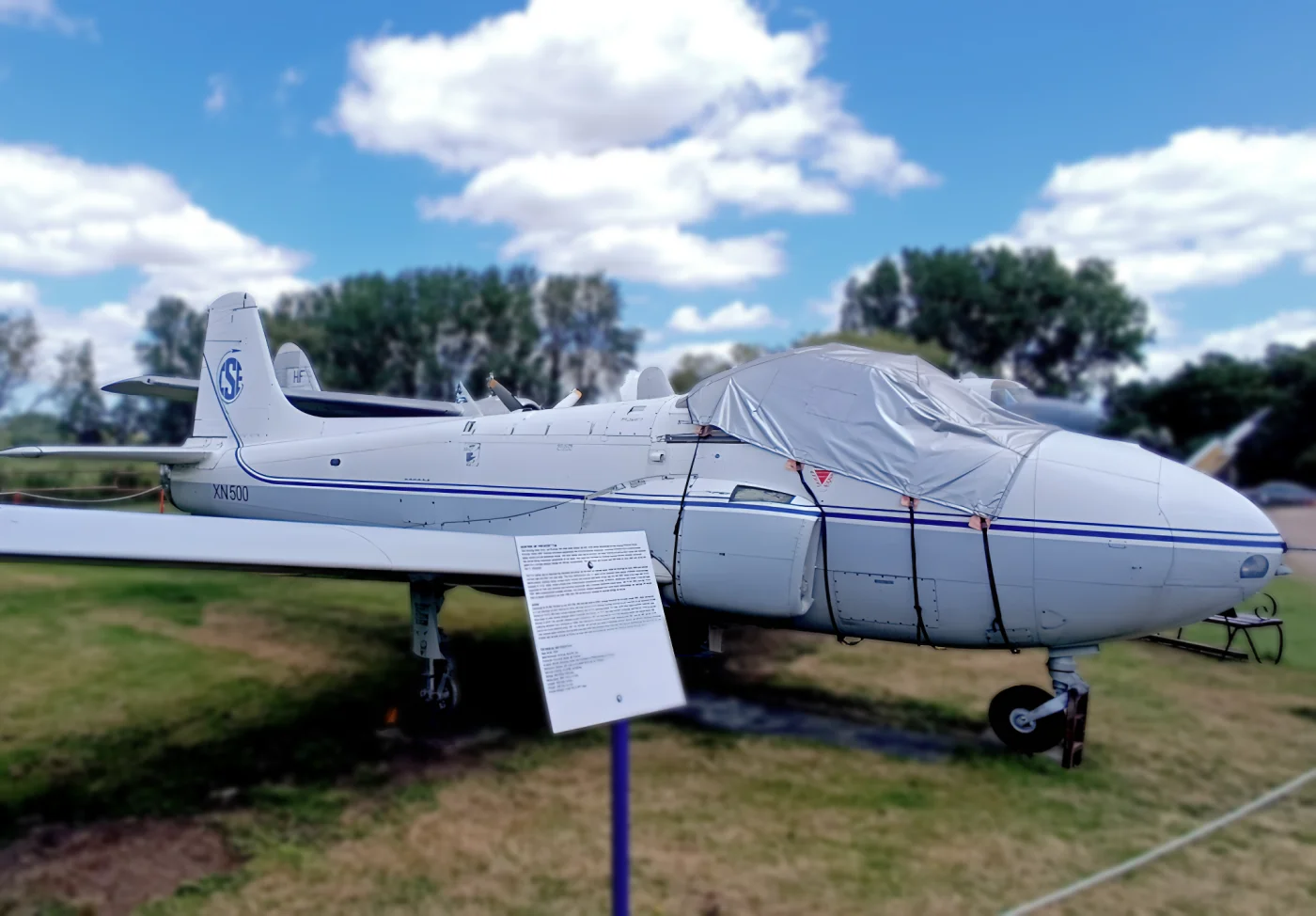
The Hunting Jet Provost T.3A served as the Royal Air Force’s primary jet trainer for several decades. This sleek, single-engine aircraft played a crucial role in shaping generations of RAF pilots and left an indelible mark on military aviation training. Pilots who had the privilege of flying the Jet Provost T.3A often describe it as a joy to handle. The aircraft’s responsive controls and forgiving nature made it an ideal platform for novice pilots transitioning from propeller-driven trainers to jet aircraft. Its cockpit layout was designed with simplicity in mind, allowing students to focus on mastering jet handling without being overwhelmed by complex systems.
The T.3A’s Rolls-Royce Viper turbojet engine provided a smooth and reliable power source, delivering a top speed of around 440 mph. While not blindingly fast by fighter jet standards, this speed was more than adequate for training purposes and gave students a taste of jet performance.
The aircraft’s docile stall characteristics and spin recovery capabilities also made it a forgiving platform for students learning advanced maneuvers. The aircraft’s design emphasized ease of maintenance, with good access to the engine and systems, reducing downtime and increasing availability for training flights.
The Jet Provost T.3A was an evolution of the earlier T.1 and T.2 models, incorporating several improvements. Its capabilities were well-suited to its primary role as a basic jet trainer:
- Performance: With a maximum speed of around 440 mph and a service ceiling of 36,750 feet, the T.3A offered performance that bridged the gap between basic trainers and frontline fighters.
- Range: The aircraft had a range of approximately 900 miles, allowing for extended training sorties and cross-country navigation exercises.
- Cockpit: The side-by-side seating arrangement facilitated effective instruction, allowing the instructor to closely monitor and guide the student pilot.
- Armament capability: While primarily a trainer, the T.3A could be fitted with underwing pylons for light weapons, allowing it to serve in a limited ground attack role if needed.
- Ejection seats: The T.3A was equipped with Martin-Baker Mk.4 ejection seats, providing crucial safety for both student and instructor.
Royal Air Force Service
The Jet Provost T.3A entered RAF service in 1959, quickly becoming the standard basic jet trainer for the force. It was used extensively at RAF training establishments, most notably at RAF Cranwell, the RAF’s officer training college.
The aircraft’s role in RAF training was multifaceted:
- Basic jet training: The T.3A introduced students to jet aircraft handling, including takeoffs, landings, and basic maneuvers.
- Instrument flying: Its stable platform and well-equipped cockpit made it ideal for teaching instrument flight rules (IFR) procedures.
- Navigation: The aircraft’s range and performance allowed for comprehensive navigation training, including long-distance cross-country flights.
- Formation flying: The T.3A’s handling characteristics made it well-suited for teaching the fundamentals of formation flight.
- Aerobatics: While not a high-performance aerobatic aircraft, the Jet Provost was capable of performing a range of aerobatic maneuvers, essential for developing a pilot’s skills and confidence.
The RAF operated several squadrons equipped with the Jet Provost T.3A, primarily focused on training roles. These included No. 1 Flying Training School at RAF Linton-on-Ouse and No. 3 Flying Training School at RAF Leeming.
The Hunting Jet Provost T.3A served the RAF faithfully until the 1990s when it was gradually replaced by the Short Tucano. Its long service life is a testament to its effectiveness as a training platform. Many of the pilots who went on to fly the RAF’s most advanced fighters, including the Harrier, Tornado, and later the Typhoon, got their first taste of jet flight in the cockpit of a Jet Provost.
Royal Navy Connection
While primarily associated with the RAF, the Jet Provost also had a connection to the Royal Navy. Although not used for carrier operations, the Royal Navy utilized a small number of Jet Provosts for land-based training of naval aviators. This allowed naval pilots to gain jet experience before transitioning to more advanced aircraft specific to naval operations.
Active Service
Despite being designed primarily as a trainer, the Jet Provost did see limited active service. During the 1960s and 1970s, export versions of the aircraft were used by several air forces for light attack and counter-insurgency operations. While the RAF did not deploy the T.3A in combat roles, its ability to carry weapons made it a versatile platform for training in ground attack techniques.
The Hunting Jet Provost T.3A, with its blend of performance, reliability, and training effectiveness, left an enduring legacy in the annals of military aviation training. It stands as a symbol of an era when jet training was coming of age, playing a crucial role in maintaining the RAF’s position as one of the world’s premier air forces.
Our Jet Provost 55-443
This aircraft on display was one of a total of 1,058 machines supplied under the Mutual Defence Aid Programme to Europe and served with the French Air Force at Nancy and Sonteux between 1956 and 1978.
Previously, it served with the 20th FBG And 803rd FBG USAF.
It was returned to RAF Sculthorpe in Norfolk at the end of its service life and placed on loan to the museum in 1978 by the USAF