
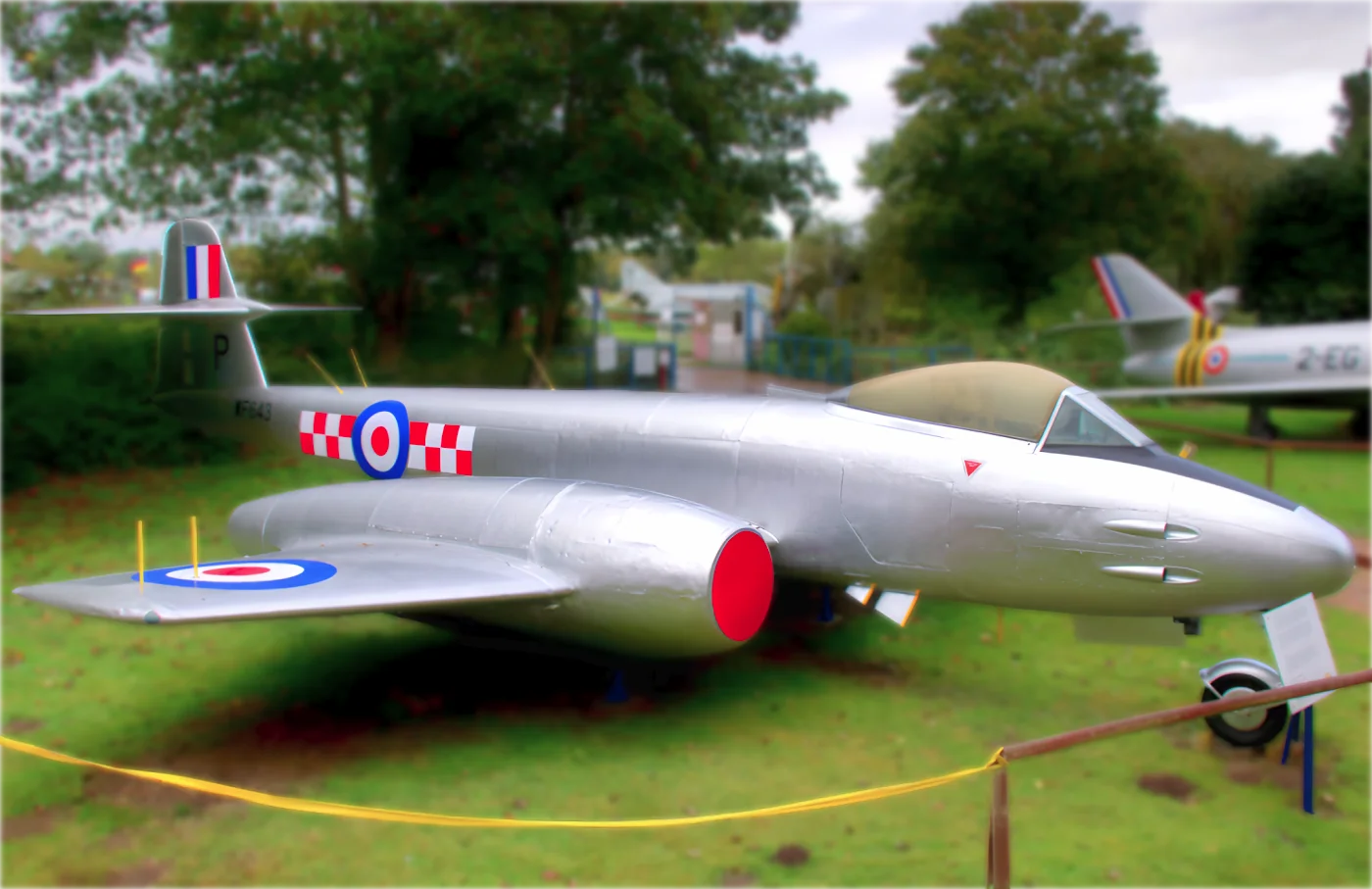
As the RAF’s first operational jet fighter, the Gloster Meteor holds a special place in aviation history – it was the first jet aircraft to go into service with the RAF and the only Allied jet to see action in World War II. The design began in 1940 but Gloster’s first experimental jet aircraft, the E 28/39, made its initial flight at Cranwell in May 1941 powered by a single 860lb thrust Whittle W.1 turbojet engine. The Luftwaffe ME-262 was the worlds first jet fighter entering service just a few months before the Meteor. 616 Squadron received the first Meteors in July 1944 and the Meteor joined the fight against the German flying bombs and later saw service in the Continent.
Among its many variants, the F(TT).8 stands out as a testament to the aircraft’s versatility and longevity. This target tug version of the venerable Meteor continued to serve long after its fighter counterparts had been retired, providing essential training services for a new generation of pilots and air defense systems.
Climbing into the cockpit of a Meteor F(TT).8, pilots were greeted by a familiar layout that had changed little since the aircraft’s introduction in World War II. The controls were robust and mechanical, a far cry from the fly-by-wire systems of modern jets. Twin Rolls-Royce Derwent engines, mounted in pods under the wings, provided the power – their distinctive whine a hallmark of early jet aviation. Taking off in a Meteor was an experience that bridged two eras of flight. The acceleration was noticeably more potent than piston-engined aircraft, but not as neck-snapping as later jets. As the aircraft gathered speed, pilots would feel the controls become more responsive, the Meteor’s thick wings generating substantial lift even at relatively low speeds. Once airborne, the Meteor F(TT).8 revealed its true character. It was stable and predictable, qualities that made it ideal for its target tug role. The aircraft could comfortably cruise at around 400 mph (640 km/h), with a top speed approaching 600 mph (965 km/h) – respectable figures for its era, though no longer cutting-edge by the time the F(TT).8 entered service.
One of the most challenging aspects of flying the Meteor F(TT).8 was managing its target-towing equipment. The aircraft was fitted with a winch system that could deploy a target drogue on a long cable. Pilots had to carefully monitor the deployment and retrieval of this target, ensuring it didn’t snag or cause stability issues during flight. Despite its specialized role, the F(TT).8 retained much of the handling characteristics that had made the Meteor popular with pilots. It was responsive to control inputs, with a good rate of roll and pitch authority. However, it lacked the raw speed and agility of newer jet fighters, a reminder of how quickly aviation technology was advancing.
The Meteor story begins in the early 1940s, as Britain raced to develop jet propulsion technology in the midst of World War II. Gloster Aircraft Company, building on their experience with Frank Whittle’s jet engine designs, produced the Meteor as Britain’s answer to Germany’s Me 262. The first Meteors entered service with the RAF in July 1944, primarily in the interceptor role against V-1 flying bombs. These early models, while groundbreaking, suffered from limited range and reliability issues common to early jet engines. However, they proved the viability of jet propulsion in combat aircraft and paved the way for rapid development in the post-war years. As the war ended, Gloster continued to refine the Meteor design. The F.4 variant, introduced in 1946, represented a significant leap forward in performance and became the definitive fighter version of the aircraft. Powered by more powerful Rolls-Royce Derwent engines, the F.4 was capable of speeds over 600 mph, making it one of the fastest aircraft in the world at the time.
The Meteor’s career as a front-line fighter was relatively short-lived, however. By the early 1950s, swept-wing designs like the Hawker Hunter and Supermarine Swift were pushing performance boundaries beyond what the straight-winged Meteor could achieve. But rather than fade into obsolescence, the Meteor found new life in specialized roles.
Enter the F(TT).8, a target tug variant developed in the mid-1950s. Based on the T.7 two-seat trainer airframe, the F(TT).8 was modified to carry and deploy towed targets for air-to-air gunnery practice and missile testing. This role capitalized on the Meteor’s stable flight characteristics and robust construction, allowing it to safely tow targets at high speeds and altitudes. The modifications for the target tug role were extensive. A winch system was installed in the rear fuselage, capable of deploying a variety of target drogues on cables up to 8,000 feet long. The aircraft’s electrical system was upgraded to handle the additional power requirements, and a new instrument panel was installed to monitor the target-towing equipment.
Externally, the F(TT).8 was distinguished by a distinctive fairing on the rear fuselage that housed the winch mechanism and target storage area. This gave the aircraft a somewhat ungainly appearance compared to its sleeker fighter predecessors, but functionality took precedence over aesthetics in this utilitarian role.
The Meteor F(TT).8 entered service with the RAF in the late 1950s, primarily operating from coastal airfields where it could tow targets over the sea for safety reasons. It quickly proved its worth, providing a stable and reliable platform for training air defense crews and testing new weapons systems. One of the key advantages of the F(TT).8 was its ability to operate at a wide range of speeds and altitudes. It could simulate everything from slow-moving bombers to high-speed fighter targets, making it an invaluable asset for training. The aircraft could also carry multiple target types, allowing for varied training scenarios in a single sortie.
The F(TT).8’s career with the RAF was long and distinguished. It remained in service well into the 1970s, long after most other Meteor variants had been retired. This longevity was a testament to both the aircraft’s suitability for its specialized role and the fundamental soundness of the original Meteor design. Beyond the RAF, the Meteor F(TT).8 found export success, serving with several other air forces around the world. The Belgian Air Force, in particular, made extensive use of the type, operating it until the early 1980s. The F(TT).8 also saw service with private contractors, who operated the aircraft on behalf of various air forces for target-towing duties.
For the pilots who flew it, the Meteor F(TT).8 represented a unique challenge. While it lacked the excitement of frontline fighter operations, it required a high degree of skill and concentration. Towing targets at high speeds demanded precise flying and constant situational awareness. The added complexity of the target-towing equipment meant that pilots had to be part aviator, part technician. One former RAF pilot recalled, “Flying the F(TT).8 was like nothing else in the inventory. You had all the responsibility of flying a jet, plus the added complication of managing a several-thousand-foot cable with a target on the end. It kept you on your toes, that’s for sure.“
The target-towing missions themselves were often grueling affairs. Flights could last several hours, with the aircraft maintaining a steady course and speed while other aircraft or ground-based systems engaged the towed target. Precision was key – pilots had to maintain exact speeds and altitudes to ensure accurate targeting data for the systems being tested. Despite its unglamorous role, the F(TT).8 played a crucial part in maintaining the readiness of air defense forces during a critical period of the Cold War. It allowed fighter pilots to hone their interception skills and provided a realistic target for the testing and development of new radar and missile systems.
The Meteor F(TT).8’s long service life also meant that it served as a bridge between generations of aviation technology. Pilots who cut their teeth on piston-engined aircraft found in the Meteor a gentle introduction to jet operations. Conversely, for younger pilots accustomed to more advanced jet trainers, the Meteor offered a glimpse into the earlier days of the jet age. As the 1970s progressed, the writing was on the wall for the Meteor F(TT).8. Newer, more capable aircraft were taking over the target-towing role, and the Meteor’s 1940s-era design was becoming increasingly difficult and expensive to maintain. The RAF finally retired its last F(TT).8s in the late 1970s, bringing to a close over three decades of Meteor operations.
Our Meteor WF643
Completed at Baginton by Armstrong Whitworth in 1951 this aircraft served with 56, 1 and 611 Squadrons before being transferred to the Middle East Air Force in 1960 where it was allocated to the Nicosia Flight until 1963. During this period it was flown by 43 Squadron as a “hack” and target-tug.
It then served with 29 Squadron at Akrotiri as a hack and trainer until retired to Kemble in 1965.
In 1973 it went to RAF Coltishall in Norfolk for use as an emergency rescue trainer until purchased by the Museum in 1975 in a poor condition. Items had to be taken from several other Meteors before it was complete again in July 1979.