
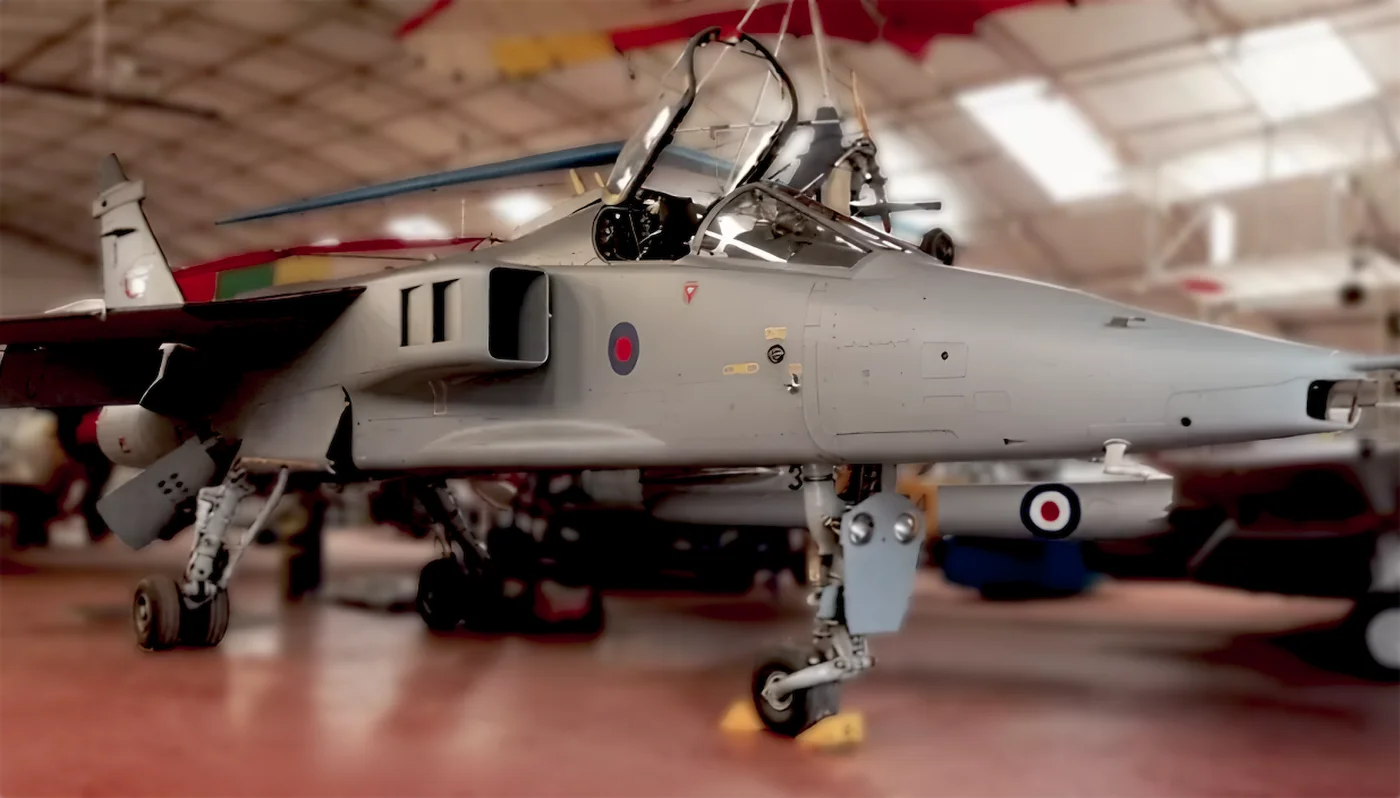
Sepecat Jaguar XX108
- 12 Oct 1972 – First Flight – XX108 was the first production Jaguar GR.1, initially without the later-standard chisel nose, which housed the laser rangefinder and marked target seeker (LRMTS).
- 1974 – Displayed as part of the Jaguar International demonstrator at the Farnborough Airshow, showcasing the type to potential export customers.
- 1979 – Appeared at the Paris Air Show, continuing its role as a high-profile demonstrator.
- Post-1979 – Returned to development trials and test roles, reflecting its special status as the lead production aircraft.
- 1996 – Upgraded to GR.1B standard, giving it the capability to deploy Sea Eagle anti-ship missiles and enhancing avionics.
- 2000 – Used for Adour Mk.106 engine trials, evaluating the performance of the updated Rolls-Royce/Turbomeca turbofan.
- 2002 – Retired from service, flown to RAF St Athan for storage and preparation for preservation.
- Oct 2003 – Transferred to Imperial War Museum Duxford, where it was suspended in the AirSpace hangar to illustrate Britain’s Cold War air power.
- June 2025 – Transferred to NASAM.
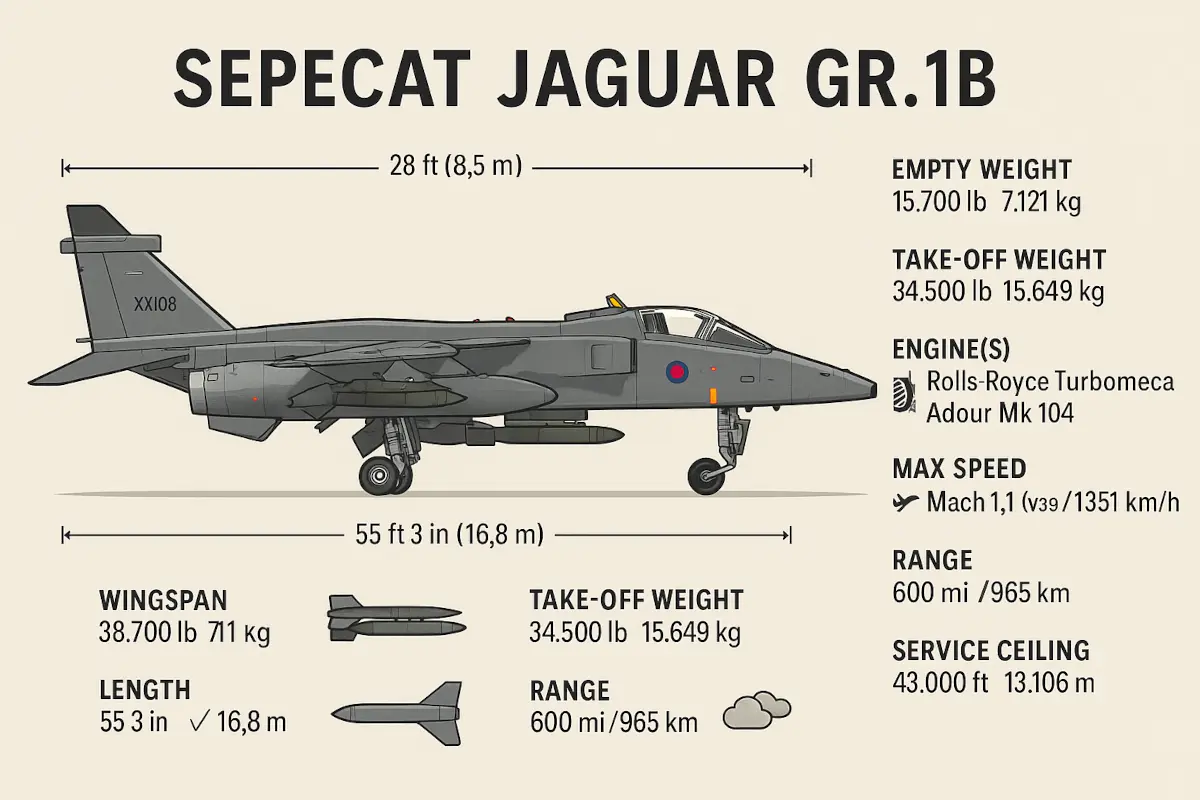
RAF Service History
Development & Origins
- Conceived in the 1960s as an advanced jet trainer/light strike aircraft for both the RAF and French Air Force.
- A collaborative project between British Aircraft Corporation (BAC) and Breguet Aviation (later Dassault) – the SEPECAT joint venture.
- First flew in 1968, and entered RAF service in 1973 as the Jaguar GR.1.
RAF Jaguar Variants
- GR.1 – Original ground-attack and tactical strike version.
- GR.1A – With reconnaissance pod compatibility.
- GR.1B – Sea Eagle anti-ship capable, used in the maritime strike role.
- GR.3 – Final RAF upgrade with new avionics, GPS, and night vision compatibility.
- T.2 / T.4 – Two-seat trainers.
Operational Use
- Designed primarily for low-level strike missions, with exceptional performance in fast, terrain-hugging flight.
- Capable of carrying a wide array of ordnance, including bombs, rockets, cluster munitions, and tactical nuclear weapons.
- Played significant roles in:
- Operation Granby (Gulf War, 1991): Over 600 sorties flown with no combat losses. the SEPECAT Jaguar’s role was significant and is often considered one of its most successful and high-profile combat deployments.
- Balkans operations in the 1990s (Bosnia/Kosovo).
- Cold War deterrence, with nuclear strike responsibilities in NATO.
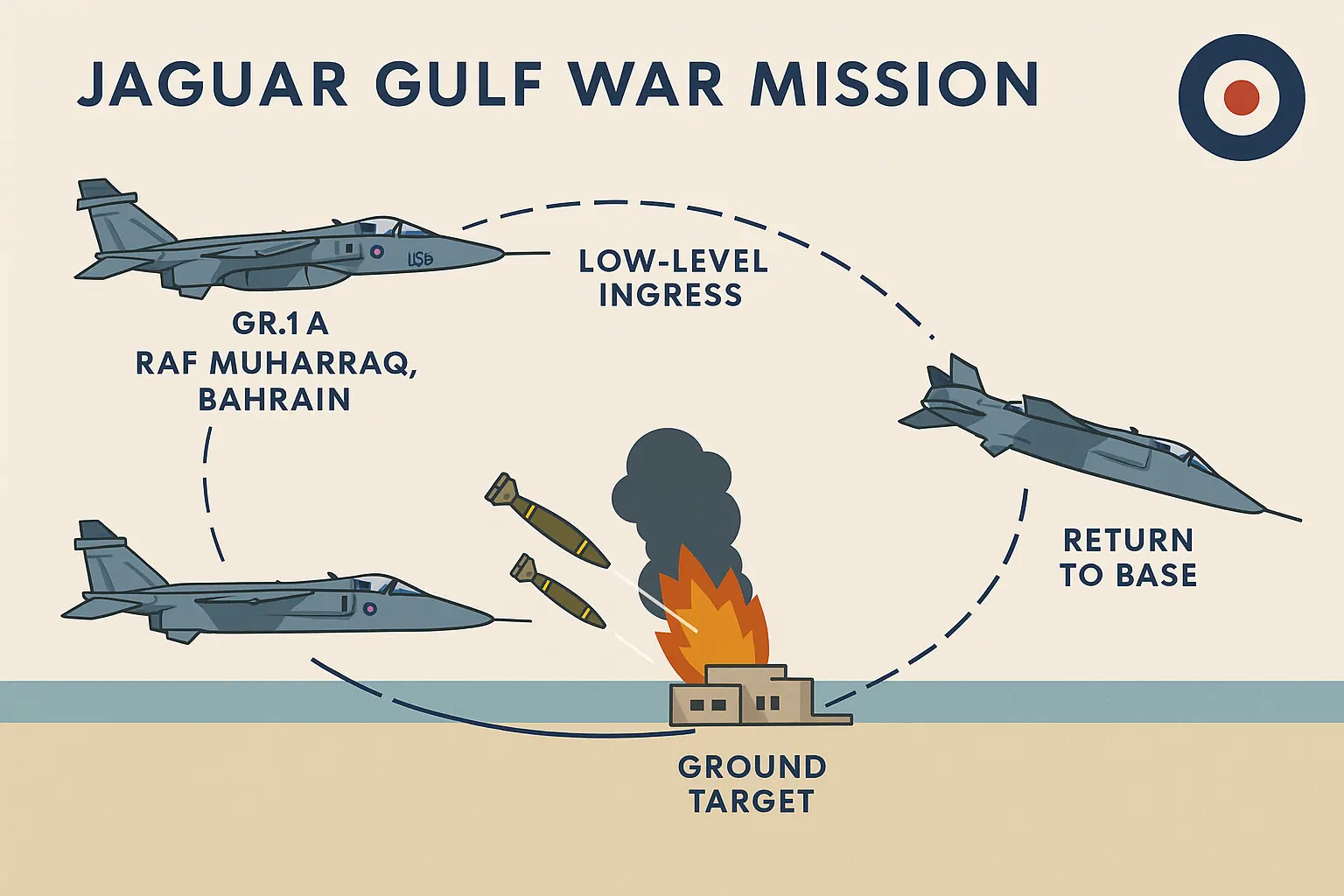
Operation Granby (Gulf War 1991, part of the larger Operation Desert Storm )
Timeline:
- August 1990: Iraq invades Kuwait.
- Late 1990: RAF Jaguars deployed to the Middle East.
- January–February 1991: Air campaign and subsequent ground offensive.
- 28 February 1991: Ceasefire and end of main combat operations.
Jaguar Deployment Overview:
- Deployed Units – No. 6 Squadron and No. 54 Squadron, Royal Air Force
- Base of Operations – RAF Muharraq, Bahrain
- Aircraft Type – Jaguar GR.1A (tactical ground-attack variant with upgraded nav/attack systems)
- Number Deployed – Around 12–16 Jaguars (rotated/augmented as needed)
Primary Roles & Missions:
Tactical Ground Attack – Jaguars were used primarily for precision ground strikes against:
- Iraqi artillery
- Command and control centers
- Airfields
- Vehicle concentrations
- Radar installations
Battlefield Interdiction – Targeted enemy supply lines, convoys, and communication nodes to disrupt Iraqi operations and logistics before ground forces moved in.
Close Air Support (CAS) – Supported Coalition ground forces during the ground offensive phase, often at low altitude using unguided and laser-guided munitions.
Tactics & Execution
- Low-Level Ingress: Jaguars often flew at ultra-low altitudes to avoid radar detection — a role they were specifically designed for during the Cold War.
- Night Operations: Some missions were flown at night, using terrain-following radar and NVG-compatible cockpit lighting.
- Buddy Lasing: RAF Buccaneers with laser designators enabled Jaguars to deliver laser-guided bombs, greatly enhancing strike accuracy.
Performance & Effectiveness
- Combat Sorties – Over 600 combat sorties flown during the conflict
- Aircraft Losses – Zero combat losses among RAF Jaguars
- Mission Success – High strike accuracy, excellent operational availability
- Notable Strengths – Rugged design, desert reliability, precise low-level ops
Despite its age by 1991, the Jaguar proved to be tough, reliable, and accurate, receiving praise for its performance under harsh desert conditions.
Legacy
- The Gulf War demonstrated the Jaguar’s continued relevance in high-intensity, modern combat.
- RAF Jaguars showed that even non-stealthy aircraft could survive and succeed in high-threat environments when used with proper tactics and support assets.
- The war was among the last major combat deployments of the Jaguar before it began to be gradually replaced by Tornado GR1/4 and later the Eurofighter Typhoon.
Retirement
- Gradual drawdown through the 1990s as Tornado and later Typhoon took over strike duties.
- Officially retired from RAF service in April 2007, after over 30 years of service.