
The English Electric Canberra stands as one of the most successful and long-lived aircraft in British aviation history. This remarkable jet bomber and reconnaissance platform served with distinction in the Royal Air Force (RAF) and Royal Navy for over five decades, leaving an indelible mark on military aviation.
The Canberra was born out of Britain’s post-World War II need for a jet-powered bomber capable of high-altitude, high-speed performance. English Electric’s chief designer, W.E.W. Petter, created an aircraft that was ahead of its time, featuring a sleek, aerodynamic design and powerful jet engines.
Key features of the Canberra included:
- Twin Rolls-Royce Avon turbojet engines
- Large, unswept wings for excellent high-altitude performance
- Spacious bomb bay capable of carrying a variety of payloads
- Adaptable design allowing for multiple variants
The first Canberra prototype flew on May 13, 1949, and the aircraft entered RAF service in 1951 as the B.2 bomber variant.
Pilots who flew the Canberra often speak of its responsive handling, impressive performance, and versatility.
Climbing into the Canberra’s cockpit, pilots are greeted by a spacious environment with excellent visibility. The large bubble canopy provides an expansive view, crucial for both low-level attack missions and high-altitude reconnaissance. The instrument panel is well-organized, with flight instruments centrally positioned and engine gauges easily visible. The control column and throttles fall naturally to hand, allowing for precise control of the aircraft.
As the throttles are advanced for take-off, pilots feel the impressive thrust of the two Rolls-Royce Avon engines. The Canberra accelerates quickly, becoming airborne at around 125 knots. Once airborne, the aircraft’s excellent climb rate becomes apparent. With a sea-level climb rate of over 3,600 feet per minute, the Canberra can rapidly reach its operational altitude. At typical cruise speeds, the Canberra exhibits stable and responsive handling characteristics. The aircraft’s large wings provide excellent lift, allowing for efficient high-altitude cruise. Pilots often praise the Canberra’s agility, which is surprising for an aircraft of its size and role.
One of the Canberra’s most impressive features is its high-altitude performance. With a service ceiling exceeding 48,000 feet, it could operate well above the reach of most interceThe Canberra’s handling at low altitudes is equally impressive. Its responsive controls and good visibility make it well-suited for low-level attack missions, a capability that would prove valuable in various conflicts.ptors of its era. This capability made it an excellent platform for both bombing and reconnaissance missions.
Approaching for landing, pilots appreciate the Canberra’s stable handling characteristics. The aircraft’s design allows for relatively low approach speeds, enhancing safety. The effective airbrakes and robust landing gear enable smooth touchdowns, even on shorter runways.
The Canberra’s performance capabilities made it a formidable aircraft throughout its long service life:
- Maximum speed: 580 mph (930 km/h) at 40,000 ft
- Service ceiling: 48,000 ft (14,600 m)
- Range: 3,380 miles (5,440 km)
- Rate of climb: 3,620 ft/min (18.4 m/s)
- Payload: Up to 8,000 lbs (3,629 kg) of bombs
This performance envelope allowed the Canberra to excel in various roles, from high-altitude bombing to low-level reconnaissance and electronic warfare.
The Canberra served extensively with both the RAF and the Royal Navy’s Fleet Air Arm. Notable squadrons and units include:
Royal Air Force:
- No. 10 Squadron: First operational RAF Canberra squadron
- No. 617 Squadron (The Dambusters): Operated Canberras in the strategic bombing role
- No. 39 Squadron: Long-serving photographic reconnaissance unit
Royal Navy Fleet Air Arm:
- 360 Squadron: Joint RAF/RN electronic warfare unit
- 700X Naval Air Squadron: Evaluation and training unit
These units, among many others, employed the Canberra in various roles, showcasing the aircraft’s versatility and adaptability.
The Canberra saw active service in numerous conflicts and operations throughout its long career:
Suez Crisis (1956):
Canberras played a crucial role in the Suez Crisis, conducting bombing raids against Egyptian airfields. Their high-altitude performance allowed them to operate with relative impunity.
Malayan Emergency (1948-1960):
RAF Canberras provided valuable close air support to ground forces fighting communist insurgents in Malaya, demonstrating the aircraft’s low-level capabilities.
Indonesia-Malaysia Confrontation (1962-1966):
Canberras conducted reconnaissance missions and showed force during this period of tension between Indonesia and Malaysia.
Vietnam War:
While not operated by British forces in Vietnam, Australian Canberras served with distinction, conducting bombing missions against Viet Cong targets.
Falklands War (1982):
Canberra PR.9 reconnaissance aircraft played a crucial role in gathering intelligence during the conflict, operating at extreme ranges from Ascension Island.
First Gulf War (1991):
RAF Canberra PR.9s provided valuable reconnaissance capabilities during Operation Desert Storm, showcasing the aircraft’s enduring relevance.
The Canberra’s long operational history is a testament to its versatility and adaptability. From high-altitude nuclear deterrence patrols during the Cold War to low-level tactical bombing in counter-insurgency operations, the Canberra proved its worth time and again.
The Canberra’s success led to the development of numerous variants tailored for specific roles:
- B.2: Initial bomber variant
- PR.3/PR.7/PR.9: Photographic reconnaissance variants
- T.4: Trainer variant with side-by-side seating
- B(I)8: Interdictor/tactical strike variant
- E.15/T.17: Electronic warfare and countermeasures variant
The Canberra T.4 was a specialized trainer variant of the English Electric Canberra, developed to train pilots and navigators for the jet bomber and reconnaissance versions of the aircraft. The T.4 featured a redesigned forward fuselage to accommodate side-by-side seating for the instructor and student, replacing the tandem arrangement of the bomber variants. This configuration allowed for better communication and observation during training flights.
Entering service with the RAF in 1954, the T.4 was used extensively to train crews for various Canberra roles. It also served with the Royal Navy’s Fleet Air Arm and was exported to several countries, including Australia and India. Many T.4s found a second life as target tugs, towing targets for air-to-air gunnery practice, extending their service life well into the 1990s for both the RAF and Royal Navy.
The T.4 was used for:
- Basic and advanced jet handling
- Instrument flying
- Navigation training
- Simulated bombing runs
- High-altitude operations
The Canberra’s capabilities attracted international attention, leading to significant export success. Notable operators included:
- United States Air Force (as the Martin B-57)
- Royal Australian Air Force
- Indian Air Force
- Argentine Air Force
- Venezuelan Air Force
Many of these operators used their Canberras in active conflicts, further proving the aircraft’s effectiveness and versatility.
The Canberra left an indelible mark on military aviation. Its long service life, spanning from 1951 to 2006 in RAF service, is a testament to its excellent design and adaptability. The aircraft pioneered many technologies and operational concepts that would become standard in subsequent bomber and reconnaissance platforms. The Canberra’s impact extended beyond its military service. Its high-altitude capabilities made it valuable for scientific research, including atmospheric sampling and meteorological observations. Several Canberras were used to set altitude and speed records, showcasing British aviation technology to the world.
The English Electric Canberra stands as one of the great success stories of post-war British aviation. From its sleek lines to its impressive performance, the Canberra embodied the rapid technological advancements of the jet age. For the pilots who flew it, the Canberra offered a rewarding and often exhilarating experience. Its combination of speed, altitude performance, and handling made it a joy to fly, whether on high-altitude reconnaissance missions or low-level attack runs. The English Electric Canberra may no longer grace the skies in military service, but its impact on aviation history and its place in the hearts of those who flew and maintained it ensure that it will be remembered as one of the great aircraft of the 20th century.
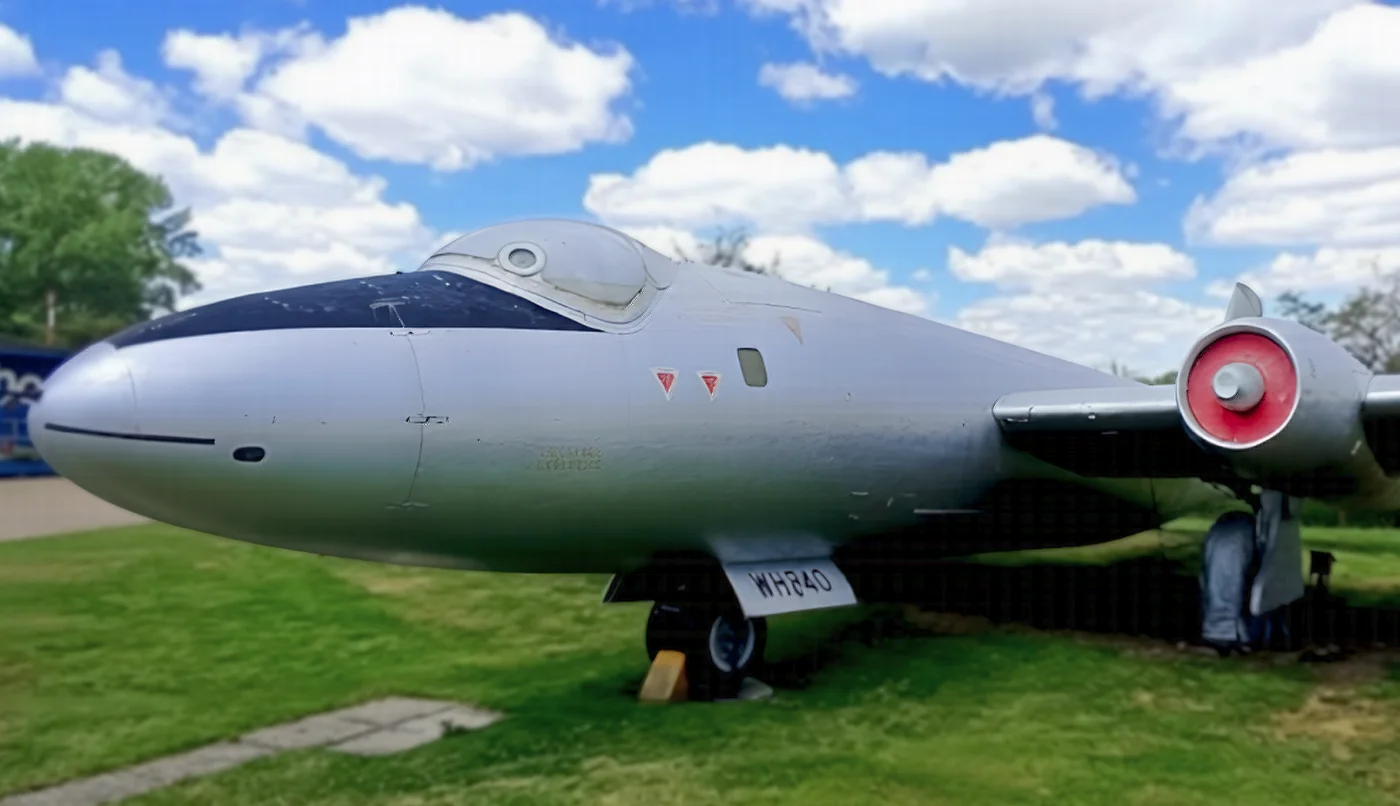
Our Canberra T.4 WH840
Canberra T.4 WH840 was one of the RAF’s dedicated twin-seat training variants of the legendary English Electric Canberra — Britain’s first jet-powered bomber and one of its most successful post-war aircraft. The T.4 version was developed to train pilots and navigators transitioning to the Canberra B.2 and later marks.
Built in the early 1950s by English Electric at their Preston facility, WH840 entered service as part of the RAF’s operational conversion units (OCUs) and flying training schools. As a T.4, it was fitted with a fully duplicated cockpit side-by-side under a long glazed canopy — the most visually distinctive feature of the type — and lacked the bomb bay and offensive capabilities of bomber variants.
WH840 served for many years as a pilot trainer, most likely with units such as No. 231 Operational Conversion Unit (OCU) or No. 7 Flying Training School (FTS). The T.4’s side-by-side seating arrangement made it ideal for advanced jet training and Canberra type conversion, preparing crews for a wide range of reconnaissance and bombing roles.
In its later years, WH840 was withdrawn from flying service and, like many Canberras, avoided scrapping due to its iconic status. The airframe was transferred to the Norfolk and Suffolk Aviation Museum at Flixton, Suffolk, where it is preserved today. It stands as one of the better-preserved examples of a T.4 and is notable for its canopy design, paintwork, and completeness.