
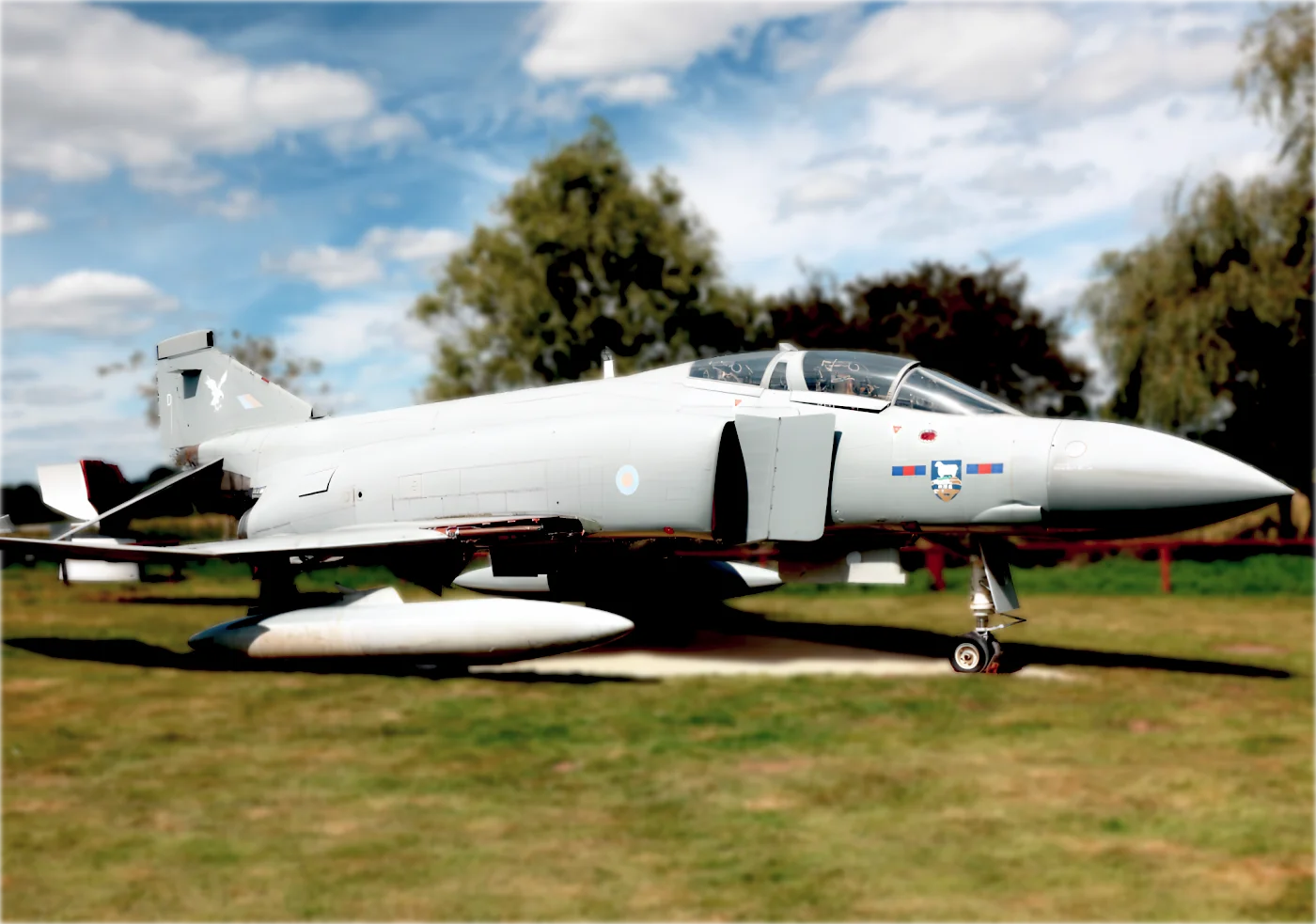
Our Phantom, XV497 RAF, was constructed on the 22nd September 1969. By May 1992 this aircraft was transferred to 74 Squadron, based at RAF Wattisham. In July 2020 we displayed it here at NASAM.
In the annals of aviation history, few aircraft have left as indelible a mark as the McDonnell Douglas F-4 Phantom II. Among its many variants, the FGR2 (Fighter/Ground Attack/Reconnaissance) version stands out as a testament to British ingenuity and adaptation. This rugged, versatile fighter became a cornerstone of the Royal Air Force’s (RAF) Cold War deterrent, serving with distinction for over three decades.
Climbing into the cockpit of a Phantom FGR2, pilots were greeted by a veritable forest of switches, dials, and gauges. The aircraft’s complexity was a far cry from earlier fighters, reflecting its multi-role capabilities. Two powerful Rolls-Royce Spey turbofan engines, replacing the original American J79s, provided the thrust – their distinctive howl becoming a familiar sound over British skies.
Taking off in a Phantom was an experience that showcased raw power. As the throttles were pushed forward, pilots would feel an immense surge of acceleration, the aircraft’s nose lifting skyward as it roared down the runway. The initial climb rate was staggering, with the Phantom able to reach 40,000 feet in under three minutes when lightly loaded. Once airborne, the Phantom FGR2 revealed its true character. It was fast and powerful, capable of speeds over Mach 2 at altitude. Yet it was also surprisingly agile for its size, able to pull high G maneuvers that could push pilots to their physical limits. The aircraft’s versatility shone through in its ability to switch seamlessly between air-to-air combat, ground attack, and reconnaissance roles.
One of the most challenging aspects of flying the Phantom FGR2 was managing its complex weapons systems. The aircraft could carry a vast array of ordnance, from air-to-air missiles to bombs and even nuclear weapons. Pilots and weapons systems officers (WSOs) had to master not only flying the aircraft but also employing its formidable arsenal effectively.
The Phantom FGR story begins in the early 1960s, as Britain sought to modernize its air force in the face of evolving Cold War threats. The original plan was to replace the English Electric Lightning with the advanced BAC TSR-2, but cost overruns led to that project’s cancellation in 1965. In need of a capable multi-role aircraft, Britain turned to the proven F-4 Phantom II. However, rather than simply purchasing off-the-shelf American models, the British government insisted on significant modifications to meet RAF requirements. The most notable change was the replacement of the American J79 engines with more powerful Rolls-Royce Spey turbofans. This engine swap was no small feat. The Spey engines were larger and heavier than the J79s, necessitating substantial airframe modifications. The result was an aircraft with greater thrust and improved low-level performance, but at the cost of some high-altitude speed compared to its American counterpart.
The first Phantom FGR2 was delivered to the RAF in 1968, entering service with No. 6 Squadron at RAF Coningsby in 1969. The aircraft quickly proved its worth, demonstrating capabilities that far surpassed those of the Lightning it was replacing. Its multi-role flexibility allowed it to serve in air defense, ground attack, and reconnaissance roles, often switching between these missions in a single sortie.
In RAF service, the Phantom FGR2 was primarily tasked with three key roles:
- Air Defense: The Phantom’s high speed and powerful radar made it an ideal interceptor. Armed with a mix of Skyflash and AIM-9 Sidewinder missiles, it could engage targets at both long range and in close combat.
- Ground Attack: With its substantial payload capacity and advanced avionics, the Phantom excelled in the strike role. It could deliver a wide variety of weapons, from conventional bombs to precision-guided munitions.
- Reconnaissance: Some FGR2s were equipped with special camera pods, allowing them to perform high-speed, low-altitude reconnaissance missions.
The Phantom’s versatility was put to the test during various deployments and exercises throughout the 1970s and 1980s. RAF Phantoms were regularly deployed to Germany as part of Britain’s commitment to NATO, standing ready to counter any potential Warsaw Pact aggression.
One of the Phantom FGR2’s most notable operational deployments came during the Falklands War in 1982. Although the conflict was primarily fought by naval and ground forces, RAF Phantoms played a crucial role in bolstering the air defenses of Ascension Island, a vital staging post for British forces en route to the Falklands. An additional 15 second-hand F-4J variants, originally from the US Navy, were acquired and extensively refurbished.
For the pilots who flew it, the Phantom FGR2 was both a challenge and a joy. Its high performance demanded respect and skill, but it rewarded competent crews with exceptional capabilities. One former RAF pilot recalled, “Flying the Phantom was like strapping yourself to a rocket. It had power to spare and could outclimb just about anything else in the sky. But it also handled beautifully – you could really throw it around when you needed to.“
The aircraft’s two-man crew arrangement – pilot in front, navigator/weapons systems officer in back – fostered a unique dynamic. The complexity of the Phantom’s systems meant that effective teamwork between the two crew members was essential for mission success. Many crews developed close bonds, their lives literally in each other’s hands during high-speed, low-level missions.
Despite its impressive performance, the Phantom FGR2 was not without its quirks and challenges. Its thirsty engines meant that fuel management was a constant concern, especially on long-range missions. The aircraft’s size and weight made it less maneuverable than some of its potential adversaries, requiring pilots to rely on energy management and tactical awareness in dogfights.
The Phantom’s service with the RAF saw it undergo several upgrades to keep pace with evolving threats. In the mid-1970s, the aircraft received improved radar warning receivers and electronic countermeasures. Later upgrades included the addition of chaff and flare dispensers and compatibility with more advanced weapons like the ALARM anti-radiation missile.
As the Cold War entered its final decade, the Phantom FGR2 remained a cornerstone of Britain’s air defenses. Its high speed and powerful radar made it particularly effective in the quick reaction alert (QRA) role, intercepting Soviet bombers and reconnaissance aircraft probing NATO airspace.
In total, the RAF procured an impressive fleet of 170 Phantoms, comprising 52 FG1 interceptors and 118 FGR2 multi-role fighters. The Phantom’s versatility and potent armament, including air-to-air missiles and a substantial bomb load, made it a formidable asset in the RAF’s order of battle. The Phantom’s career with the RAF began to wind down in the late 1980s, as newer aircraft like the Panavia Tornado F3 entered service. However, the Falklands War had demonstrated the continuing need for long-range fighters, and this extended the Phantom’s service life. The last RAF Phantoms were finally retired in 1992, bringing to a close over two decades of distinguished service.
Throughout its career, the Phantom FGR2 left an indelible mark on the RAF and British aviation. It introduced a new level of performance and capability, pushing pilots and ground crews to adapt to the demands of a truly multi-role fighter. The aircraft’s complexity and power meant that those who mastered it were among the elite of RAF pilots. For all its advanced technology, the Phantom FGR2 was also known for its ruggedness and reliability. Ground crews often remarked on the aircraft’s ability to absorb punishment and keep flying. This durability, combined with its impressive performance, earned the Phantom a special place in the hearts of those who flew and maintained it.
One aspect of the Phantom’s legacy that shouldn’t be overlooked is its contribution to RAF tactics and doctrine. The aircraft’s multi-role capabilities forced a rethink of how air power could be applied, leading to more flexible and integrated approaches to air operations. The experience gained with the Phantom directly influenced the development of later aircraft like the Tornado and Eurofighter Typhoon.
The Phantom FGR2 also played a significant role in Britain’s nuclear deterrent strategy. Some aircraft were modified to carry the WE.177 nuclear bomb, forming part of the UK’s tactical nuclear force. This dual-capable nature of the Phantom underscored its strategic importance during the tensest years of the Cold War.
For many, the sight of a Phantom still evokes memories of its distinctive profile and earth-shaking roar – a symbol of British air power during the Cold War. The McDonnell Douglas Phantom FGR2 may no longer patrol the skies, but its impact on British aviation continues to be felt. It set new standards for performance and versatility, paving the way for the advanced multi-role fighters of today. For those who flew it, maintained it, and relied on it to keep British skies safe, the Phantom will always remain a true aviation legend – a guardian of the Cold War era that helped ensure that conflict never turned hot.